










Best AI Dash Cam Systems for Reducing Risky Driving
AI Dash Cam Systems for Reducing Risky Driving
For fleet managers, the greatest cost is often not fuel or insurance, but an avoidable accident caused by: fatigued driving, tailgating, smartphone distraction, right-turn blind spots, harsh acceleration, or harsh braking. Traditional GPS can only tell you "where the vehicle went," whereas modern AI dash cam systems are designed to answer "why the driver drove that way just now."
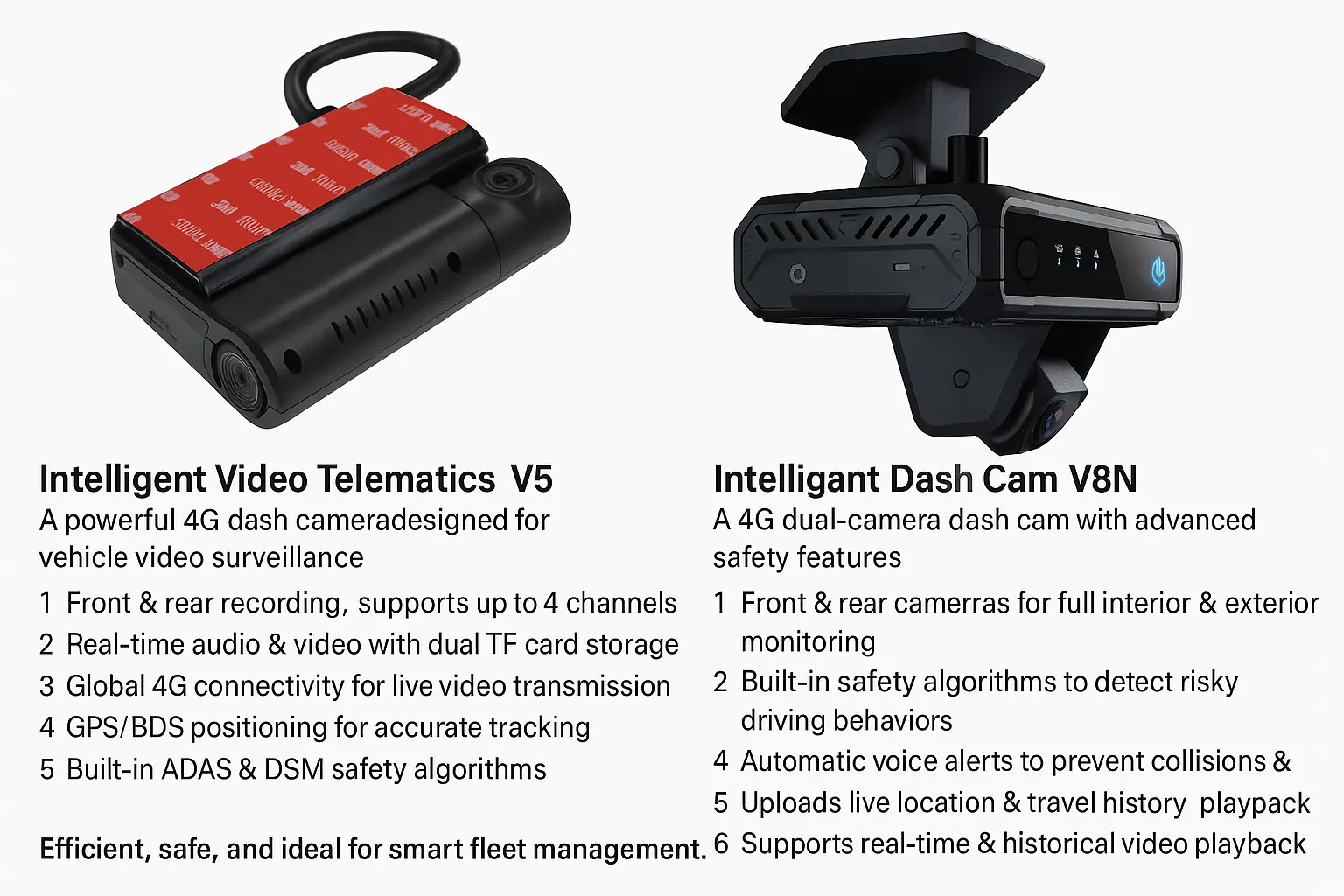
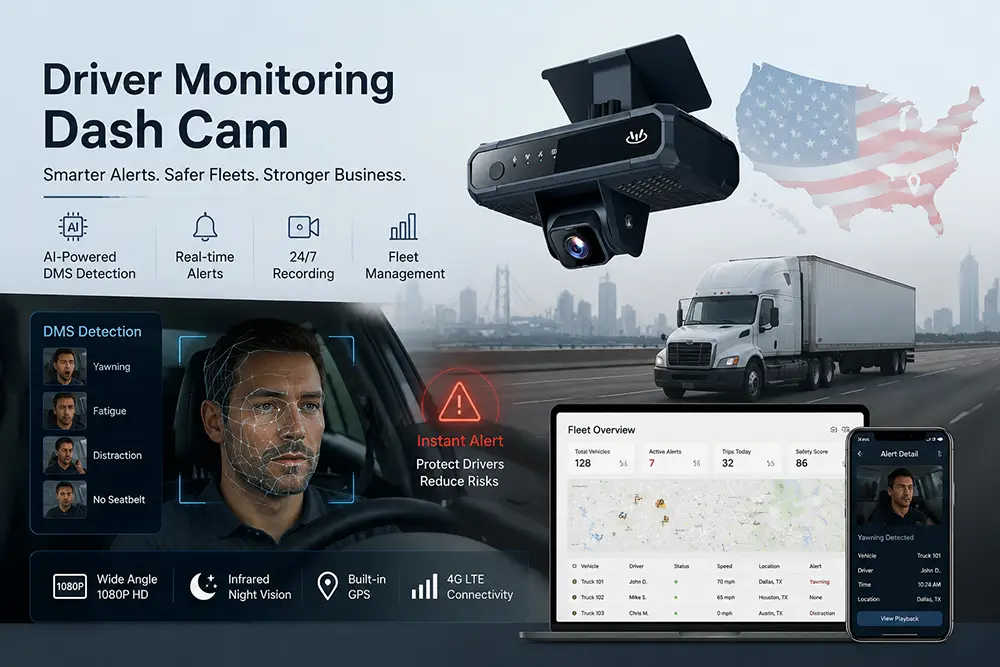
YUWEI's three commercial AI dash cams—the V5, V5C, and V8N—are not merely recording devices. Instead, they integrate ADAS (Advanced Driver Assistance Systems), DMS (Driver Monitoring Systems), blind-spot monitoring, aggressive driving detection, and cloud platform alerts into a comprehensive proactive intervention system.
Why Do Fleets Need AI Dash Cams?
Distracted driving is one of the leading causes of commercial vehicle accidents in the United States. According to NHTSA data, distracted driving claimed 3,275 lives in 2023. Relevant industry research by the FMCSA also indicates that the proportion of driver inattention in truck accidents is much higher than what is typically reported after the fact.
Key AI Dash Cam Features:
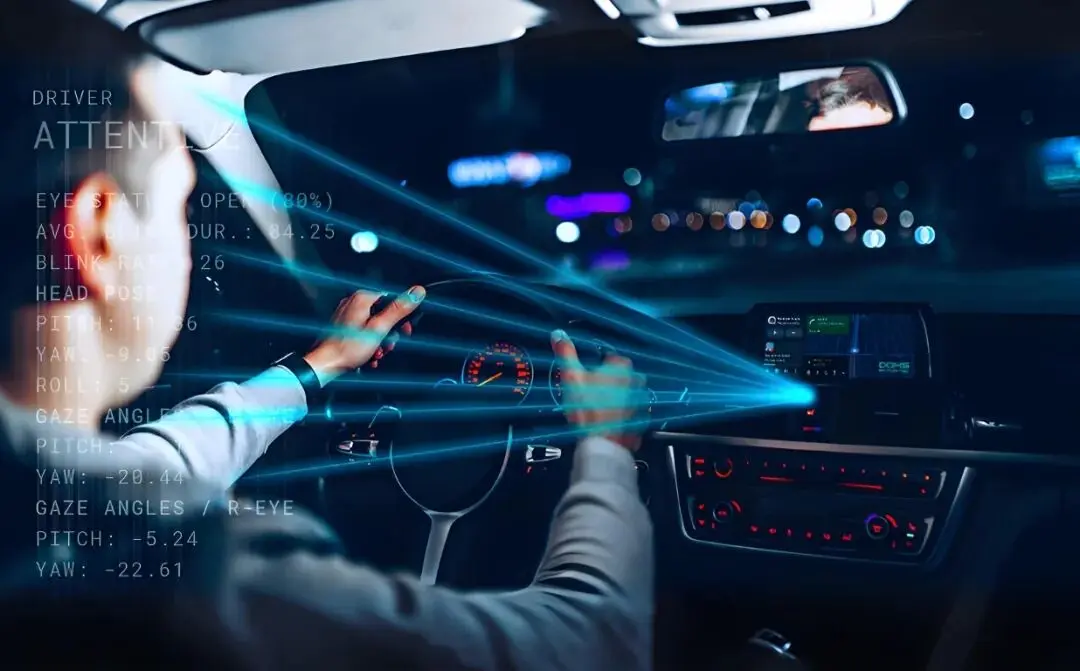
1.Smartphone Distraction: When a driver looks down at their phone, an instant in-cabin voice alert is triggered.
2.Tailgating: When following too closely, an early voice prompt warns the driver to "Keep Your Distance."
3.Fatigue Detection: When yawning or closing eyes exceeds a set threshold, the backend generates a fatigue event.
4.Aggressive Driving: Harsh braking, harsh acceleration, and sharp turns are automatically tagged by the G-sensor / 6-axis sensor.
5.Blind Spot Monitoring: When pedestrians or non-motorized vehicles appear in the right-turn blind spot, the BSD triggers an alarm.
6.Data-Driven Management: Managers can view a "High-Risk Driver Leaderboard" in the backend, rather than sifting through hundreds of hours of video footage.
This is the watershed moment where the AI dash cam evolves from a simple evidence-collection tool into a proactive safety management system.
The "Road + Driver" Dual-Lens Solution for Small to Medium Fleets (V5C)
1.Ideal For: Fleets of 10–50 vehicles, urban delivery, ride-hailing, taxis, corporate shuttles, and light trucks.
2.Core Positioning: Establishing control over "forward road risks + driver status" with the lowest deployment threshold.
The V5C is an all-in-one device with built-in dual lenses: a forward-facing 1080P@25fps camera with a 140° wide angle, and an inward-facing 720P@25fps camera with a 150° wide angle. It features built-in ADAS + DSM + Face ID. The 3-axis G-sensor supports HA/HB/HC detection, meaning harsh acceleration, harsh braking, and collision events can be directly tagged.
In terms of "reducing risky driving behaviors," the core value of the V5C lies in:
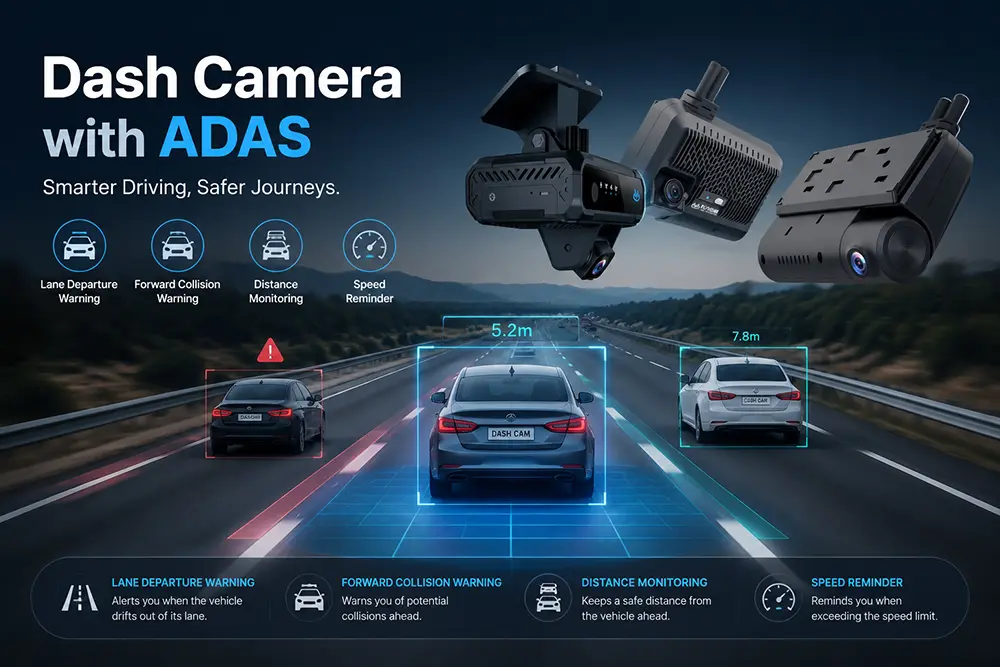
1.The front camera handles FCW (Forward Collision Warning), LDW (Lane Departure Warning), and tailgating alerts.
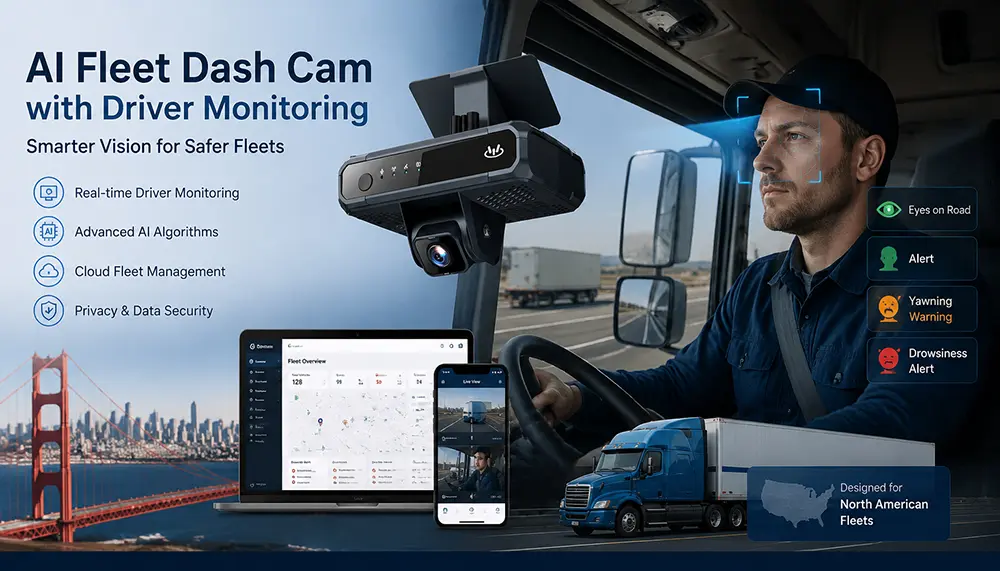
2.The inward camera detects closed eyes, yawning, phone usage, smoking, and unbuckled seatbelts.
3.Face ID check-in prevents unauthorized drivers from operating the vehicle.
4.Automatic lens occlusion alarms prevent drivers from intentionally covering the camera.
5.If forcibly dismantled, the backend issues an immediate alert and uploads the preceding 60 seconds of video.
6.During a power outage, it protects critical footage to prevent the loss of accident videos.
The V5C doesn't aim for a four-channel panoramic view; instead, it focuses your budget on the "two most accident-prone angles": the road and the driver. For fleets just starting to implement safety scoring, it is the easiest model to deploy and offers the clearest ROI.
The 4-Channel AI Dash Cam for Medium and Large Fleets (V5)
1.Ideal For: Taxi companies, urban distribution logistics, government vehicles, passenger transport, and fleets requiring multi-channel recording (front, rear, and sides).
2.Core Positioning: A single-channel ADAS front camera combined with multi-channel expansion, balancing evidence collection, compliance, and driver behavior analysis.
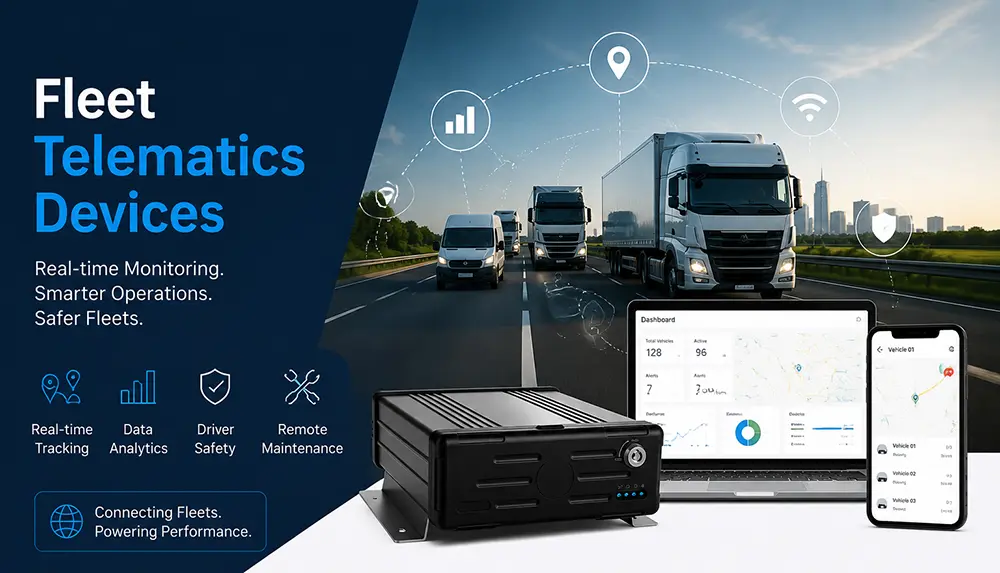
The V5 supports 1 channel of 1080P front recording + up to 3 channels of 720P external expansion. It features dual TF card slots (up to 2TB×2), GPS/BDS dual-mode positioning, and global 4G real-time video transmission. It runs industry protocols like JT/T808 / JT/T1078 and also supports OTA updates, two-way intercom, and TTS voice broadcasting.
For risky driving management, the V5 outperforms the V5C in "scenario coverage":
1.Forward ADAS: FCW, LDW, HMW (Headway Monitoring Warning), and Pedestrian Collision Warning.
2.Driver DSM: Fatigue, distraction, phone usage, smoking, and mask/facial verification.
3.In-Cabin Expansion: Passenger counting, cabin anomalies, and rear-seat dispute evidence collection.
4.Side/Rear Expansion: Recording for reversing lanes, right-turn lanes, cargo doors, and side blind spots.
5.Automatic Platform Reporting for speeding, overtime driving, and geofence violations.
6.Video Overlays displaying license plates, coordinates, speeds, and times—eliminating guesswork during accident reviews.
If your pain points have evolved beyond "driver distraction" to include reversing scrapes, passenger complaints, route violations, and nighttime urban delivery, the V5 is highly recommended as your primary terminal.
The Flagship Proactive Safety Terminal for Fleets of 50+ Vehicles (V8N)
1.Ideal For: Heavy trucks, cement mixers, buses, school buses, night logistics, densely populated urban areas, and high-risk right-turn blind spot scenarios.
2.Core Positioning: Comprehensive behavior management via ADAS + DSM + BSD + Aggressive Driving Detection + CAN Data.
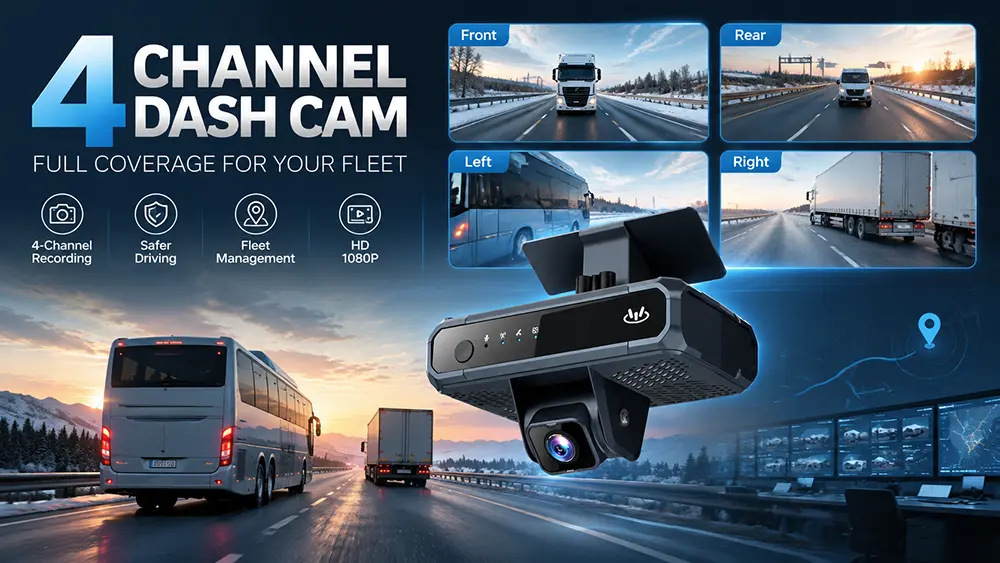
The V8N is YUWEI's 4-channel AI Dash Cam designed for advanced safety scenarios. The main unit features a built-in front camera and an inward cabin camera, with the capability to expand by 2 AHD channels to cover the forward road, the driver, the right-side blind spot, and the rear/operational area.
Its true differentiation isn't that it "can also record," but lies at the algorithm level:
1.ADAS: LDW, HMW, FCW, PCW (Pedestrian Collision Warning), crosswalk warnings, and front vehicle departure alerts.
2.DSM: Closed eyes, yawning, distraction, phone usage, smoking, unbuckled seatbelts, infrared glasses interference, and failed facial authentication.
3.BSD Blind Spot Monitoring: Alarms trigger when pedestrians or non-motorized vehicles enter the right-side or rear blind spots.
4.Aggressive Driving Detection: Harsh acceleration, harsh braking, and sharp turns, determined by 6-axis acceleration/angular velocity data.
5.CAN Bus: Reads vehicle speed, RPM, and vehicle status to align "driver behavior" with "actual vehicle data."
6.Starlight-Grade Front Camera + IR-CUT Cabin Camera: Provides superior stability in low-light conditions and nighttime supply/dump truck/mining scenarios.
7.Extreme Durability: Operating temperature of -30℃ to 80℃, with a supercapacitor enabling about 1 second of continued recording after power loss to prevent critical frame corruption.
For fleet managers, the value of the V8N is that you can finally turn "driver complaints" into "system-tagged events"—
For example, if a driver has 9 harsh braking incidents, 4 tailgating incidents, 2 right-turn blind spot alarms, and 3 closed-eye alerts this week, training is no longer based on intuition but is driven by data and event footage.
How to Choose Between the Three Dash Cams?
Prioritize Driver Distraction + Forward Collision/Lane Deviation → Choose V5C
1.Best for small-to-medium fleets, budget-sensitive operations, and deployments requiring completion within a week.
Prioritize Front/Inner/Side/Rear Multi-Channel Evidence + Platform Compliance → Choose V5
1.Best for taxis, passenger transport, urban delivery, and corporate fleets where handling accident disputes and operational audits are both critical.
Prioritize Right-Turn Blind Spots, Pedestrians, Night Shifts, Heavy Trucks, and High Accident Costs → Choose V8N
1.Best for fleets of 50+ vehicles facing heavy insurance pressure and where safety KPIs are directly tied to management evaluations.
All three models utilize Embedded Linux, 4G + WiFi + GPS/BDS, TF local storage, and platform uploading. The core difference lies not in "whether they can record," but in "when they issue warnings, who receives the alarms, and what data managers use to make decisions."
Email:hello@yuweitek.com