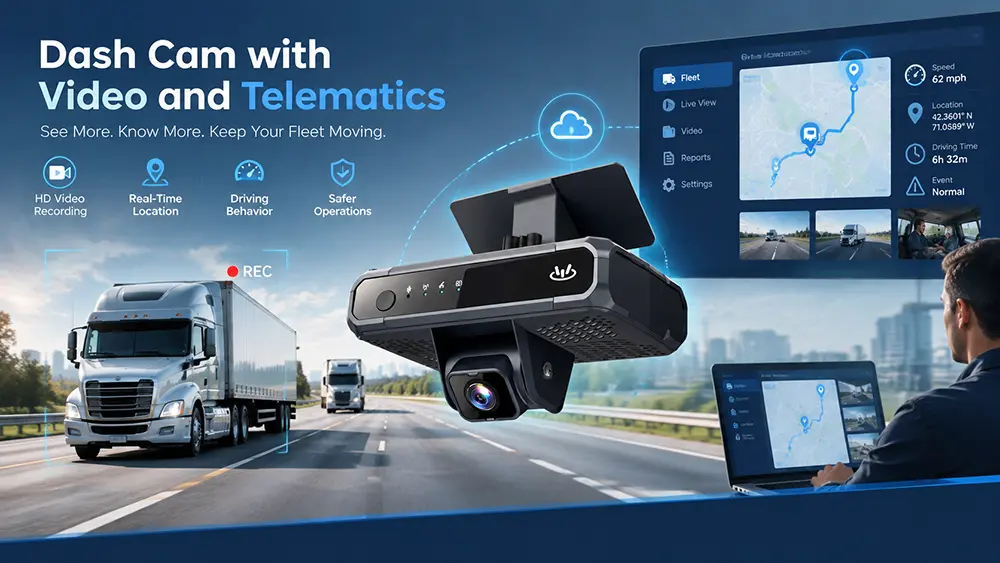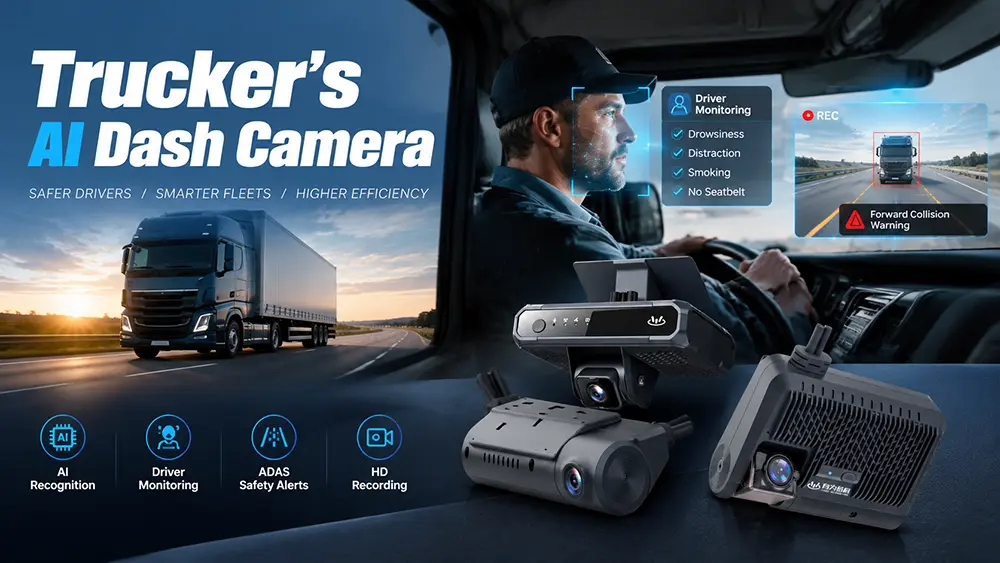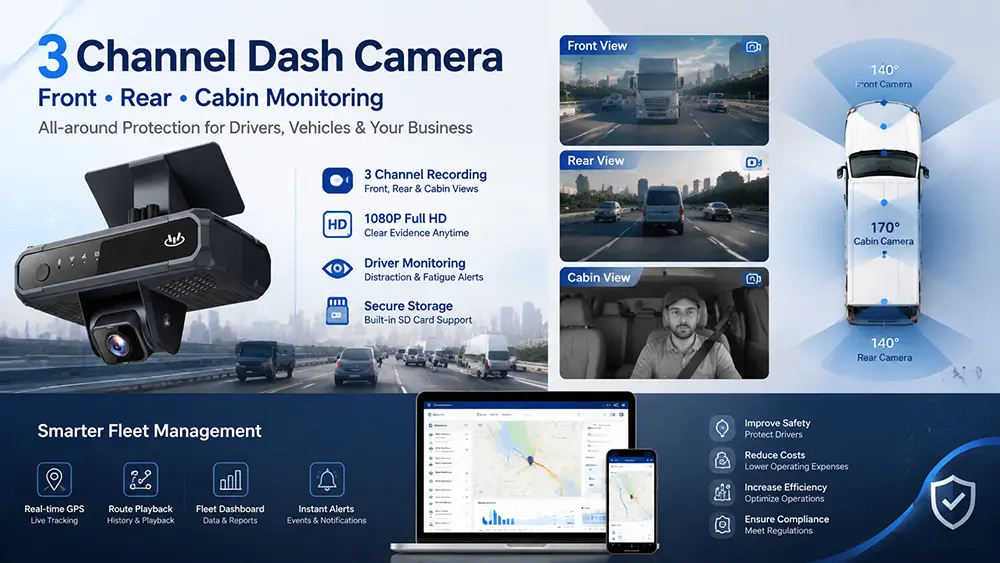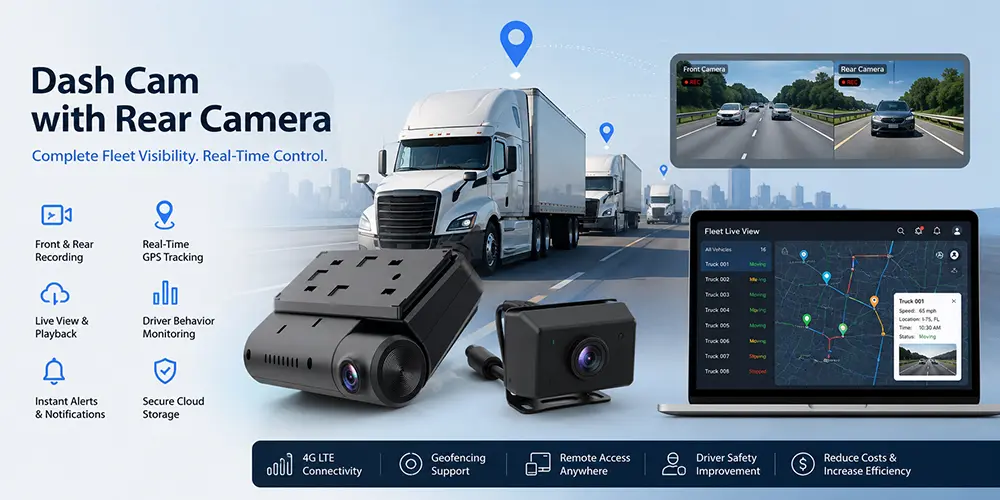













Best Fleet Dash Cam with AI Driver Coaching
Fleet Dash Cam with AI Driver Coaching
When a heavy truck is cruising at a speed of 80 km/h and the driver glances down at their phone—for about 4.6 seconds—the vehicle travels blind for nearly 100 meters. This is a real record from a naturalistic driving study of commercial vehicles by VTTI. For fleet managers, the question is no longer "whether to install surveillance," but "which AI driver coaching system can eliminate accidents before they happen."
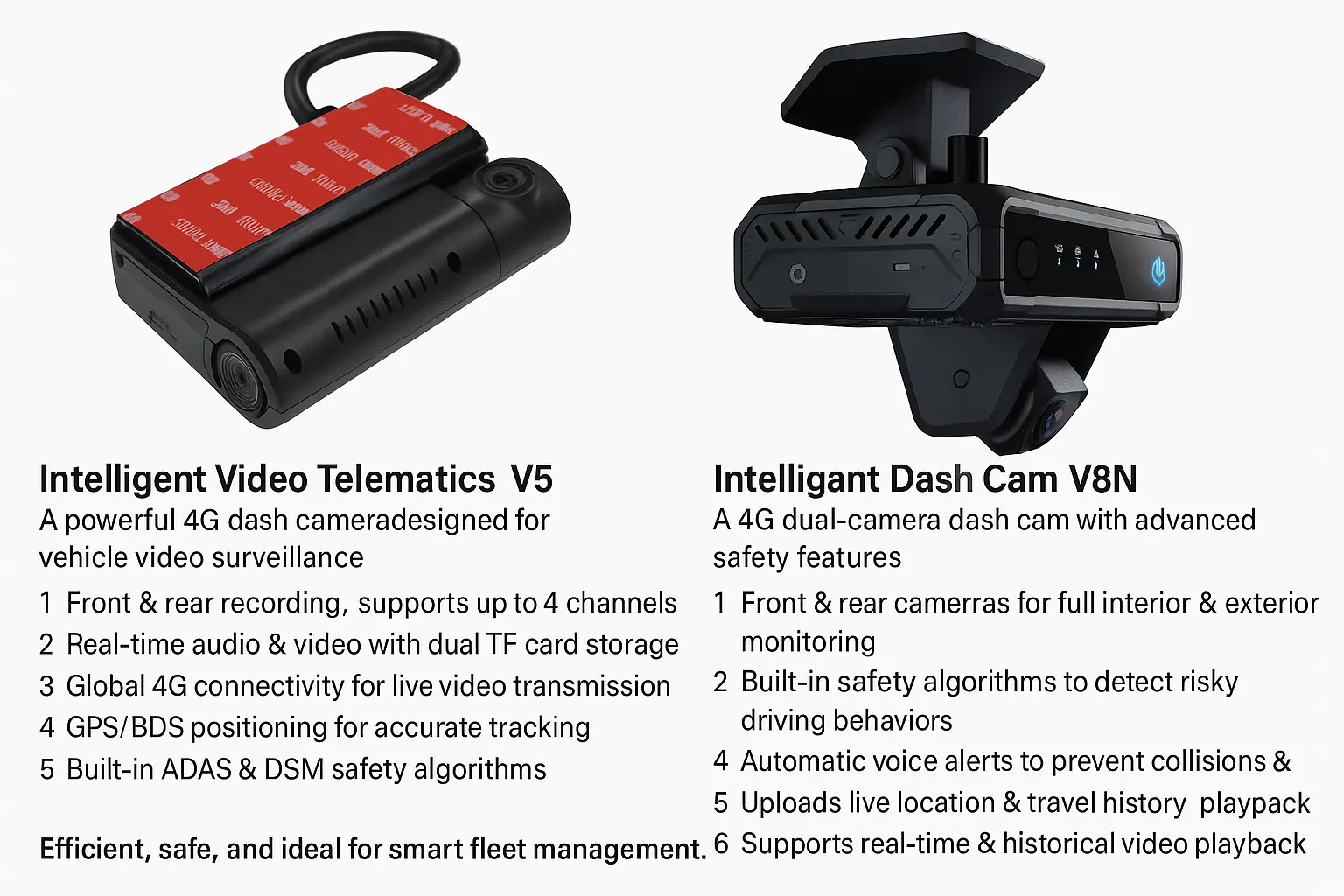
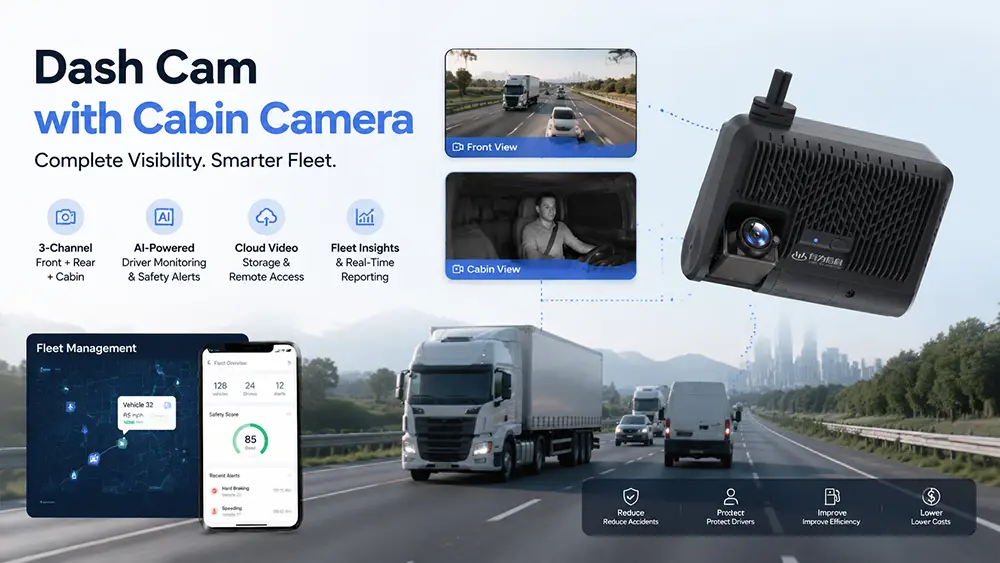
In 2026, the global AI dash cam market reached $3.8 billion, with a year-over-year growth of 22%. The YUWEI dual-lens AI dash cam V5C, with its natively integrated triple AI engines of ADAS, DSM, and face recognition, has become the highly cost-effective benchmark for logistics, ride-hailing, bus, and construction fleets.
The Risk Landscape for Fleet Managers in 2026
FMCSA data: The average cost of a heavy truck collision is $91,000, rising to $200,000 for crashes involving injuries, and up to $3.6 million for fatal crashes. SambaSafety analyzed 5 million driving records: speeding increases the probability of a collision by 47%, while distracted driving caused 3,275 deaths and 324,819 injuries in the United States in 2023.
EU GSR compliance: The European Union's General Safety Regulation (GSR) requires that all newly sold vehicles must be equipped with advanced driver distraction warning systems starting in July 2026. Fleets lacking AI status monitoring will face a compliance gap during their 5 to 8-year vehicle replacement cycles.
What is True AI Driver Coaching?
A large number of "AI dash cams" on the market only stop at motion detection and collision lock-recording. To managers, these are more like expensive black boxes—recording what has already happened, but unable to prevent it.
True AI driver coaching must possess three layers of real-time cognition:
1.Forward Road Perception (ADAS): The forward-facing camera recognizes lane departure, tailgating, forward collisions, and pedestrian intrusions in real time, immediately correcting the driver via in-vehicle voice alerts before danger strikes. The core is the "time difference"—the system completes its judgment and intervention before the driver's own reaction initiates.
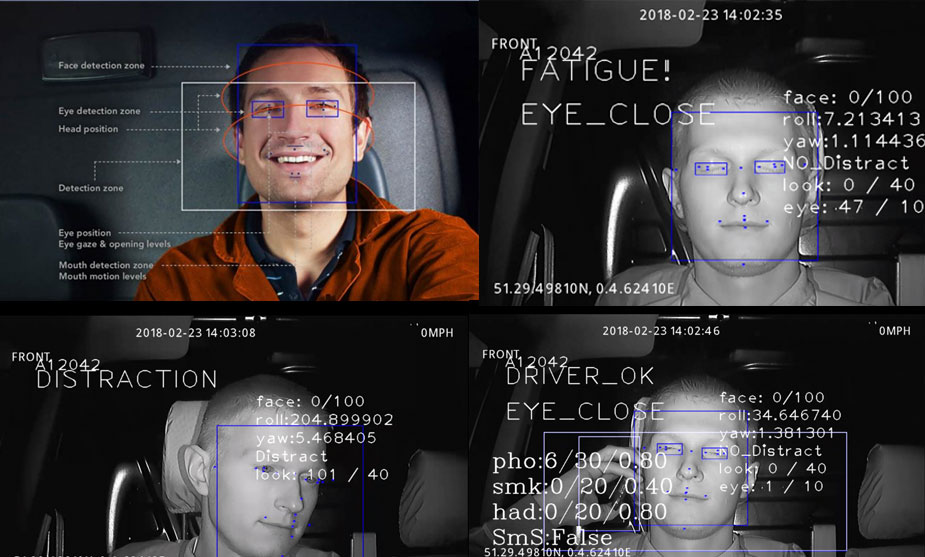
2.Driver Status Monitoring (DSM): Distraction, fatigue, yawning, eye closure, smoking, and phone calls—the inward-facing camera's visual algorithms continuously identify these behaviors.
3.Identity Recognition and Behavior Archiving: Face recognition prevents impostor driving and accurately attributes every behavioral segment to a specific driver, providing data for performance evaluations and personalized training.
The V5C is not an ordinary dash cam with attached sensors; it is an edge computing terminal with natively integrated AI inference. All algorithms run in real-time on the device without needing round trips to the cloud, ensuring sub-second alert latency.
V5C Dash Cam Analysis
ADAS Forward Collision Warning
The V5C's forward-facing camera offers 1080P@25fps and a 140-degree wide angle covering multiple lanes. ADAS continuously monitors:
1.Forward Collision Warning (FCW): Issues an immediate voice alert when the distance to the vehicle ahead falls below a safety threshold. At high speeds, a 2 to 3-second early warning is enough to shorten the braking distance by dozens of meters—this is the dividing line between fatal collisions and preventable accidents.
2.Lane Departure Warning (LDW): Provides immediate prompts for accidental lane departures without signaling. Brief attention lapses or microsleeps from long-haul drivers are the most common causes of lane departures.
3.Headway Monitoring Warning (HMW): Alerts when following a vehicle too closely. SambaSafety data shows that tailgating is the second-largest collision-related violation, just behind speeding.
The G-sensor supports HA/HB/HC three-axis detection, identifying harsh acceleration, hard braking, and severe collisions. Even if the visual system does not cover it, mechanical sensors can still lock onto dangerous footage.
DSM Driver Status Monitoring
The V5C's inward-facing camera offers 720P@25fps and a 150-degree wide angle that completely covers the driver's upper body in the cabin. DSM identifies in real time:
1.Fatigue driving is the primary behavioral precursor to commercial vehicle accidents. A 2026 report by Motive states: collision risk at 3:00 AM is 3 times higher than at noon, and 5:00 AM to 7:00 AM is a critical window for drowsiness. The V5C analyzes eyelid closure, yawning, head posture, and line-of-sight direction to issue alerts before microsleep occurs.
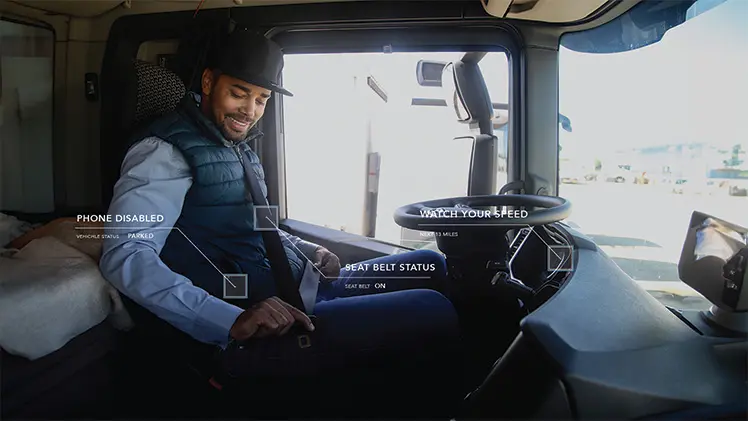
2.Distracted driving is equally critical. Damoov analyzed 5.5 million commercial trips in the US in 2025: 36.5% involved phone use; the average collision impact speed was 21% higher during handheld calls, and handheld call scenarios reached 31%. The V5C identifies behaviors such as handheld phone calls, looking away, and smoking, providing instant voice reminders through a 1.5W speaker.
The V5C's two-way audio—microphone plus speaker—not only supports AI voice prompts but also allows the dispatch center to communicate directly with drivers, which is irreplaceable during emergency handling and route dispatching.
Face Recognition
The V5C's face recognition assumes three roles:
1.Identity Authentication: Ensures vehicles are driven by authorized personnel. For fleets facing risks of shift changes, outsourcing, or private use of company vehicles, it directly resolves the liability of "who is driving."
2.Behavior Archiving: Accurately binds every ADAS alert and DSM event to the corresponding driver's profile. The companion platform supports grouping by fleet, route, or driver, automatically generating monthly/quarterly reports—violation statistics, route summaries, and accident rates—which can be directly exported for performance evaluations without manual sorting.
3.Fatigue and Identity Correlation: Allows managers to identify high-risk individuals. Does a specific driver experience recurring drowsiness during early morning shifts? Does a new employee have a significantly higher phone usage rate? These insights can only be extracted when identity recognition and behavior monitoring are deeply integrated.
Beyond AI Coaching
1.All-Weather Connectivity and Positioning: The V5C features built-in universal 4G, WiFi (802.11 b/g/n, AP/STA mode), and Beidou + GPS dual-mode positioning. Whether for urban distribution or cross-state highways, managers can track locations, routes, and statuses in real time. The 4G connection supports up to 4 servers simultaneously, ensuring uninterrupted multi-channel transmission of video streams, location data, and alarms.
2.Storage and Security: Supports TF cards up to 1TB with H.264/H.265 dual-stream compression. Real-world user tests show a 512GB card can store about 15 days of continuous video. All data features AES-256 encryption with local and cloud dual backups, accessible only by authorized accounts. A retention period of 15 to 90 days can be set, after which data is automatically and anonymously deleted—compliant with GDPR and other privacy regulations.
3.Anti-Tampering and Reliability: If the lens is blocked, the AI automatically detects it and issues a "camera anomaly" alert while recording the driver's actions; if the device is forcibly removed, the backend immediately sounds an alarm and automatically uploads the last minute of video. It features anti-pry hardware screws and supports covert installation. Operating temperatures range from -20°C to +70°C, with adaptive 9V to 36V voltage for 12V/24V systems—running stably in both Nordic cold chain trucks and Middle Eastern sun-exposed construction vehicles.
4.Open Integration: The V5C provides open APIs for data interoperability with mainstream fleet management systems—location synchronization, alarm linkage, and driving behavior integration. The technical team provides complete documentation, ready for use upon configuration. For medium and large fleets with deployed dispatch, fuel consumption, or ERP platforms, this avoids data silos. The device is also equipped with a wired SOS panic button and fuel cut-off output, with IO supporting turn signal inputs, reserving space for future expansions.
Frequently Asked Questions (FAQ)
Are algorithms running in real-time on the device or dependent on the cloud?
Cloud solutions may fail in tunnels, underground garages, or remote road sections. The V5C algorithms run real-time inference on the edge device, providing sub-second alerts.
Does the inward-facing camera angle cover the cabin?
The 150-degree wide angle completely covers the driver's upper body, including hand movements and facial expressions—a prerequisite for accurate DSM distraction recognition.
Is data protected during power loss?
Accidents are often accompanied by power loss. The V5C supports the automatic saving of crucial clips during power outages.
Does the platform support unlimited vehicles and automated reports?
The V5C does not limit the number of vehicles, supports grouped management, and automatically generates monthly/quarterly reports.
Is it equipped with anti-tampering features?
Lens blockage detection, forced removal alerts, anti-pry screws, and covert installation—protections exist on both hardware and algorithm layers.
Do certifications cover target markets?
The V5C has passed CE, FCC, UKCA, and NBTC certifications, meeting market access requirements for major markets in Europe, North America, and Southeast Asia.
Conclusion
Fleet safety management in 2026 has entered a new phase. Regulations are tightening—the EU GSR mandates distraction warnings for new vehicles starting in July 2026. The YUWEI V5C represents not just hardware, but a complete methodology for fleet safety: ADAS intervenes before collisions, DSM corrects drivers instantly when they enter dangerous states, and face recognition combined with behavior archiving transforms every kilometer into a manageable, coachable, and optimizable operational asset.
Email:hello@yuweitek.com