











AI Dash Cam for Truck Fleet Safety
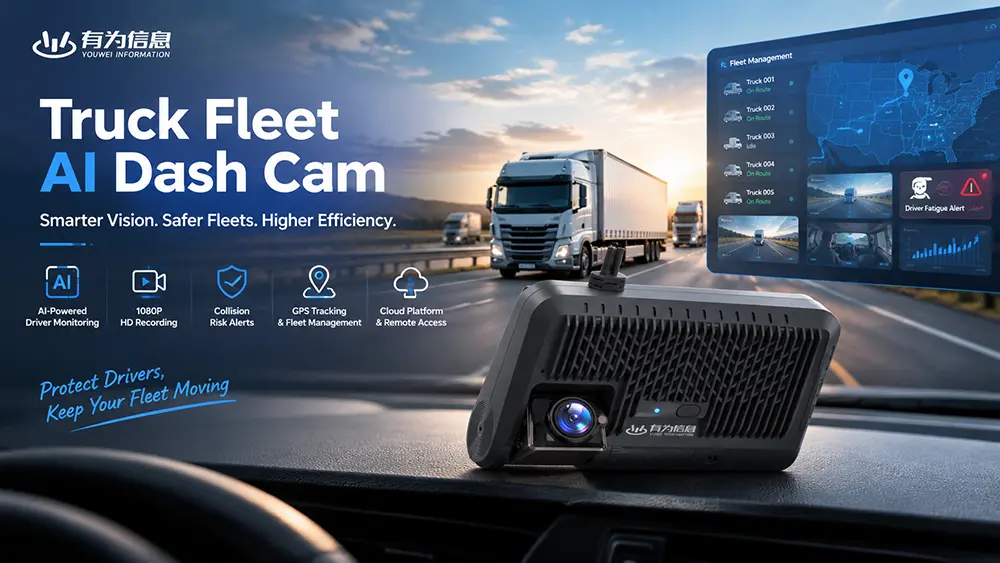
Truck Fleet Safety AI Dash Cam
According to FMCSA (Federal Motor Carrier Safety Administration) statistics, the average cost of a commercial vehicle crash resulting in an injury is approximately $400,000. BTS data shows that large trucks account for 9.3% of vehicles involved in fatal crashes. For fleet managers, accidents are not merely chance occurrences, but quantifiable business losses, alongside insurance premiums, compliance fines, and reputation costs.
Why Truck Fleets Need an AI Dash Cam System
What fleet managers want is not just "video recording," but "fewer accidents, traceable evidence, and reliable data." Fleets that integrate real-time AI warnings and remote coaching generally see their accident rates drop by 30% to 80%. Truck routes are complex: long braking distances, large blind spots, high risk of long-distance fatigue, and more severe accident consequences. Therefore, an AI dash cam system must simultaneously address both "road" and "driver" risks, and transform anomalies into actionable management data.
How AI Dash Cam Systems Identify Truck Driver Fatigue and Distracted Driving
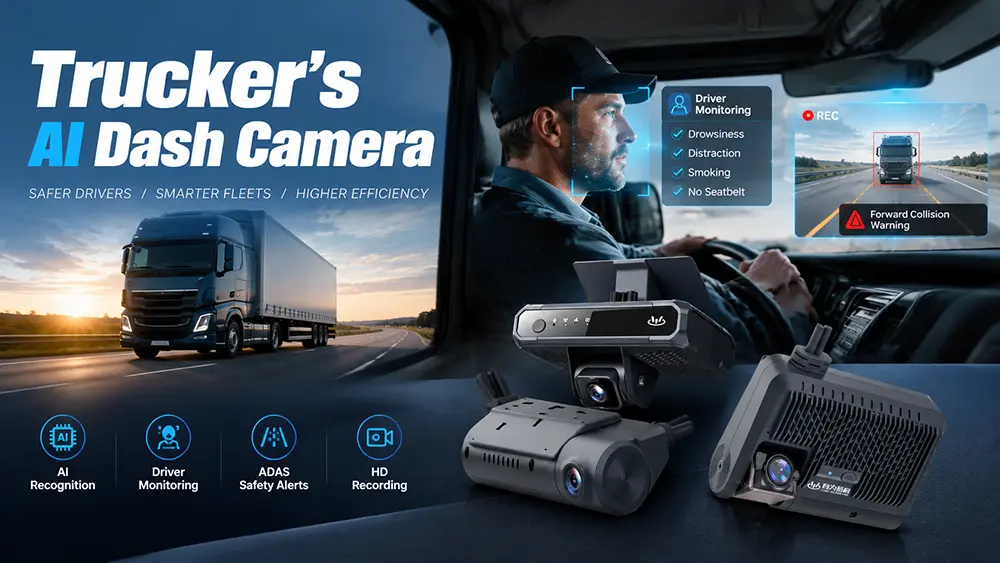
Fatigue driving is a constant risk for truck drivers. A 2024 study by the AAA Foundation estimates that approximately 17.6% of fatal crashes are fatigue-related; NHTSA places the annual cost of fatigue-related crashes at around $109 billion. The system uses DSM (Driver Status Monitoring) to identify signals such as closed eyes, yawning, and gaze deviation, instantly interrupting dangerous states. Distracted driving is equally deadly: making phone calls and looking away from the road are identified as distraction events, prompting real-time self-correction. Data shows that real-time prompts can significantly drive down phone usage rates within weeks. This blocks "human" risks before an accident occurs.
ADAS and Dual-Lens: How AI Systems Reduce Following Distance and Blind Spot Accidents for Trucks
Trucks have long braking distances and large turning blind spots. ADAS (Advanced Driver Assistance Systems) uses a forward-facing camera to provide early warnings for close following distances, lane departures, and forward collision risks. By prompting "one beat early" before the driver can react, it compensates for the natural limitations of the human eye. This is precisely the value of an AI dash cam system in mitigating road risks.
How AI Dash Cams Preserve Evidence
After an accident, fleets need objective, continuous, and tamper-proof evidence. The system ensures evidence collection through continuous dual-lens recording, G-sensor collision detection, critical video protection during power loss, and encrypted storage.
AI Dash Cam System Built for Truck Fleet Safety
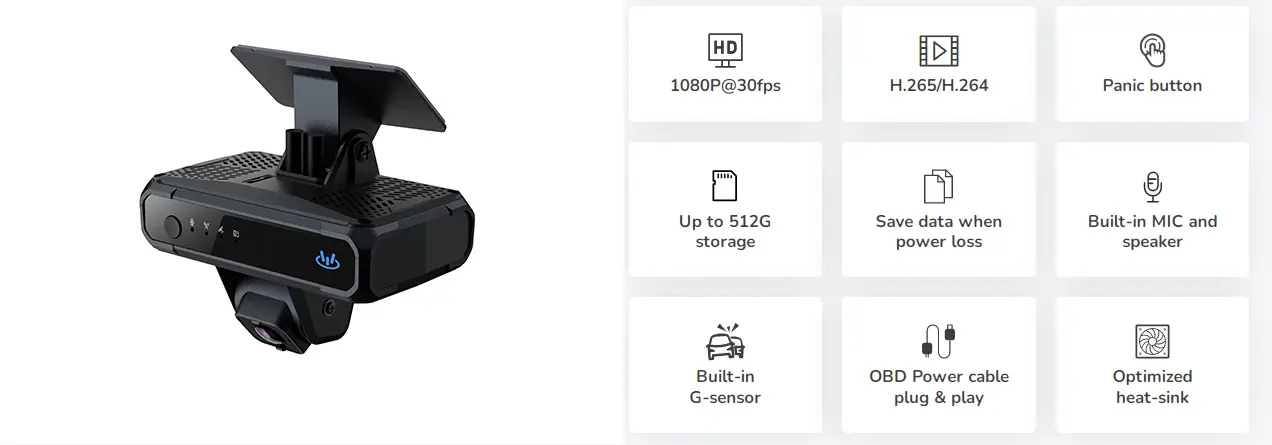
The V5C is not just about "adding an AI feature"; it is holistically designed around the real-world operating conditions of trucks:
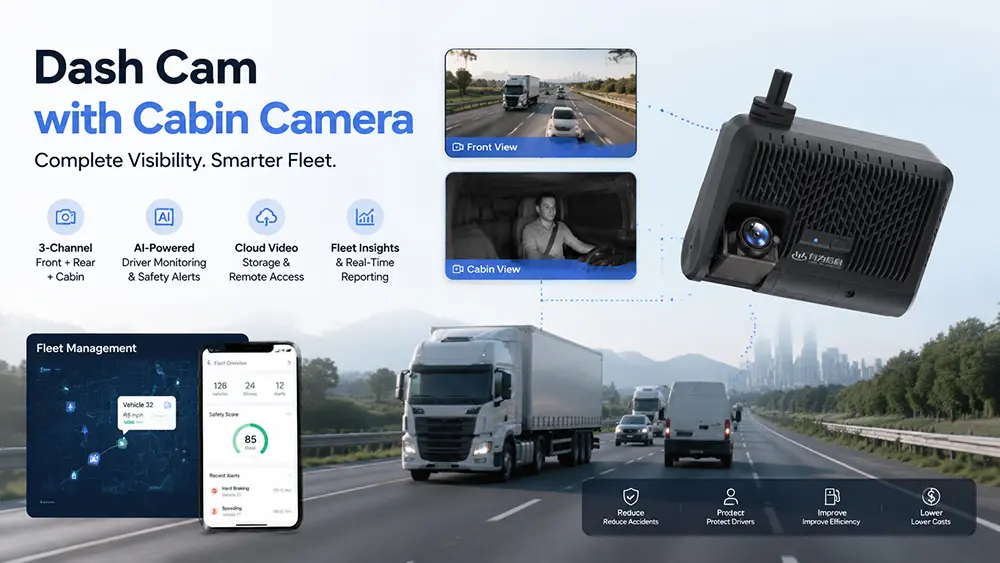
1.Dual-Lens: Front road 1080P/140°, In-cabin 720P/150°, covering both road conditions and the driver simultaneously.
2.Wide Voltage & Wide Temperature Range: 9V to 36V, adapting to 12V/24V trucks; -20°C to +70°C; saves critical video during power loss.
3.AI Covering Four Risk Categories: ADAS, DSM, Facial Recognition, plus a G-sensor to capture hard acceleration, hard braking, and collisions.
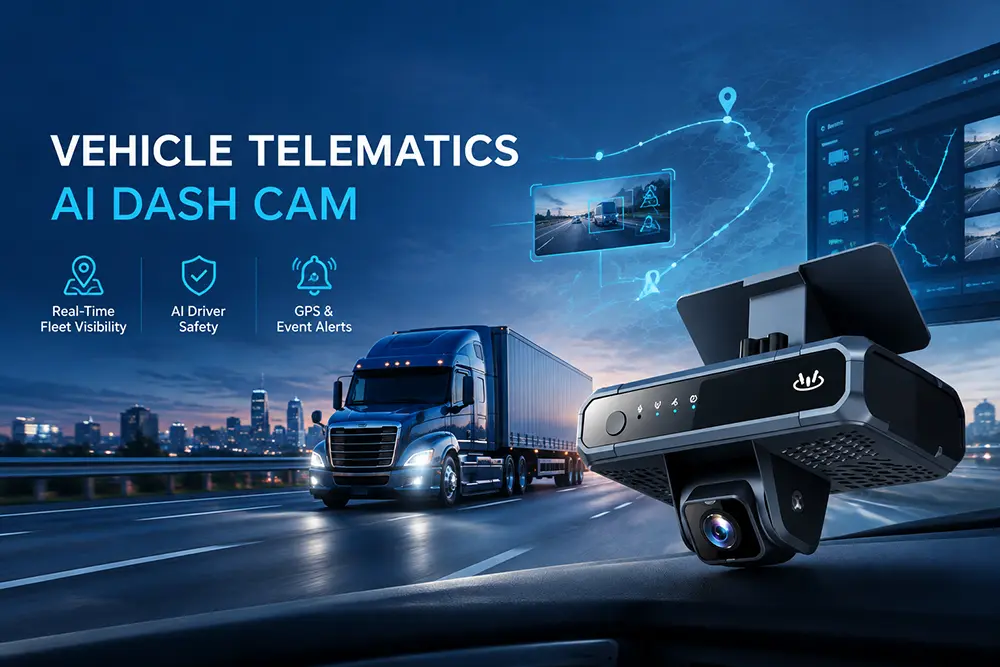
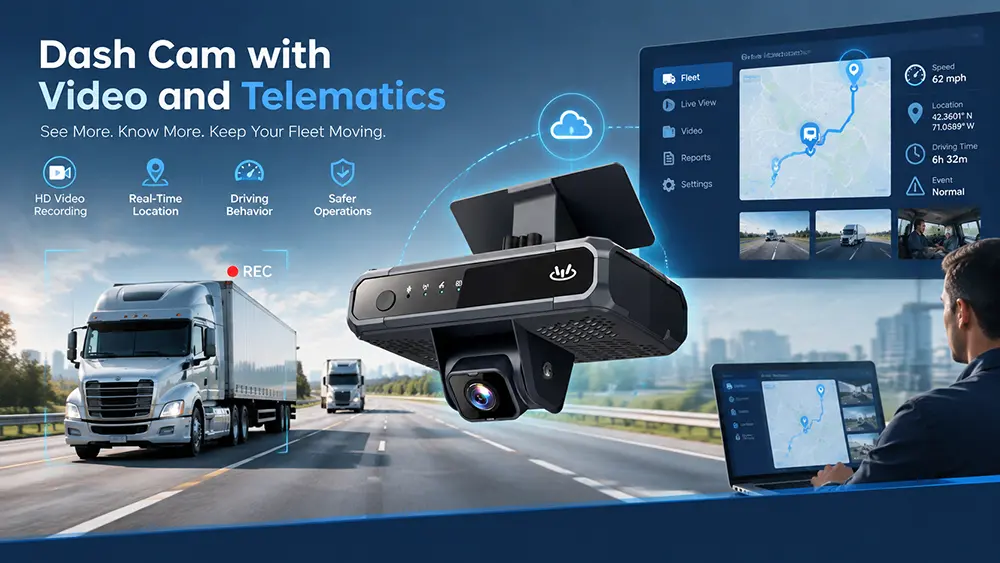
4.Transmission & Positioning: 4G network, BDS+GPS dual-mode positioning, Wi-Fi transfer, 1TB storage per card, supports JT808 protocol.
5.Certification & Security: CE/FCC/UKCA/NBTC certified, AES-256 encryption, local + cloud dual backup, automatic desensitization after 15 to 90 days of retention.
Fleet Safety Management Platform
The value of the V5C lies in unified multi-vehicle management. The platform supports an unlimited number of vehicles and can group them by fleet, route, or driver. It automatically generates monthly/quarterly reports, including violation statistics, route summaries, and accident rates, which can be directly exported for evaluation. The device provides an Open API to integrate with existing dispatch and fuel consumption systems, enabling location synchronization and alarm linkage. A tamper-proof sensor triggers a backend alarm and uploads the last minute of video if the device is forcibly removed; AI identifies and alerts when the lens is covered. Combined with anti-pry screws and hidden installation, it reduces the risk of human vandalism.
AI Dash Cam Deployment Cost
The V5C is compact (111×81×36mm, 215g), takes about 20 minutes to install, and requires no modification to the vehicle's wiring harness. The cost per unit is around $80, supporting AI features, with wholesale pricing available for orders of 50 vehicles or more. Weighing the "approximately $400,000 cost of a single injury accident" against the system deployment cost, preventing just one severe accident yields an immediate return on investment.
Conclusion
A complete AI dash cam system should be able to prevent fatigue and distraction, warn of unsafe following distances and blind spots, intervene during incidents, collect post-accident evidence, and transform everything into actionable management data. With its dual lenses, wide voltage, 4G positioning, ADAS/DSM/facial recognition, and multi-vehicle compliance platform, the YUWEI V5C integrates all of this into a practical, ready-to-deploy truck fleet safety system.
Email:hello@yuweitek.com