










Public Transit Passenger Counting Solution
Public Transit Passenger Counting System
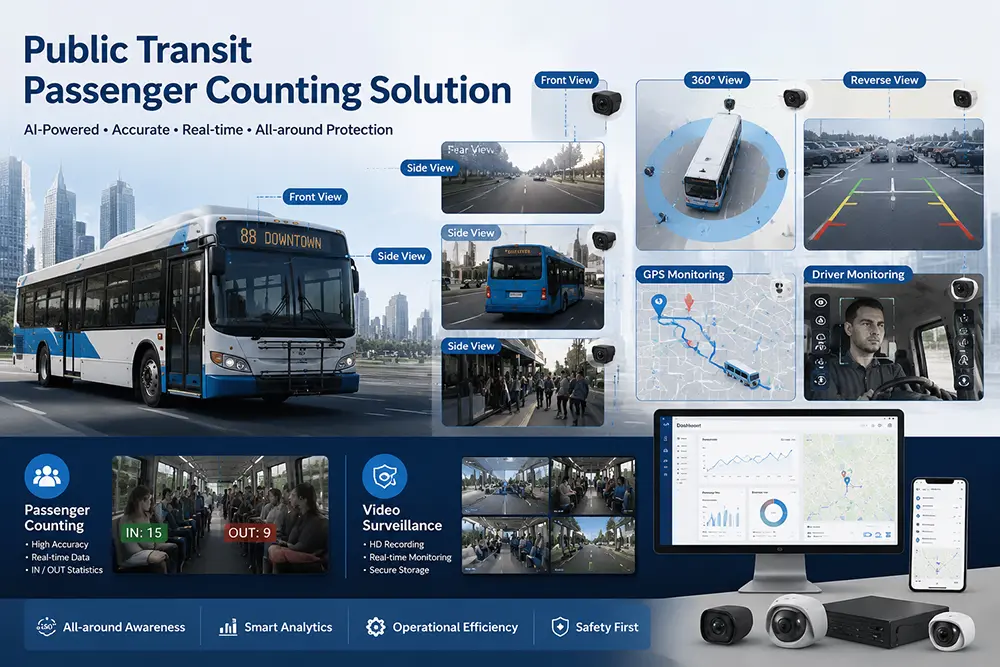
Public transit passenger counting solution is an automatic monitoring technology installed on buses, subways and other transportation vehicles. It is used to tally passenger boarding and alighting volumes as well as the number of passengers on board in real time. Such systems generally integrate sensors, cameras, Internet of Things (IoT) and data transmission technologies to achieve accurate passenger flow monitoring and analysis, so as to facilitate transport operation optimization and decision-making.
With urbanization advancing and the growing demand for public transit, traditional manual counting methods can no longer meet real-time and accuracy requirements. Therefore, automatic passenger counting technology has become a vital component of modern smart transportation systems.
Working Principle of Public Transit Passenger Counting System
1. On-Board Counting Mechanism
Automatic passenger counting systems are usually mounted at vehicle doors. They detect passengers entering and exiting via various sensors or camera devices and automatically record relevant data. Examples are listed below:
• Sensors installed at doorways identify passengers boarding and alighting
• Cameras capture boarding and alighting movements for identification and analysis
• Data is uploaded to cloud platforms in real time for statistics and analysis
The collected data can generate real-time passenger flow data and support historical trend analysis, helping optimize transit routes and vehicle dispatching schedules.
2. Multi-Sensor Fusion Architecture
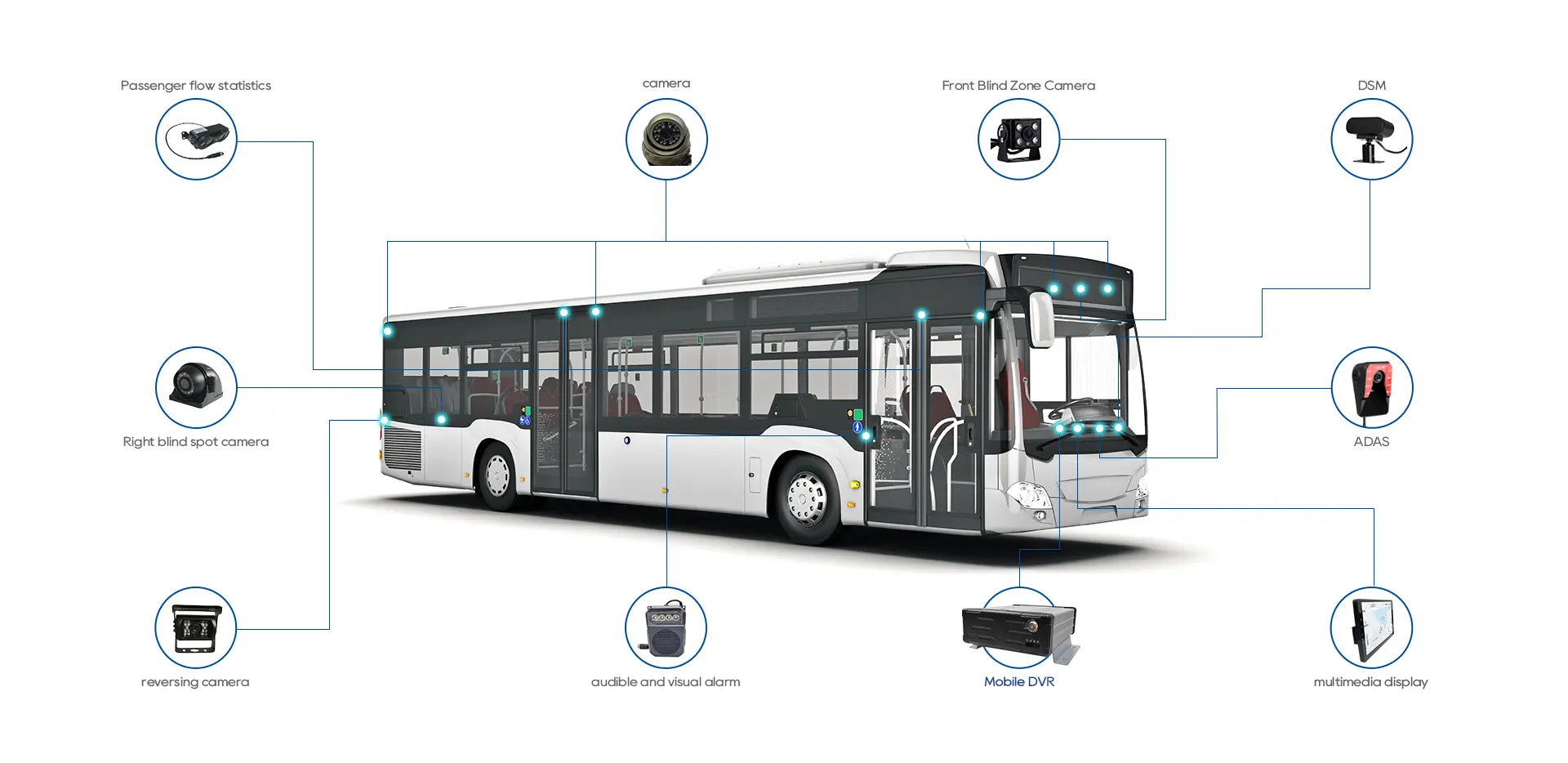
Modern APC (Automatic Passenger Counting) systems mostly adopt multi-source data fusion to boost accuracy and robustness, including the following technologies:
• Infrared Sensors: Count the number of people passing through
• Pressure / Weight Sensors: Assist in identifying changes in on-board load
• CCTV Cameras + AI Algorithms: Conduct visual recognition and passenger tallying
• Wi-Fi / Bluetooth / RFID: Help identify passenger or equipment signals
• LiDAR / Thermal Imaging Technology: Strengthen detection performance in complex scenarios
The combination of these technologies effectively enhances recognition performance under complicated conditions such as visual occlusion, varying lighting and crowded cabins.
3. Data Transmission and Network System
Systems rely on on-board communication hardware to upload data to the cloud, including the following equipment:
• 4G / 5G cellular mobile networks
• GPS / GNSS positioning modules
• On-board routers and edge computing devices
• Wi-Fi local area network transmission
For instance, on-board routers can connect cameras, sensors and information systems to realize centralized data processing and real-time data transmission.
Core Technology Types
1. Cameras + Machine Learning (Mainstream Solution)
In current research and practical applications, the CCTV camera and machine learning solution supplied by YUWEI delivers the highest counting accuracy:
• Leverage computer vision to identify boarding and alighting passengers
• AI models handle visual occlusion and crowded passenger scenarios
• Can be integrated with deep learning for target detection
This solution outperforms single-sensor technologies in complex operating environments.
2. Traditional Ticketing and Card Swiping Systems
Early counting systems rely on the following hardware:
• IC card swiping records
• Paper ticket or RFID ticketing systems
They feature simple implementation but only tally fare-paying passengers, failing to reflect actual passenger flow (such as fare evasion or passengers without transit cards).
3. Wireless Signal and Communication Sensing
Wireless signal-based solutions have emerged in recent years:
• Wi-Fi CSI (Channel State Information)
• RSSI signal strength analysis
• Collaborative computing with multiple signal receivers
These solutions deliver high accuracy without camera deployment, achieving an accuracy rate of over approximately 94% in laboratory test environments.
System Advantages and Application Value
1. Improved Operational Efficiency
• Real-time visibility of on-board passenger loads
• Optimization of public transit routes and service frequencies
• Reduction of traffic congestion and resource waste
2. Support for Intelligent Dispatching
Passenger flow data analysis enables the following capabilities:
• Dynamic adjustment of departure intervals
• Optimized route planning
• Enhanced capacity allocation during peak travel hours
3. Better Passenger Experience
• Alleviated cabin overcrowding
• Provision of real-time passenger flow information
• Improved travel comfort and safety
4. Data-Driven Decision Making
The system generates the following analytical outputs:
• Passenger flow heat maps
• Historical passenger flow trend analysis
• Statistics of boarding and alighting patterns
These outputs serve urban transportation planning and policy formulation.
Key Challenges
1. Accuracy Limitations
Complex environments including visual occlusion, unstable lighting and dense crowds degrade recognition performance. Multi-sensor fusion is generally required to improve operational stability.
2. Data Noise Interference
APC system data may contain errors and deviations, which require data cleansing and optimized algorithms for correction. ([arXiv][5])
3. Privacy and Regulatory Compliance (GDPR)
Camera deployment and human behavior recognition technologies raise critical privacy protection and data compliance concerns, which are subject to strict regulatory supervision especially within the European Union.
4. High Costs and Complex Deployment
• High hardware installation costs for multi-device setups
• Complicated system maintenance and version upgrades
• Unified architectural support required for deployment across large-scale vehicle fleets
The public transit passenger counting solution is evolving from single-sensor counting devices to intelligent integrated systems combining AI vision, IoT, wireless sensing and edge computing. Its core values are summarized as follows:
• Higher passenger flow counting precision
• Optimized public transit operational efficiency
• Support for smart urban transportation planning
• Improved passenger experience and system safety
As relevant technologies mature, this system will become an indispensable core infrastructure for public transit in smart cities.
Email:hello@yuweitek.com