












Best 360 Degree Camera for Car with DVR
360 bird's eye view Car Camera DVR
For fleet managers, the real problem a 360-degree in-vehicle camera system needs to solve is not "whether the image quality is clear enough," but rather the invisible areas surrounding commercial vehicles. The blind spots (No-Zones) of large trucks/commercial vehicles extend about 20 feet in front of the vehicle, up to 200 feet behind it, and can span multiple lanes on the left and right sides. According to NHTSA/FMCSA statistics, approximately one-third of collisions between large trucks and passenger cars occur when the passenger vehicle is already hidden in the truck's blind spot, meaning the truck driver simply did not see the other party before contact.
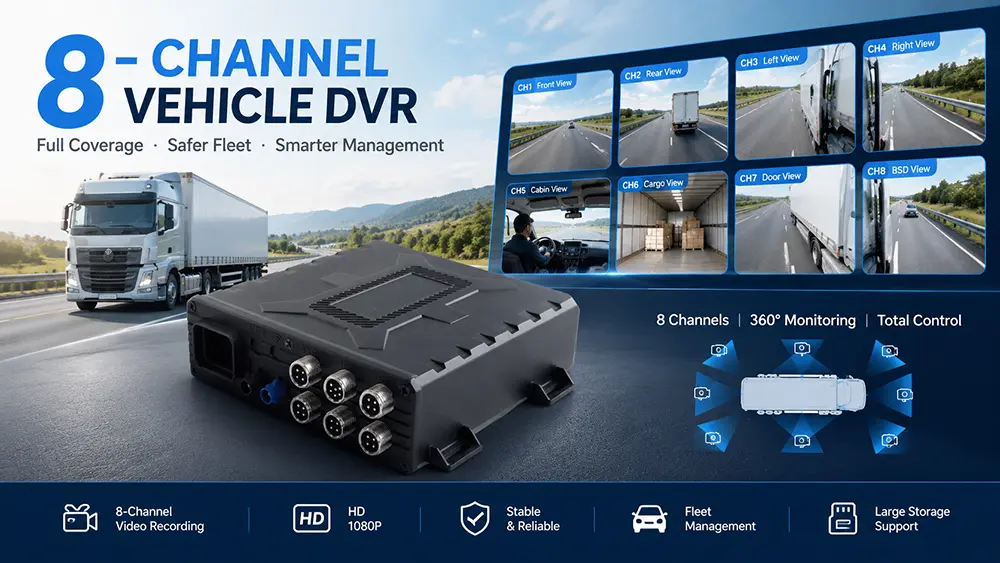
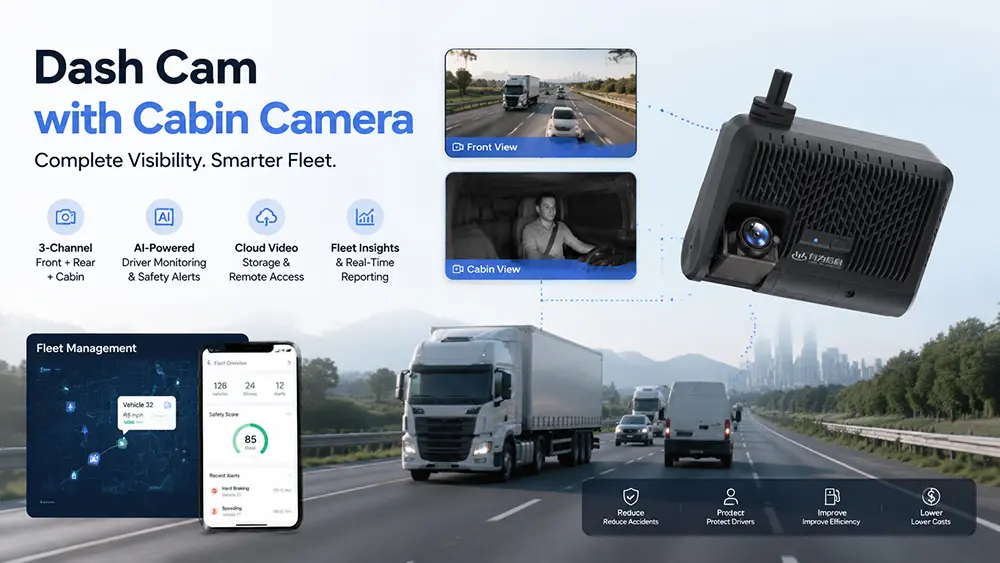
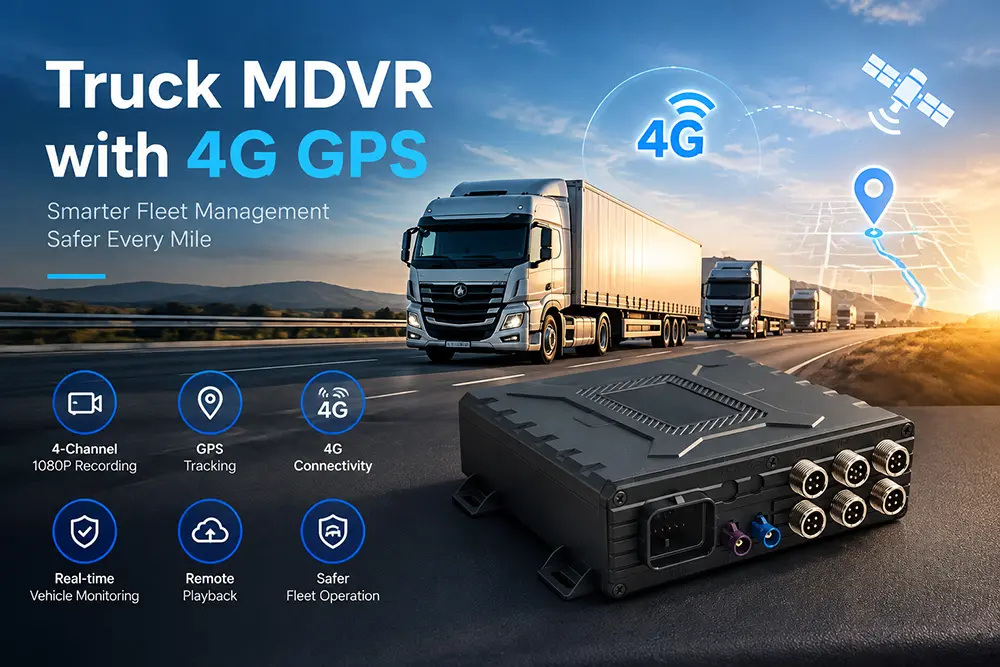
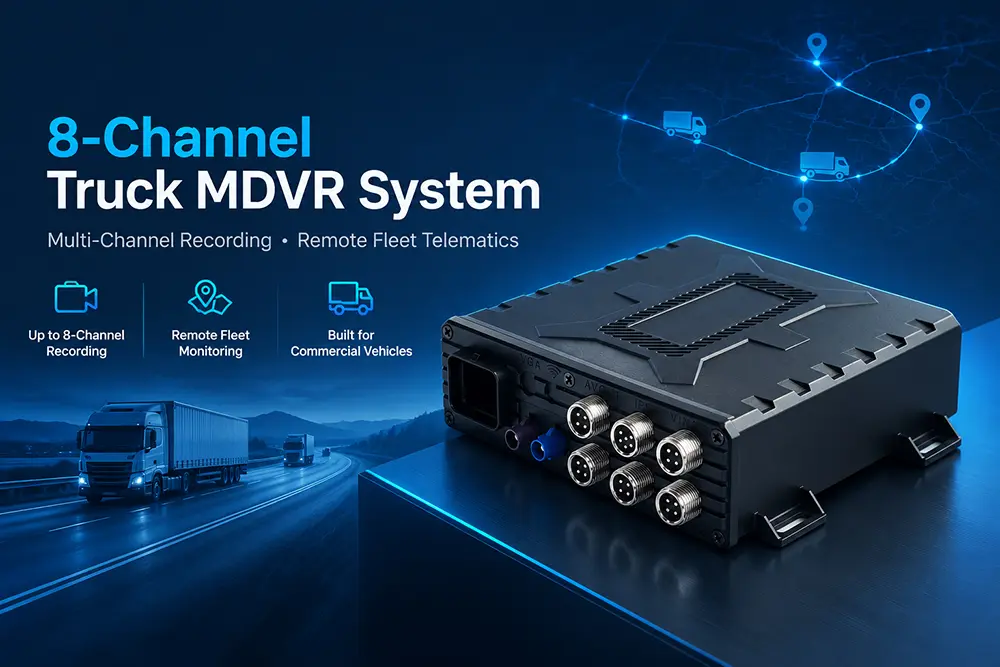
YUWEI's 360-degree in-vehicle camera system, which utilizes an MDVR (Mobile Digital Video Recorder) as the host, integrates perspectives from the surroundings, cabin, driver, and cargo compartment of trucks, buses, construction vehicles, and cold chain vehicles into a single in-vehicle screen. This allows drivers to view blind spot perspectives in real-time, and by equipping alarms, it can also provide real-time alert prompts.
MDVR is the Host of the 360-Degree System
Different in-vehicle cameras correspond to specific functions depending on their placement:
1.Front-facing ADAS Camera: Prevents rear-end collisions, lane departure, and pedestrian collisions.
2.Cabin DSM Camera: Prevents fatigue, distraction, phone calls, and smoking.
3.Left/Right Side / Blind Spot Camera: Covers BSD blind spots, especially for truck turning scenarios.
4.Rear Camera: Assists during reversing; provides evidence after accidents.
5.Cargo/Passenger Area Camera: Monitors loading/unloading, cold chain door openings, and bus passenger safety.
6.MDVR Host: Integrates all the above surveillance video feeds + GPS/BDS + IO signals + AI events into an untamperable fleet management system.
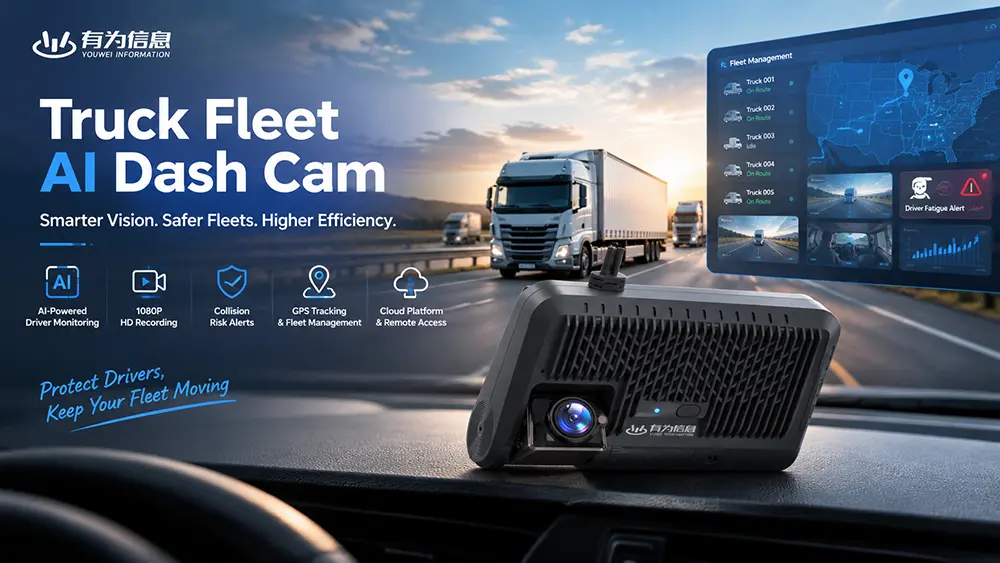
F4 Commercial Fleet MDVR
The positioning of the F4 is very clear: it is designed for daily yet high-intensity operational fleets such as trucks, school buses, transit buses, cold chain, sanitation, and logistics vehicles.
It supports up to 6 channels of analog video input, including 2 channels of 1080P HD, plus 2 audio channels, 1 IPC channel, and 1 CVBS output. For fleets, this means a single host can simultaneously connect to: the front-view, driver, left blind spot, right blind spot, rear, and cargo compartment—essentially covering all controversial scenarios of a commercial vehicle.
Core Features:
1.H.264 / H.265 encoding: More friendly for bandwidth and storage.
2.2.5-inch HDD/SSD up to 2TB + Dual SD card dual storage: Ensures recordings are not lost due to single-medium damage.
3.UPR power-off continuous recording: A supercapacitor supplies power instantly upon power loss, ensuring accident footages are not cut short.
4.Low voltage protection: Prevents draining the fleet vehicle's battery to the point of failure to start.
5.GPS/BDS dual-mode + 4G + Wi-Fi: Dispatch centers can remotely view real-time video, tracks, and electronic fences.
6.ADAS + DSM + BSD: Handles forward collision, lane departure, fatigue, distraction, and blind spots all at once.
7.Patented streaming media file system: Tamper-proof video recording, providing more solid evidence for insurance claims and arbitration.
F6 MDVR Dustproof and Waterproof Host
The F6 is suitable for construction machinery, forklifts, ships, mining/civil engineering/port vehicles, as well as extreme environments like construction sites in western North America, rainy seasons, dust, and heavy vibrations.
The F6 adopts a die-cast aluminum casing, IP67 protection, operates from -30℃ to 70℃, has dimensions of 158.5×144.5×44mm, average power consumption below 24W, and static current less than 2mA. It also connects up to 6 channels of video, but its focus leans more towards "not breaking down even in unmanaged places":
1.GPS/BDS dual-mode: Optional RTK high-precision positioning + inertial navigation; can continue to calculate pose even without satellite signals.
2.SD card up to 2TB + M.2 SSD control capability: Suitable for long-term unattended card retrieval.
3.ADAS / DSM / BSD / pedestrian / crosswalk / following distance: All fully configurable.
4.Comprehensive driver risk monitoring: Supports detecting fatigue grading, making phone calls, smoking, leaving the seat, changing drivers, and infrared glasses occlusion.
5.Advanced remote functions: Remote fault diagnosis, remote parameter configuration, TTS voice broadcast, and remote intercom.
6.Supercapacitor protection: Guarantees 2–3 seconds of recording before power loss, keeping the chain of evidence unbroken.
ADAS + DSM Features
ADAS (Forward Risks)
Forward Collision Warning: Triggerable at ≥30km/h; official data claims it can warn approximately 2.7 seconds in advance.
Lane Departure: Monitors lane markings at ≥55km/h.
Additional detections: Following too closely, pedestrian collision, crosswalk detection.
Tamper alert: Reports a failure if the camera is blocked by mud/stickers, avoiding "AI pretending to be online."
DSM (Driver Risks)
Behavioral monitoring: Closed eyes, yawning, turning head, bowing head, making phone calls, smoking, leaving the seat, changing personnel.
Identity verification: Local face database for driver identity binding.
Adaptability: Configurable speeds and thresholds; usable in daytime/nighttime/tunnels/rainy days (excluding extreme weather).
How to Configure 360-Degree Coverage?
AVIN1: Front-view 1080P AHD + ADAS
AVIN2: Cabin DSM camera
VIN3: Left blind spot
VIN4: Right blind spot / BSD target area
VIN5: Rear reversing
VIN6: Cargo compartment / Passenger area
IPC: Optional high-definition door area or license plate camera
MDVR Backend: GPS track + electronic fence + alarm footage + insurance evidence package
Summary of Options:
F4 MDVR is suitable for situations where "6 channels are enough, large hard drive capacity is required, and everyday fleet-scale replication is needed."
F6 MDVR is suitable for situations where "the environment is dirtier and vibrates more, IP67 is required, RTK/inertial navigation is needed, and special vehicles also require AI."
Conclusion
YUWEI's F4 and F6 pack MDVR, 360-degree multi-channel cameras, ADAS, DSM, BSD, GPS/BDS, 4G remote transmission, and tamper-proof storage into industrial-grade hosts. For fleets that want to seriously manage safety, insurance, personnel, and assets, this is the most cost-effective solution available.
Email:hello@yuweitek.com