











Cheapest Dash Cam Front and Rear
Cheapest Dash Cameras Front and Rear
For fleet managers managing 10 to 50 vehicles, "cheapest" should not equate to "incomplete evidence." What a fleet truly needs is: restorable forward accident footage, monitorable driver status, traceable location and speed, remote alarms for abnormal situations, and a single hardware investment that won't blow the annual budget. The YUWEI V5C dash cam compresses the above capabilities into a dual-lens solution starting at approximately $70. Its positioning is a low-threshold remote video management system for fleets, rather than a cheap dash cam for personal commuting vehicles.
What Should "Front and Rear Dual Recording" Solve from a Fleet Perspective?
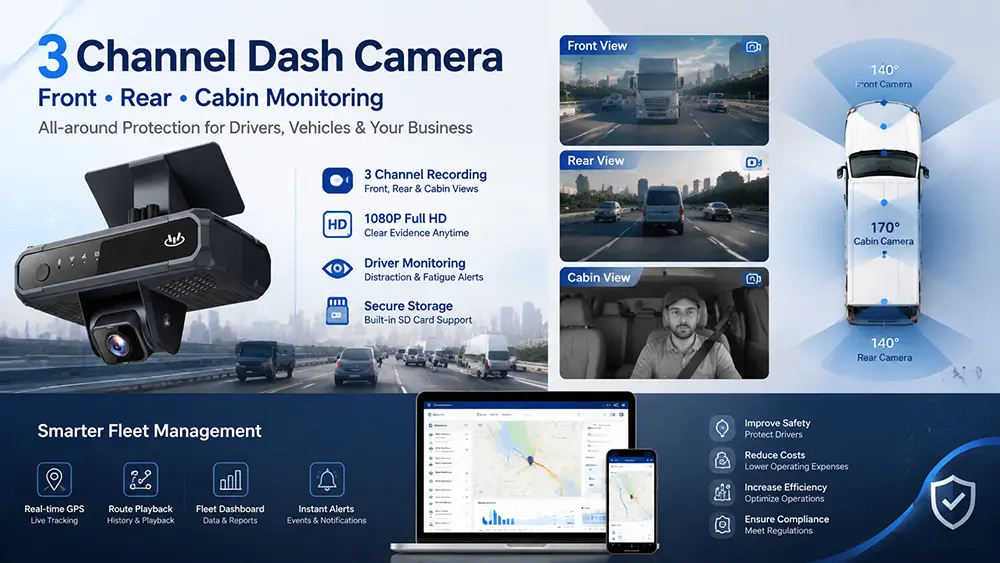
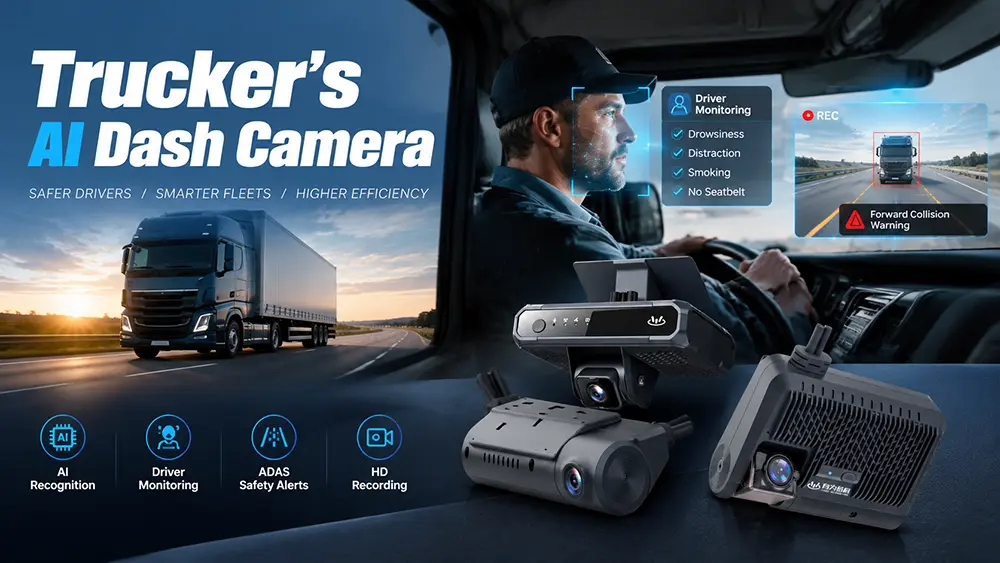
The so-called front and rear dual recording for traditional passenger cars focuses on the external rear lens for rear-end collision evidence. The liability structure of commercial fleets is more complex: the road ahead determines the cause and effect of the accident, while the cabin determines intervenable risks such as fatigue, distraction, phone usage, and smoking. The V5C adopts a dual-channel setup of 1080P front road + 720P inside the cabin, forming a dual-recording closed loop of "road evidence + driver behavior."
1.Front lens: 1080P@25fps, 140° wide angle, covering lanes, signs, and playback of oncoming license plates.
2.In-cabin lens: 720P@25fps, 150° wide angle, recording the driver's head, hands, dashboard, and passenger dynamics.
3.H.264/H.265 main and sub-streams: Compressed and stored by events, reducing SD card storage and data traffic costs.
4.If the SOP requires an external rear bumper/cargo box rearward view, it can be evaluated separately during the deployment stage based on the existing cameras and channel mapping on the vehicle, without changing the V5C's positioning as the management host.
5.For urban delivery, ride-hailing, taxis, corporate shuttles, construction vehicles, and small freight, this dual-recording combination is closer to claims defense than a simple "front 4K + rear 1080P but without driver management."
Why Can the V5C Achieve Both Low Price and Manageability Simultaneously?
The most common cut corners for low-priced fleet equipment are: no network, no platform, no AI, and no anti-tamper features. The difference with the V5C lies in bringing telecom-grade connectivity and edge algorithms down to an entry-level price.
1) Always-on Positioning and Transmission
Built-in full-band 4G, Wi-Fi 802.11b/g/n, and GPS/BDS dual-mode. The location is transmitted as soon as the vehicle is ignited. Managers can view real-time tracks, geofences, and speeding events in the background; after an accident is triggered, key clips are automatically uploaded to the cloud, without relying on the driver to manually extract the card.
2) Edge AI Directly Reduces Manual Review
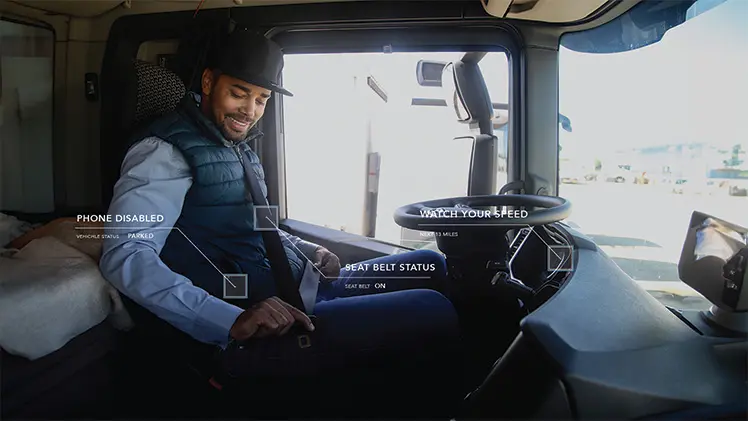
ADAS is responsible for road risks such as forward collisions and lane departures; DSM is responsible for driver states such as closed eyes, yawning, distraction, phone usage, and smoking; Face ID performs driver check-in and substitute driver identification. Alarms provide in-car reminders via the local 1.5W speaker, while simultaneously pushing to the platform to generate a behavior score. For fleet managers, this is equivalent to turning "watching videos after the fact" into "prior reminders + monthly reports."
3) Anti-Tampering and Evidence Integrity
A built-in tamper sensor automatically reports and uploads the previous 60 seconds if forcibly removed; lens occlusion is recognized by algorithms and triggers an alarm; anti-pry screws + concealed installation reduce intentional damage. Combined with TF card local storage and cloud dual backup, and AES-256 encryption, it meets the basic requirements for an untampered evidence chain.
4) Commercial Vehicle Electrical and Temperature Adaptation
9–36V wide voltage compatible with 12V/24V, operating from -20°C to +70°C, 111×81×36mm, 215g compact body, approximately 20 minutes of non-destructive installation. It is more stable for cross-model batch deployment, North American summer/winter temperature differences, and long-distance standby scenarios.
Cost Model: $70 Per Unit is Just the Starting Point
The V5C public starting price is about $70/unit, and for over 50 units, it further drops according to tiered wholesale pricing. What is more meaningful to buyers is the total cost of ownership:
1.Low hardware cost per unit: No need to pay the premium of high-end MDVRs for "AI + 4G + Platform".
2.Storage efficiency: Single TF card up to 1TB; 512GB provides about 15 days of loop recording; cloud retention period can be set to 15–90 days, automatically and anonymously deleted upon expiration, reducing the burden of storage compliance.
3.Automated operations: Infinite vehicle addition in the background, grouped by fleet/route/driver, automatically generating monthly and quarterly reports on violations, mileage, and accident rates, reducing manual dispatch statistics.
4.System integration: Open API and JT808-2013 protocol, connectable to existing TMS/FMS, dispatch, and fuel consumption systems to avoid redundant construction.
5.Compared to high-priced cloud video subscription solutions, the V5C fits the operational logic of "first achieve low-cost full coverage, then conduct driver coaching based on data"; compared to ordinary consumer-grade dual-recording dash cams, it saves the assembly cost of purchasing separate GPS boxes, AI boxes, and anti-tamper boxes later.
Fleet Deployment Suggestions (Managers Can Proceed Directly Based on This)
1.Select 5–10 units for a pilot first: Run urban delivery or ride-hailing routes to verify front lens license plate readability, DSM false alarm rate, 4G coverage, and cloud playback timeliness.
2.Unify driver profiles: After Face ID enrollment, incorporate fatigue/distraction/rapid acceleration/hard braking/speeding into scoring, rather than solely relying on post-accident video checks.
3.Set retention strategies: 15–30 days of cloud storage for high-frequency accident vehicles; low-frequency corporate vehicles can primarily use 15 days of local storage with event-based cloud uploads to control data traffic.
4.Incorporate anti-tamper SOPs into vehicle handover inspections: Concealed wiring, anti-pry screws, lens angle calibration, and linkage between automatic tamper alarms and dispatch work orders.
5.Request batch pricing for over 50 units: Single unit hardware cost decreases; training, installation templates, and platform account systems are standardized at once, ensuring subsequent expansions do not change the architecture.
Actual Benefits in Compliance, Insurance, and Claims
What fleet managers care about most is not "how high the pixels are," but whether an incident can be quickly categorized after it occurs. The V5C packages speed, coordinates, time, front road video, and driver status into an event package that can be used to:
1.Refute fake rear-end collisions, crash-for-cash scams, and exaggerated injuries by third parties.
2.Prove that the driver executed tasks according to SOPs, or pinpoint specific distraction periods for retraining.
3.Provide structured evidence to insurance companies, reducing dispute cycles.
4.Conduct traceable coaching for drivers with consistently low scores, rather than issuing subjective fines.
5.In data governance, AES-256, authorized accounts, and automatic anonymous deletion upon expiration can address audits by European and American fleets regarding driver privacy and GDPR/local data laws.
In What Scenarios is it Not Recommended to Buy Just Because it is "Cheap"?
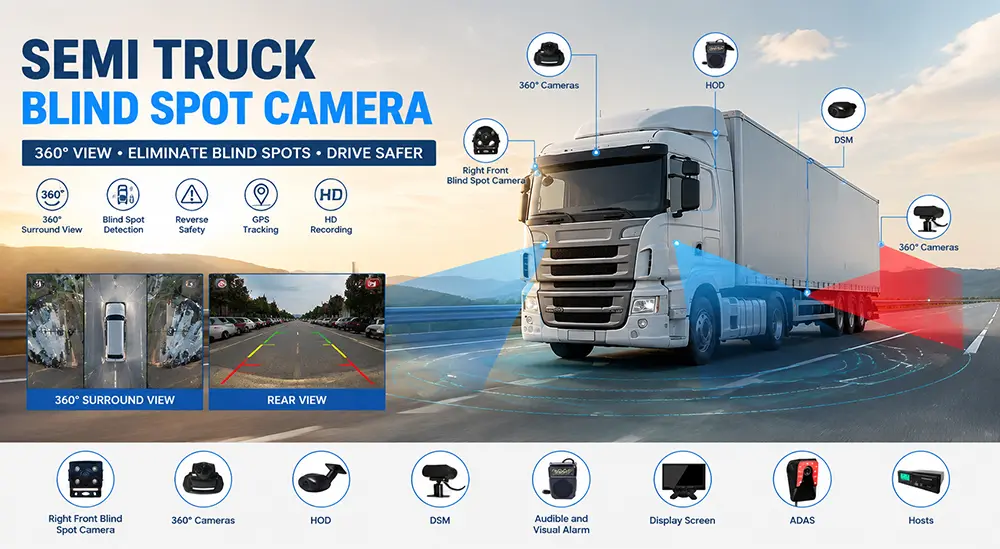
If the core demands of the fleet are an external rear view, side blind spot BSD, multi-channel cargo box, hazardous chemicals, or a panoramic view for buses, then the V5C dual-lens specification may not be enough; you could consider purchasing the higher-performance V5 or V8N. However, for managers aiming to "establish front road evidence + driver behavior + 4G platform with the lowest budget," the V5C is one of the few solutions in 2026 capable of pushing the per-unit cost into the $70 range without losing anti-tampering and cloud management capabilities.
Email:hello@yuweitek.com