













How to Install a Backup Camera on a Truck
Install a Backup Camera on a Truck
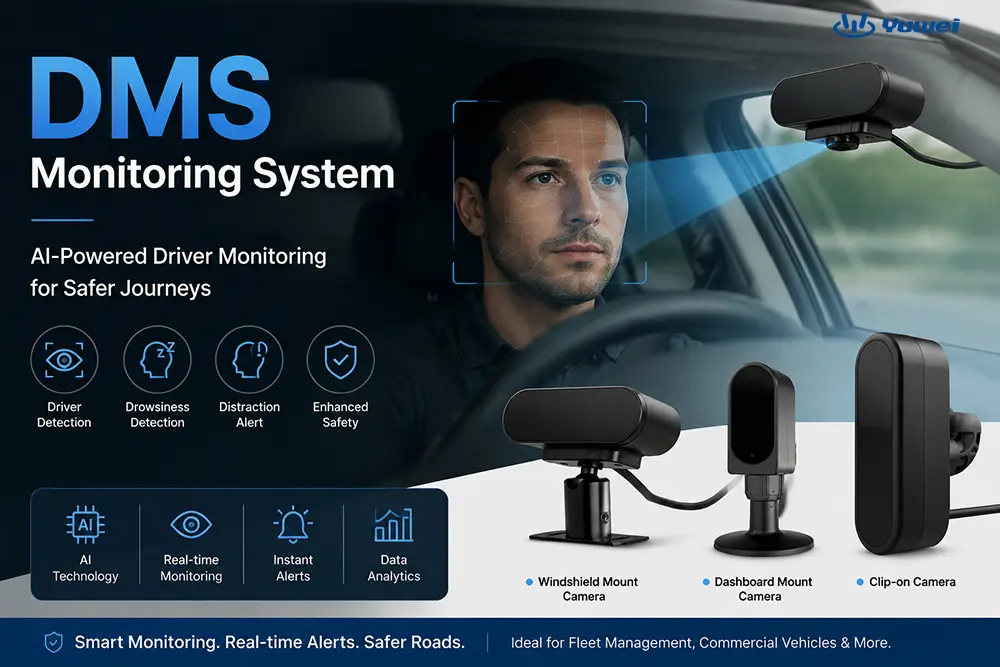
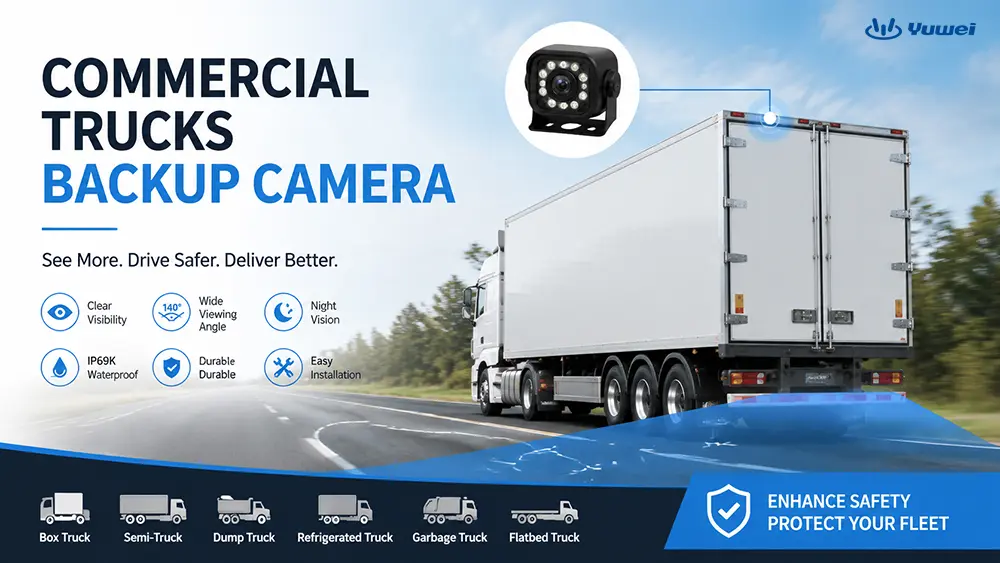
A truck backup camera is a rear visual perception and video transmission device specially designed for commercial vehicles. It captures real-time footage of the vehicle rear via a waterproof camera and transmits the signal to the in-cab display through wired video cables. The system activates automatically when reverse gear is engaged, enabling drivers to see rear blind spots that traditional rearview mirrors cannot cover.
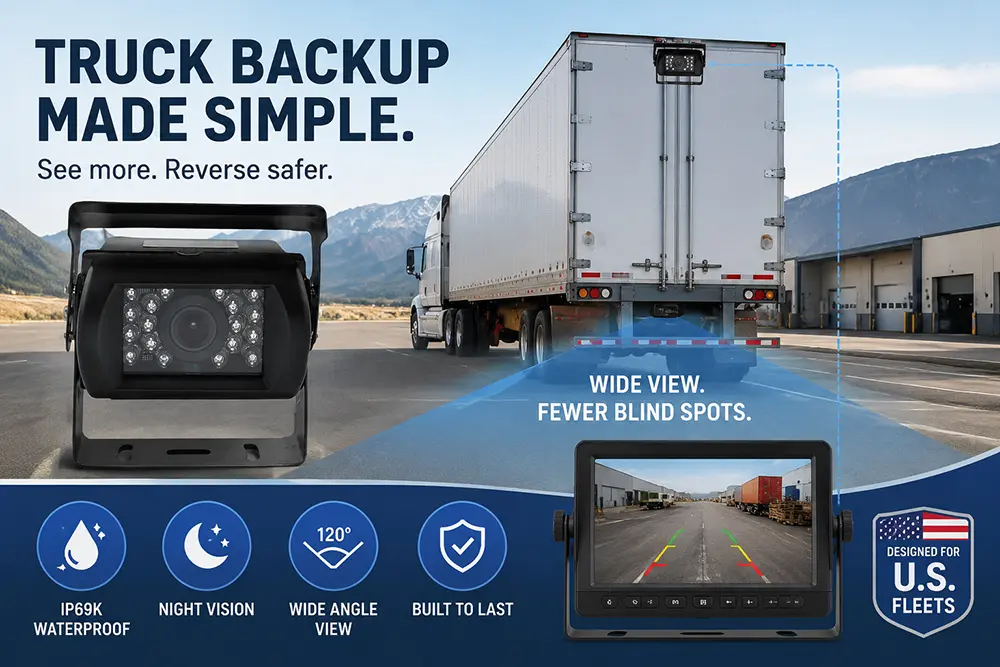
For heavy-duty trucks with an overall length often exceeding 10 meters and rear blind spots over 5 meters wide, this system serves as a standard active safety solution to reduce scraping, collisions, and fatal accidents.
Regulatory Requirements in European and American Markets
Global market demand for truck backup cameras is mainly driven by mandatory regulations in Europe and North America, which represent core compliance requirements for overseas buyers.
U.S. Market: FMVSS 111 Rear Visibility Standard
The National Highway Traffic Safety Administration (NHTSA) enforces FMVSS 111 (Rear Visibility), mandating that passenger vehicles, trucks and buses with a gross vehicle weight rating under 10,000 lbs (approximately 4,536 kg) must be factory-fitted with a compliant Rear Visibility System (RVS). The system shall satisfy the following specifications:
1.Field of View: An area measuring 10 ft × 20 ft (approx. 3 m × 6 m) directly behind the vehicle
2.Activation Time: Automatically display rear footage within 2.0 seconds after shifting into reverse
3.Image Performance: Deliver sufficient resolution and color reproduction to identify a 32-inch-tall test object (simulating a child)
4.Display Requirements: The monitor must be positioned within the driver’s line of sight and pass durability tests covering temperature, humidity, vibration and other conditions
While FMVSS 111 directly targets light and medium-duty vehicles, heavy-duty trucks and commercial fleets in the U.S. widely adopt rear vision systems as an active safety upgrade. NHTSA explicitly encourages fleet operators to deploy camera-based solutions to minimize blind zones and improve road safety. For foreign trade suppliers, camera systems meeting FMVSS 111 performance benchmarks are critical evaluation criteria for U.S. buyers during factory audits and procurement.
EU Market: GSR General Safety Regulation + UN ECE R158/R151/R159
The EU General Safety Regulation (GSR, Regulation 2019/2144) sets the global benchmark for commercial vehicle safety legislation. According to official European Commission documents, starting from 2022, all new vehicles sold in the EU must be equipped with a mandatory reversing safety camera or sensor. For trucks and buses, regulations further require improved direct driver vision and mandatory detection systems for Vulnerable Road Users (VRUs) around the front, rear and sides of vehicles.
Upon entering Phase 2 of GSR2 (effective July 2024), the following systems become mandatory for new registrations of all M2/M3 passenger vehicles and N2/N3 freight vehicles (gross weight > 3.5 tonnes) sold within the EU:
Regulation No. | System Name | Function |
UN ECE R158 | Reversing Information System (REIS) | Monitor rear blind spots during reversing |
UN ECE R151 | Blind Spot Information System (BSIS) | Detect cyclists and pedestrians approaching the truck’s sides and trigger warnings during turns |
UN ECE R159 | Moving Off Information System (MOIS) | Detect pedestrians or cyclists in close proximity to the vehicle front when the vehicle starts moving |
In addition, EU GSR mandates additional systems including ISA Intelligent Speed Adaptation, DDAW Driver Drowsiness Warning, and TPMS Tire Pressure Monitoring System. Per industry documentation, UN ECE R151 and R159 requirements for BSIS and MOIS will apply to new vehicle types from 2026, and to all newly registered vehicles from 2029.
Implications for Export Enterprises: Truck safety equipment exported to the EU must comply with the GSR2 framework. A standalone backup camera can no longer satisfy compliance requirements. Integrated solutions combining backup camera + BSD Blind Spot Detection + ADAS Forward Vision + DSM In-Cabin Monitoring qualify as compliant products for EU purchasers.
Quantifiable Market Demand
1.The updated EU GSR regulation is projected to save more than 25,000 lives and prevent at least 140,000 serious injury accidents by 2038.
2.Over 45% of long-haul freight trucks in North America and Europe are fitted with at least dual-camera systems.
3.The global rear vision backup camera market size is expected to exceed USD 18 billion in 2025.
Benefits of Truck Backup Camera Systems
1.Eliminate Rear Blind Spots: Heavy trucks have rear blind zones exceeding 5 meters. Wide-angle high-definition cameras deliver full visibility of the rear area, removing risks from unseen pedestrians and low obstacles.
2.Reduce Accident and Claim Costs: Continuous MDVR recording with reverse event locking provides tamper-proof video evidence for insurance claims, mitigating substantial compensation risks caused by backover incidents.
3.Boost Operational Efficiency: Real-time high-definition video enables precise maneuvering during narrow-road U-turns, loading dock docking and yard dispatching. It reduces reliance on ground spotters and shortens parking cycle times.
4.Operable at Night and in Severe Weather: Infrared illumination paired with starlight sensors maintains clear visibility for overnight unloading and operations in fog and rain.
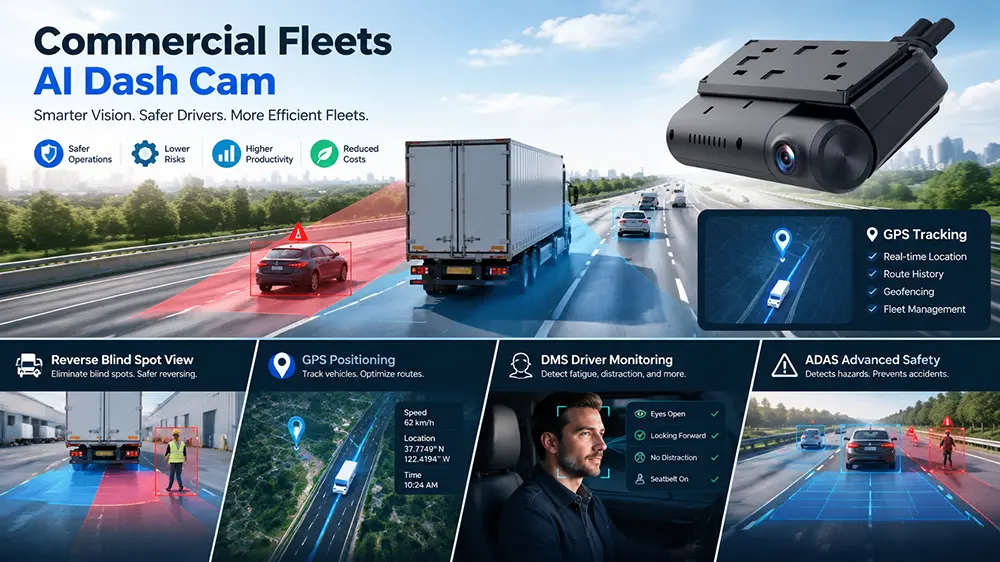
5.Scalable into a Full-Vehicle Active Safety Platform: Built upon the backup camera foundation, the system can integrate ADAS forward vision, DSM in-cabin monitoring and BSD blind spot detection to form a closed-loop fleet safety management system, achieving full GSR2 compliance in one deployment.
Recommended YUWEI Truck Backup Cameras
As a leading Chinese manufacturer of commercial vehicle safety components, YUWEI delivers end-to-end solutions ranging from single cameras to full-vehicle intelligent video systems. Its core advantages directly address the operational pain points of European and American trucks:
1.Industrial-Grade Protection: YUWEI waterproof backup cameras (Model A720PJ-3228-412) adopt metal housings with IP67 ingress protection. Operating temperature range: -30℃ ~ 70℃. Built-in infrared illumination covering 15 meters, with imaging performance at ultra-low illumination of 0.01 Lux. The cameras withstand heavy rain, mud, high-pressure washing and long-distance vibration.
2.Professional-Grade Imaging: 1080P Full HD, 3D noise reduction, strong light suppression and Wide Dynamic Range (WDR) effectively mitigate backlight and glare. Horizontal viewing angle ≥ 90°, covering rear and partial side zones of the truck.
3.Comprehensive Product Portfolio & Global Certifications: All products hold international certifications including FCC and CE. The lineup covers entry-level V5C dual-lens AI dashcams, flagship V8N units (integrated ADAS + DSM), and 4-channel 1080P mobile DVR hosts, supporting all scenarios from light-duty trucks to heavy-duty fleets and individual vehicles.
4.EU Compliance Capability: YUWEI systems support extended BSD blind spot detection algorithms, ADAS forward collision / lane departure warning, and DSM in-cabin monitoring. Combined modules form complete safety packages meeting UN ECE R158 / R151 / R159 requirements.
5.Global Service Network: YUWEI maintains overseas branches offering 24-hour technical support. OEM/ODM customization is available, including custom alarm logic and data interface integration per client requirements.
Truck Backup Camera Solution Kits
Component | Recommended Model | Key Specifications |
Backup Camera | YUWEI Waterproof Backup Camera A720PJ-3228-412 | 1080P, IP67, 15m infrared range, 3D noise reduction, DC 12/24V wide voltage |
In-Cab Display | YUWEI In-Vehicle Infotainment Monitor | Touchscreen, multi-channel video input, wide voltage support |
Main Unit / Recording Device | V5C Dual-Lens AI Dashcam or V8N AI Flagship Dashcam | Built-in 4G + GPS / BeiDou positioning; V8N supports dual ADAS + DSM algorithms |
Wiring Harness & Mounting Brackets | Standard Aviation Connector Extension Cables | Waterproof, shock-resistant, plug-and-play |
Extended Kits for EU GSR2 Compliance
1.BSD Blind Spot Camera: Compliant with UN ECE R151; monitors side pedestrians and non-motor vehicles, paired with external audio-visual alarms.
2.Forward MOIS Camera: Compliant with UN ECE R159; detects vulnerable road users in close front proximity during vehicle startup.
3.ADAS Forward Vision Camera: Supports active safety aligned with UN ECE R158; provides LDW Lane Departure Warning, FCW Forward Collision Warning, PCW Pedestrian Collision Warning.
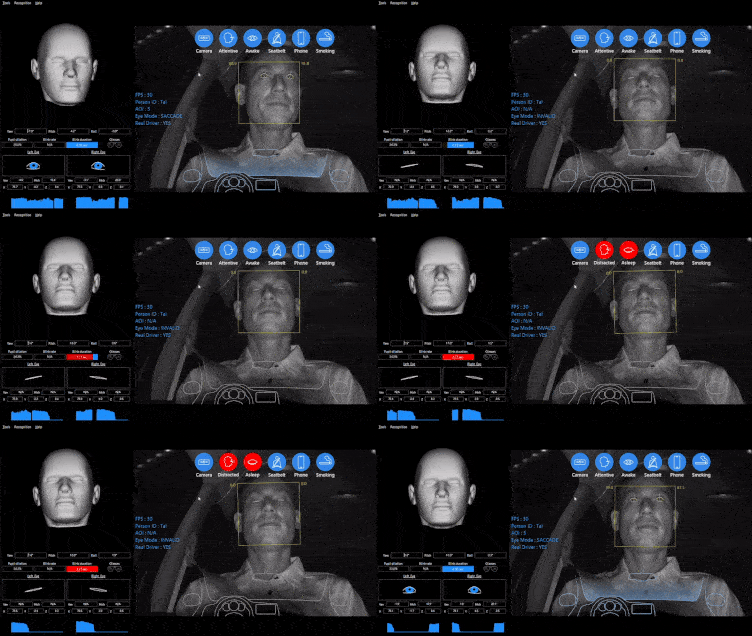
4.DSM In-Cabin Monitoring Camera Y9: Meets GSR2 DDAW requirements; detects driver fatigue, phone use, smoking and distracted driving.
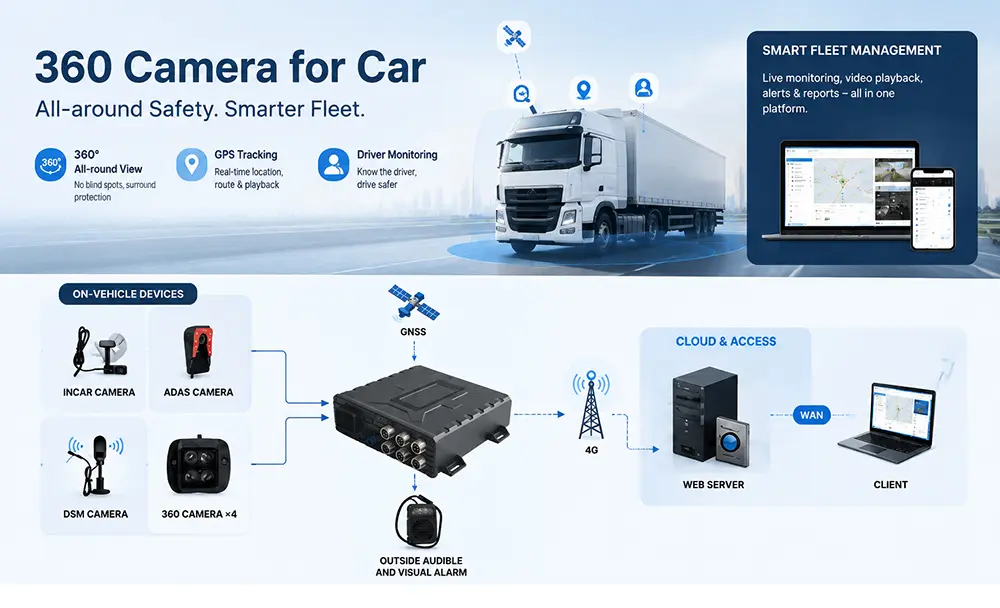
5.MDVR Main Unit: 4-channel 1080P recording, 6 AHD/CVBS video inputs, supports 2TB hard disk + SD card storage, 4G/5G remote video transmission.
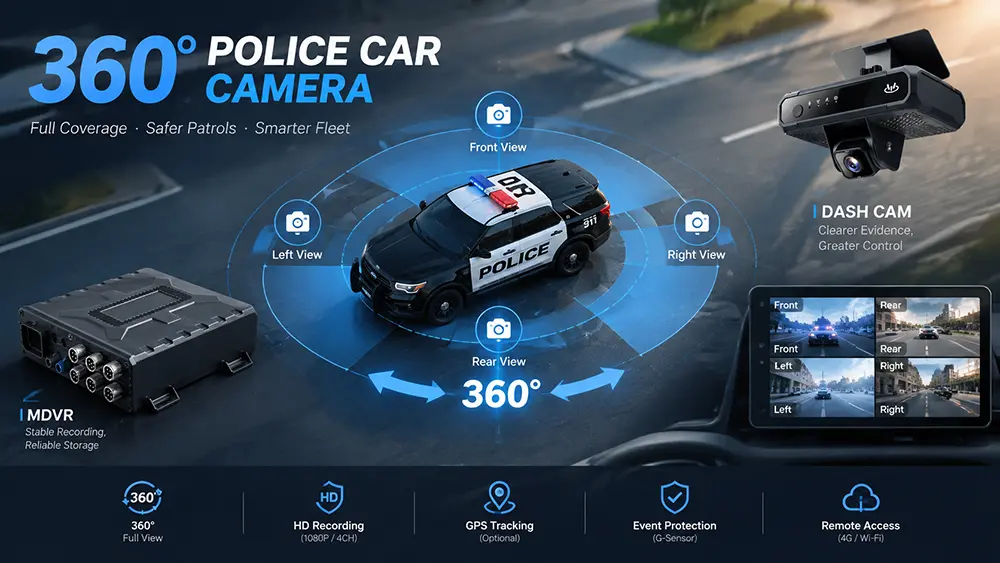
6.360° Panoramic Camera Kit: Eliminates blind spots surrounding the entire vehicle.
Typical Configuration for EU-Bound Heavy-Duty Truck Fleets
V8N Flagship Dashcam (ADAS + DSM included) + Rear Waterproof Backup Camera (R158 compliant) + Side BSD Cameras + Forward MOIS Camera + In-Vehicle Display + 4G Cloud Platform Access. One unified solution fulfills all mandatory GSR2 compliance requirements.
Procedures to Install a Backup Camera on a Truck
Standardized installation directly determines system service life and imaging quality. Professional technicians are recommended; typical installation takes 2–4 hours.
Step 1: Pre-Installation Assessment & Preparation
1. Confirm vehicle voltage specification (12V or 24V), reverse light wiring position and mounting location for the in-cab display.
2. Prepare tools: electric drill, screwdrivers, wire strippers, multimeter, heat-shrink tubing, cable ties.
3. Disconnect the vehicle battery negative terminal to prevent accidental power-on.
Step 2: Secure the Backup Camera
1.Heavy-Duty Trucks: Mount the camera at a high rear position, 2–2.5 meters above ground, covering a rear distance of 3–5 meters.
2.Trailers / Semi-Trailers: Install cameras on each trailer section to cover rear blind zones extending up to 30 meters.
3.Adjust the camera horizontal reference line to the lower 1/3 of the frame. Fasten securely using waterproof gaskets and lock nuts to maintain IP67/IP69K sealing performance.
Step 3: Route Video and Power Cables
1. Run video and power cables alongside the original vehicle wiring harness; fasten with cable ties every 20–30 cm to avoid loose dangling.
2. Avoid high-temperature zones and moving mechanical components. For trailers, use coiled spring cables connecting the tractor and trailer, with cable length reserved at 1.5 times the vehicle length.
3. Seal all connectors with waterproof fittings or heat-shrink tubes to prevent water ingress and short circuits.
Step 4: Wiring and Power Connection
1. Trigger wire: Connect the positive terminal of the camera power cable to the positive reverse light wire (verify power supply in reverse gear via multimeter). Ensure image activation completes within 2.0 seconds to satisfy FMVSS 111 timing requirements.
2. Display power supply: Connect to ACC or cigarette lighter power source; ground the negative wire to chassis earth.
3. Route the opposite end of the video cable to the AV/AHD input of the in-cab display or a video channel on the MDVR.
Step 5: Mount the Display / Main Recording Unit
1. Install the display within the driver’s natural line of sight; YUWEI solutions support touchscreen monitors.
2. If paired with an MDVR, V8N or V5C main unit, secure the device on the passenger side dashboard or below the sleeper bunk. Connect 4G antenna, GPS antenna and CAN bus wiring.
Step 6: System Commissioning and Testing
1. Reconnect power, start the vehicle and verify automatic video activation when engaging reverse gear.
2. Adjust camera tilt angle to confirm horizontal reference positioning and rear coverage range.
3. Test whether reverse guide lines match actual physical distances.
4. Engage and disengage reverse gear continuously for 10 cycles to check for black screens or image distortion.
5. Spray water onto the camera housing to validate IP67 waterproof sealing.
Step 7: Platform Activation & Driver Training
1. Bind vehicles via the YUWEI backend or mobile App, and configure alarm rules (speeding alerts, geofence speed limits, etc.).
2. Deliver training for drivers covering system operation and alarm response protocols.
3. Create installation records documenting installation date, mounting positions and wiring layout to facilitate future maintenance.
Installing a truck backup camera appears to be a mechanical task involving drilling, wiring and power connection, yet it forms the foundational building block of commercial vehicle active safety systems. With the rollout of U.S. FMVSS 111 and EU GSR2 (UN ECE R158/R151/R159), demand from European and American truck buyers has shifted from purchasing standalone cameras toward sourcing fully compliant integrated safety solutions.
Email:hello@yuweitek.com