











Best AI Dash Cam Solutions for Commercial Fleets
Why Commercial Fleets Need AI Dash Cams in 2026
For fleet managers managing dozens or more commercial vehicles, traditional cameras only provide after-the-fact evidence. Modern fleets require real-time location awareness, driver behavior alerts, a complete chain of evidence, and remote device maintenance. An isolated local recording device is practically equivalent to being unequipped in the context of a 2026 fleet.
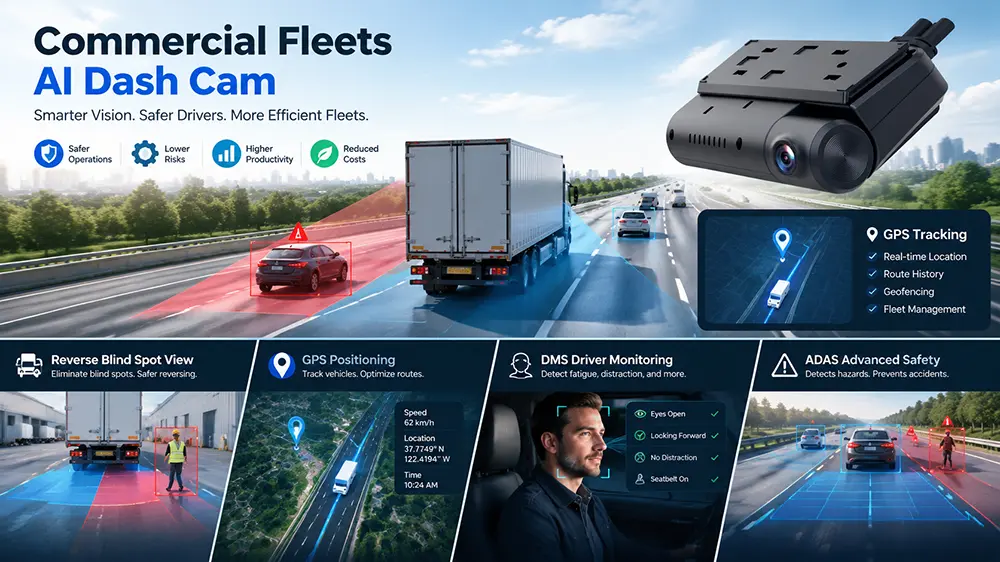
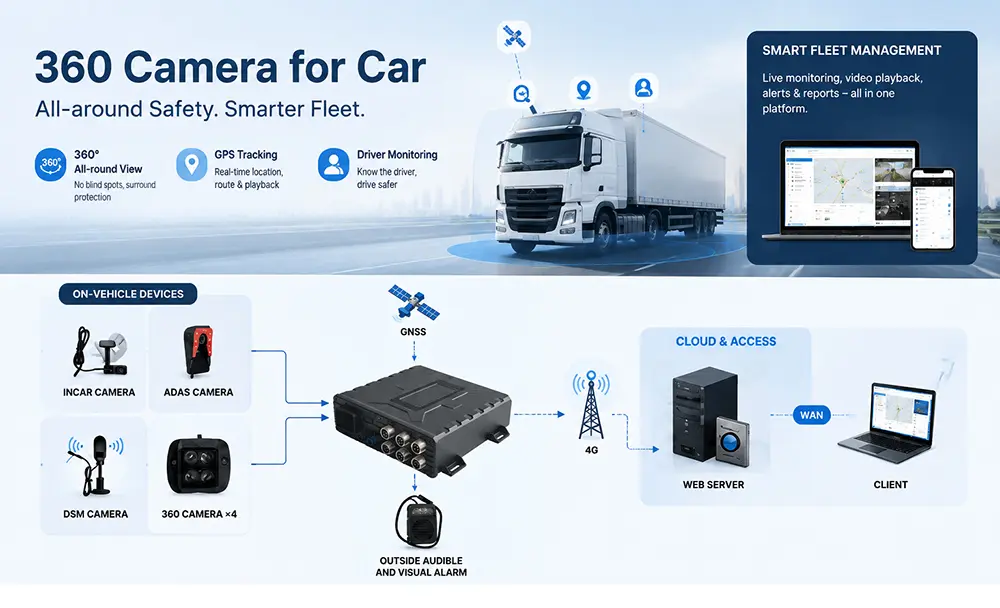
The essential difference of an AI Dash Cam is that it is an intelligent in-vehicle terminal integrating video capture, GPS positioning, 4G communication, edge AI computing, and cloud management. The YUWEI V5 is the benchmark in this category—it provides comprehensive management across four dimensions: fleet GPS tracking, remote video dispatch, active safety algorithms, and remote maintenance.
How V5 Achieves Fleet GPS Trajectory Tracking and Management
The V5 features a built-in GPS antenna, supports GPS + BDS dual-mode positioning, and complies with the JT/T808 protocol. It does not merely report latitude and longitude; it supports scheduled location reporting, trajectory storage, and base station-assisted positioning.
Fleet managers can remotely configure license plates, reporting intervals, and speeding thresholds. Each driving trajectory is overlaid with time, vehicle speed, and video footage, forming a complete driving record that can be used for operational reviews and liability determination.
Combined with a Geo-fence, the platform provides instant alerts when vehicles deviate from their routes or enter/exit designated areas. For fleets with strict routing compliance requirements, such as urban distribution logistics, ride-hailing services, and official government vehicles, this directly translates into visualized risk control.
4G 4-Channel Video Fleet Remote Management
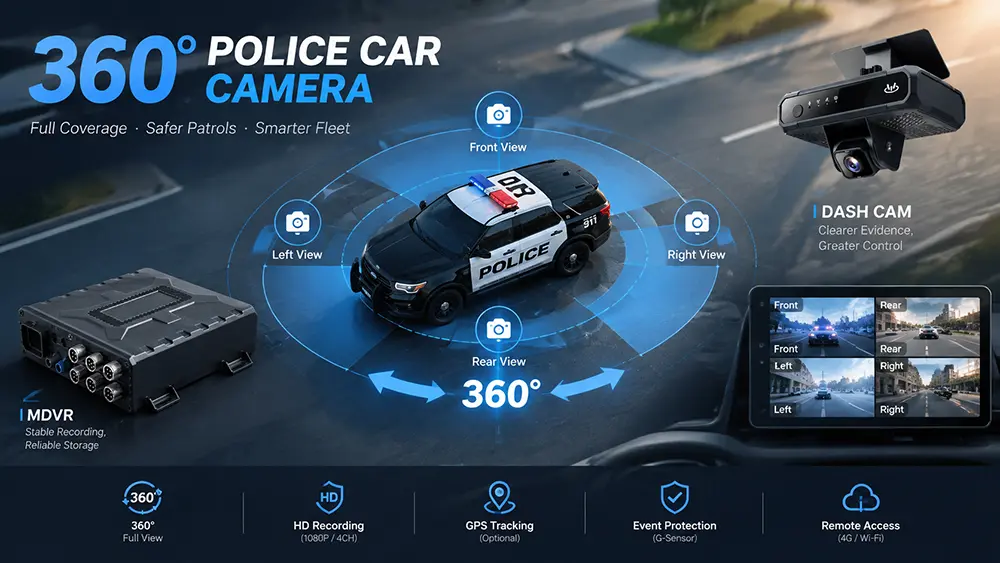
The V5 is a 4G DVR in-vehicle video terminal that supports global 4G frequency bands. Its video capture capabilities far exceed those of standard dual-recording devices:
1.Front ADAS Camera: 1080P, 112° horizontal / 55° vertical, covering the road ahead;
2.In-Cabin DSM Camera: AHD 720P, infrared night vision, capturing driver status;
3.In-Cabin Passenger Camera: AHD 720P, infrared night vision, covering the front and rear seats;
4.Fourth Channel: AHD 720P, capable of connecting to blind spot or rear-view cameras.
Video transmission complies with the JT/T1078 protocol, supporting real-time live streaming, remote historical playback and downloading, and post-engine-off recording. The dispatch center can access the footage of any online vehicle at any time and remotely retrieve clips after an accident without needing to be on-site to remove the SD/TF card.
Storage utilizes dual TF cards, with a maximum capacity of 2×2TB, and employs a patented DXR streaming format for loop recording. The videos are in an encrypted format and are automatically watermarked with the license plate, latitude/longitude, vehicle speed, time, and channel number—ensuring the evidence is complete and tamper-proof for insurance claims and liability determination. In weak network areas, videos are cached locally and automatically transmitted back once the network is restored; accident recordings have the highest storage priority.
How ADAS + DSM Reduce Fleet Accident Rates
The cost of a commercial vehicle accident far exceeds repair fees: vehicle downtime, lost labor hours, increased insurance premiums, cargo delays, and damaged reputation. The V5 shifts safety management from post-accident accountability to pre-accident intervention.
ADAS (Advanced Driver Assistance Systems) identifies forward risks such as forward collision and lane departure, providing real-time TTS voice alerts.
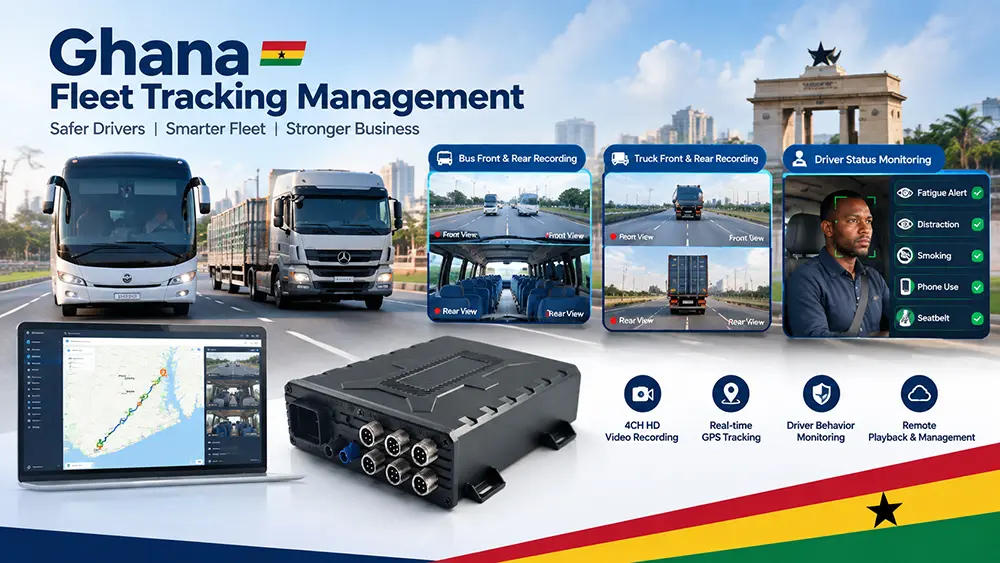
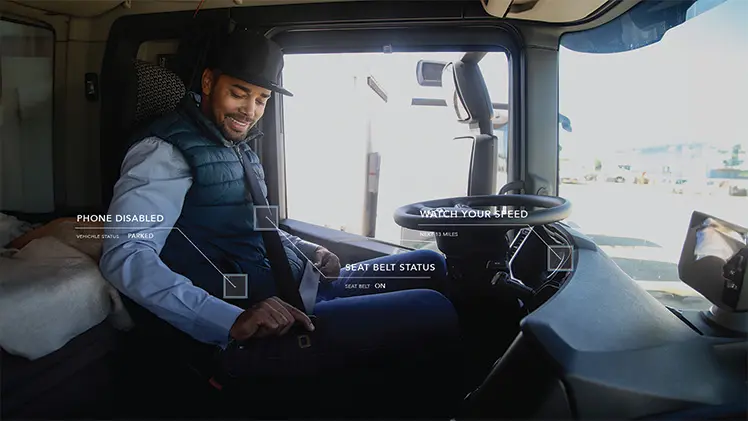
DSM (Driver Status Monitoring) uses an infrared camera to capture behaviors like fatigue, distraction, smoking, and phone calls, issuing immediate voice warnings and reporting to the platform.
Additionally, the V5 features three fleet-level intelligent recognitions:
1.FaceID Check-in: Verifies driver identity before startup to prevent unauthorized driving;
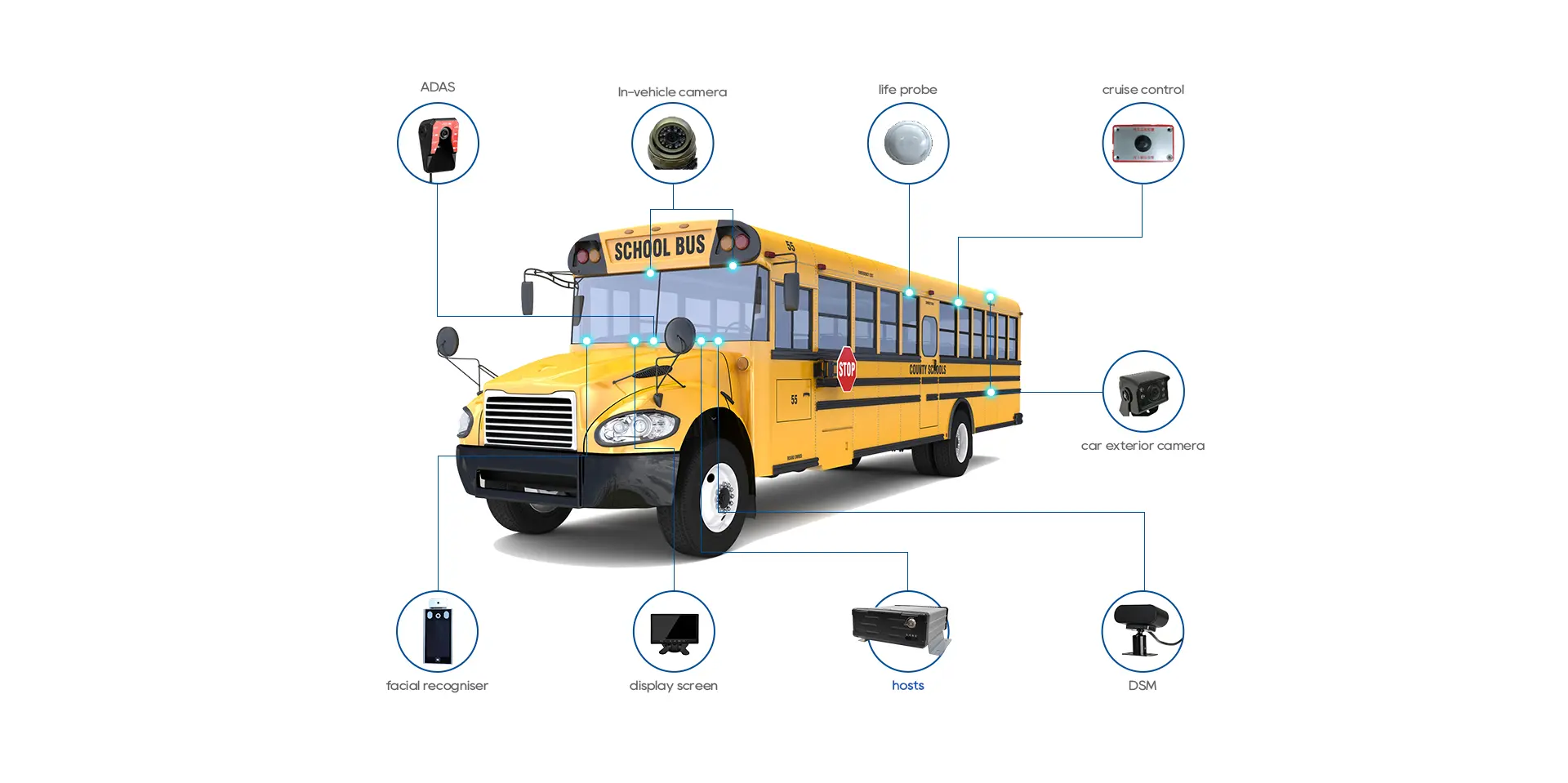
2.Passenger Counting: In-cabin camera algorithms automatically count and report the number of passengers, suitable for school buses, passenger transport, and ride-hailing services;
3.No-Mask Detection: Detects and provides voice prompts to meet specific compliance scenarios.
Alerts for speeding, overtime driving, geo-fencing, SOS emergencies, camera failures, and storage failures are all uploaded in real-time.
Fleet Remote Maintenance
The V5 supports OTA (Over-the-Air) remote upgrades, meaning firmware and algorithm iterations do not require disassembling devices one by one. Administrators can send remote debugging commands, query, and configure parameters via a mobile app. Combined with two-way intercom (G711A audio) and an SOS button, the management center can not only monitor the vehicles but also communicate directly with the drivers.
For fleets with dozens or more vehicles, the vast majority of configuration adjustments and software updates can be completed remotely from the office.
Hardware Reliability of AI Dash Cams for Commercial Fleets
The V5 complies with the JT/T794 standard (hardware tests, software tests, and reliability tests), with key specifications including:
1.Operating Temperature: -20℃ to 70℃; Storage Temperature: -40℃ to 85℃;
2.Electrostatic Protection: Contact 6KV, Air 10KV;
3.12V/24V Wide Voltage: Compatible with both light and heavy-duty commercial vehicles;
4.ACC OFF Standby Current: ≤3mA, preventing battery drain during parking;
5.Built-in 3-Axis Acceleration Sensor: Detects collisions and rapid acceleration/deceleration.
Certifications include CE, FCC, UKCA, NBTC, IATF 16949, and ISO 9001, meeting the market access requirements of major global markets.
Which Commercial Fleets Are Best Suited for the V5 Dash Cam?
1.Urban Distribution Logistics and Cold Chain: Geo-fencing + trajectory playback + 4G real-time video, ensuring timeliness and cargo safety;
2.Ride-Hailing and Taxis: DSM monitoring + passenger counting + two-way intercom, balancing passenger safety and compliance;
3.School Buses and Passenger Transport: Passenger counting + FaceID + infrared night vision, meeting minor protection requirements;
4.Official Government Vehicles: Trajectory auditing + geo-fencing + remote parameter management, preventing the private use of public vehicles;
5.Long-Haul Trucks: ADAS forward warning + overtime driving alerts + post-engine-off recording, reducing highway accident rates;
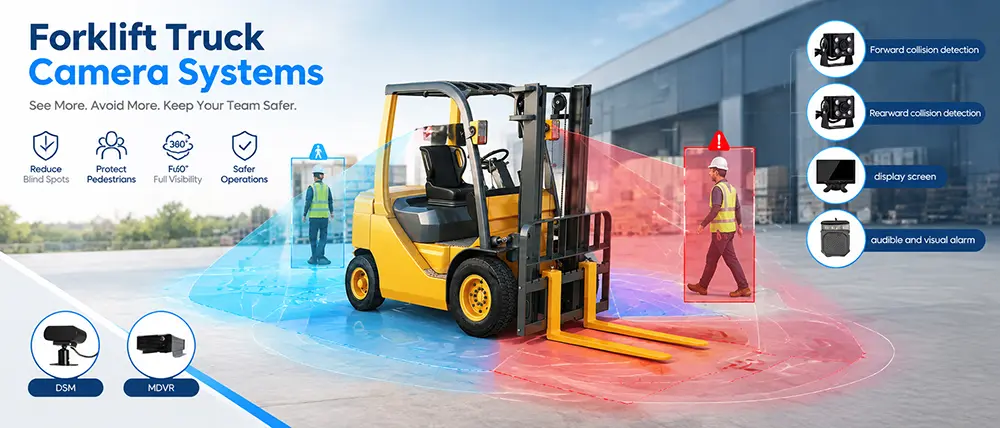
6.Sanitation, Firefighting, and Special Engineering Vehicles: 4-channel expansion + global 4G + wide-temperature design, adapting to complex operational environments.
Conclusion
For commercial fleets in 2026, what is needed is not just a "video recorder on the windshield," but an intelligent in-vehicle node capable of real-time video transmission, precise trajectory positioning, proactive risk warning, and remote maintenance. The V5 provides the most balanced answer in the current market with its complete capability stack, consisting of global 4G networking, GPS/BDS dual-mode fleet tracking, 4-channel HD video, ADAS + DSM active safety, FaceID identity verification, OTA remote upgrades, and mini-program debugging.
Email:hello@yuweitek.com