












Best 4 Channel DVR System for Truck Fleet Monitoring
4 Channel DVR System for Truck Fleet Monitoring
In Indonesia, complex road environments, long-distance transportation, driver fatigue, and vehicle overloading present significant safety challenges for logistics companies. A 4 Channel Mobile DVR (MDVR) system can help companies strengthen vehicle management through multi-channel cameras, 4G remote communication, GPS positioning, and AI safety monitoring.
What is a 4 Channel Truck DVR System?
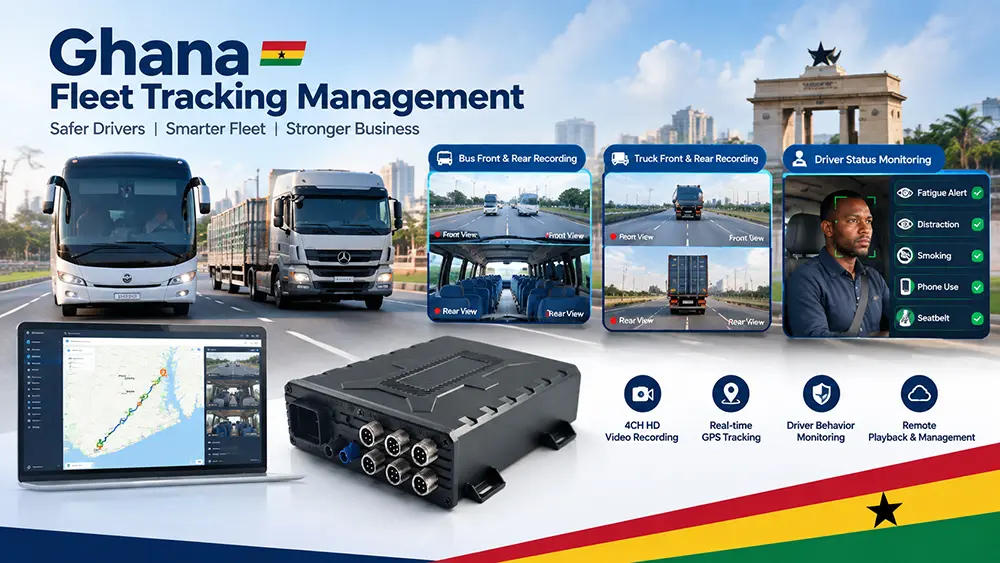
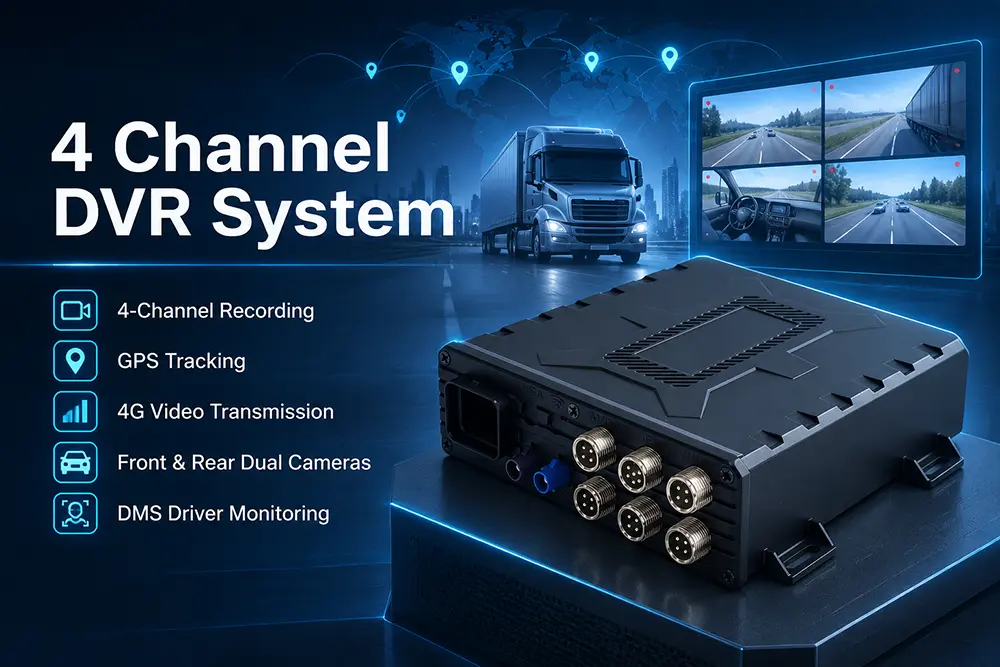
A 4 Channel Mobile Digital Video Recorder (4 Channel MDVR) is a video surveillance device designed specifically for trucks, buses, and commercial vehicles. Unlike standard dashcams, a 4 channel MDVR can connect to four cameras simultaneously, recording video from different positions around the vehicle.
A four-camera setup includes:
1.Front-View Camera: Records the road ahead, providing video evidence in the event of an accident.
2.Left-Side Camera: Monitors the left blind spot and lane changes.
3.Right-Side Camera: Observes vehicles, pedestrians, and motorcycles on the right side.
4.Rear-View Camera: Monitors reversing, loading/unloading operations, and the rear environment.
If driver monitoring is required, one of the channels can also be configured as a cabin camera.
How Does a 4 Channel MDVR System Work?
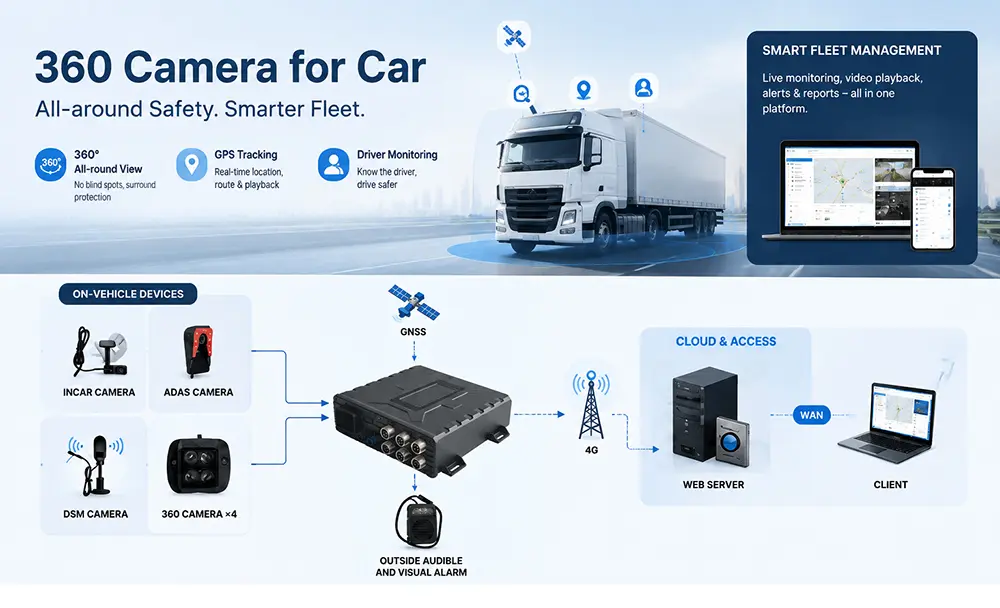
A complete 4 channel MDVR system typically consists of the DVR host unit, vehicle cameras, a GPS module, a 4G communication module, local storage, and a remote management platform.
While the vehicle is operating, the cameras continuously capture video while the MDVR manages recording and storage. The GPS module simultaneously logs the vehicle's position, speed, and driving route. When abnormal events occur, the system can preserve critical footage and send alarms to the management platform.
Via the 4G network, managers can remotely view vehicle locations, real-time video, and historical records. Therefore, a 4 channel MDVR is not merely a recording device, but an all-in-one fleet management terminal combining video surveillance, vehicle positioning, and driving safety management.
Indonesian Truck Fleet Management Challenges
Indonesia is a major logistics and transportation market in Southeast Asia, with road freight handling a vast amount of goods and materials. However, road traffic accidents remain a critical safety concern for the local logistics industry.
According to an official report released by the Indonesian Ministry of Transportation on November 2, 2026, the traffic accident statistics for 2025 are as follows:
Freight vehicles in Indonesia continue to face substantial road safety pressures. Strengthening driver behavior monitoring and vehicle safety management is essential.
Key Challenges Faced by Indonesian Truck Fleets
Driver Fatigue and Distracted Driving
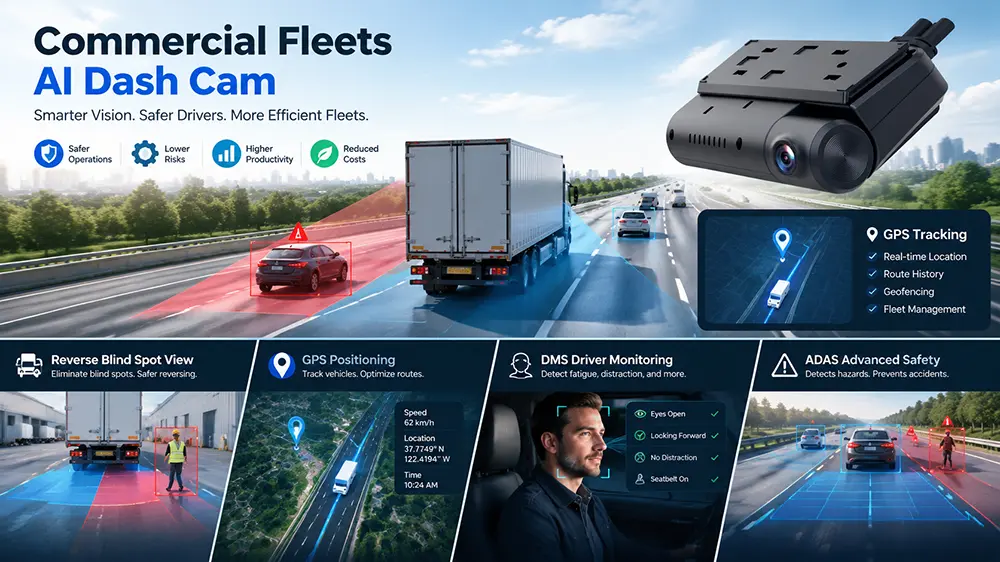
Indonesian long-haul truck drivers frequently face night driving and extended transit times. Behaviors such as fatigue, distraction, and mobile phone usage increase accident risks. Traditional GPS devices cannot directly detect these dangerous behaviors, whereas an AI MDVR equipped with DSM functions can provide auxiliary monitoring and early warnings.
Large Truck Blind Spot Risks
In densely populated traffic hubs like Jakarta and Surabaya, trucks frequently share the road with motorcycles, cars, and pedestrians. Large vehicles have substantial side and rear blind spots, leading to elevated risks during turns or lane changes. Multi-channel cameras combined with BSD (Blind Spot Detection) provide drivers with enhanced situational awareness of their surroundings.
Vehicle Overloading and Regulatory Pressures
Over Dimension Over Load (ODOL) transport has long been a major governance issue for Indonesian road transport. According to data from the Indonesian Ministry of Transportation, from August 10 to October 31, 2026, the ETLE HUB electronic enforcement pilot program identified 239,087 violations, of which 165,537 involved vehicle weight compliance issues. The Indonesian government plans to enforce "Zero ODOL" regulatory measures starting January 1, 2027.
Two Truck MDVR Models: F4 vs. F6
When selecting an MDVR for Indonesian truck fleets, key considerations should include video channels, AI safety features, remote connectivity, storage capacity, and environmental durability.
Both YUWEI F4 and F6 can be deployed in four-camera monitoring solutions, but they feature distinct product positioning.
F4 Smart MDVR
Recommended Scenarios: Urban delivery, general freight, and long-haul logistics trucks.
The YUWEI F4 Smart MDVR integrates video surveillance, 4G communication, GPS positioning, and AI driving safety functions, making it suitable for logistics companies seeking to upgrade traditional GPS management systems. The F4 offers multiple configurations: the SD card economic version supports 4-channel video input, while the high-spec version supports up to 6 channels.
Key Features:
1.4-channel or up to 6-channel video input (depending on version)
2.High-spec version supports up to 2-channel 1080P video
3.4G remote video monitoring
4.GPS/Beidou dual-mode positioning
5.Supports ADAS, DSM, and BSD intelligent safety features
6.H.264/H.265 video encoding
7.SD card or Hard Drive (HDD/SSD) storage options
8.Overspeed, fatigue driving, and route deviation alarms
9.Geofencing and historical route playback
10.Power-off protection and low-voltage protection
Core Advantage of F4: Flexible configuration, making it adaptable to logistics fleets of various scales.
Companies can monitor vehicle operations via remote video, identify hazardous driving with AI alerts, and utilize historical footage for driver training. For vehicles requiring basic four-channel monitoring, the F4 economic version is an ideal fit. For higher storage demands and additional camera requirements, the high-spec version can be selected.
F6 Waterproof MDVR
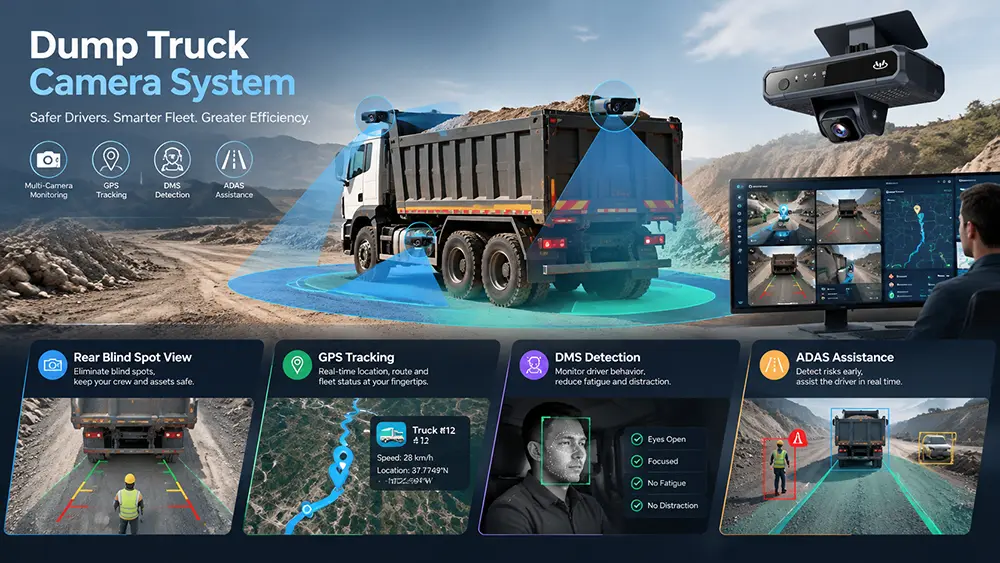
Recommended Scenarios: Engineering trucks, dump trucks, construction vehicles, and outdoor operation fleets.
The YUWEI F6 Smart MDVR is an in-vehicle video terminal featuring an IP67 protective design, making it well-suited for environments with heavy dust, rain, and rugged road conditions. The F6 supports up to 6 analog video inputs and can also be deployed with a 4-camera configuration based on operational needs.
Key Features:
1.Up to 6-channel AHD/CVBS video input
2.Supports up to 6-channel 720P video capture
3.IP67 dustproof and waterproof rating
4.4G remote communication
5.GPS/Beidou dual-mode positioning
6.Optional RTK high-precision positioning and inertial navigation
7.Supports ADAS, DSM, and BSD safety features
8.H.264/H.265 video encoding
9.SD card storage (official specs indicate support up to 2TB)
10.UPR power-off recording protection
11.Anti-tamper storage and low-voltage protection
12.Geofencing, route playback, and remote diagnostics
Core Advantage of F6: Superior environmental durability paired with expandable high-precision positioning options. Construction trucks frequently encounter heavy dust, rainfall, and intense vibrations; the IP67 protective rating of the F6 reduces external environmental impact on device operation.
F4 vs. F6 MDVR Comparison
Note: Specific parameters depend on hardware versions and functional configurations; confirm with the manufacturer prior to procurement.
Selection Recommendation: Prioritize F4 for daily highway transport and urban distribution; prioritize F6 for construction sites, mining areas, and complex outdoor environments.
What Capabilities Do F4 and F6 MDVRs Deliver?
The F4 and F6 do more than just record video—they help enterprises manage driving risks, vehicle tracking, and transportation incidents.
Four-Channel Video Surveillance
Function: Simultaneously records views from the front, sides, rear, or interior cabin.
Benefits:
1.Provides multi-angle video evidence for accidents.
2.Facilitates observation during reversing and turning maneuvers.
3.Assists in investigating vehicle or cargo damage claims.
4.Reduces reliance on purely verbal driver reports.
Multi-angle recording enhances accident investigation efficiency and helps resolve transport disputes.
ADAS (Advanced Driver Assistance System)
Function: Delivers Forward Collision Warnings (FCW), Lane Departure Warnings (LDW), and Headway Monitoring Warnings based on camera algorithms.
Benefits:
1.Reminds drivers to maintain a safe tailgating distance.
2.Identifies unintended lane departures.
3.Provides real-time driving risk alerts.
4.Logs events for targeted safety training.
DSM (Driver Status Monitoring)
Function: Uses AI to detect behaviors such as eye-closing, yawning, distraction, and mobile phone usage.
Benefits:
1.Issues timely alerts for fatigue driving risks.
2.Helps management identify risky driving habits.
3.Supplies objective data for driver safety coaching.
4.Improves overall fleet driving safety behavior.
DSM is particularly suited for night-time operations and long-haul logistics.
BSD (Blind Spot Detection)
Function: Detects vulnerable targets in the vehicle's side blind spots using cameras and AI algorithms.
Benefits:
1.Assists in identifying side blind spots around large trucks.
2.Alerts drivers to nearby motorcycles and pedestrians.
3.Mitigates potential collision risks during turns and lane changes.
4.Enhances situational safety alerts in complex traffic conditions.
4G Remote Video & GPS Positioning
Function: Connects the in-vehicle unit to the central management platform via 4G, offering real-time video, vehicle tracking, and route history playback.
Benefits:
1.Enables remote monitoring of vehicle operational status.
2.Provides real-time visibility into transit progress.
3.Facilitates rapid response to abnormal alarms.
4.Allows centralized management of multi-truck fleets.
H.265 Video Encoding & Local Storage
Function: Both F4 and F6 support H.265 video compression and local footage storage.
Benefits:
1.Reduces video storage footprint under proper configurations.
2.Lowers bandwidth consumption for video transmission.
3.Simplifies historical footage retrieval.
4.Supports seamless accident video playback.
How to Choose a 4 Channel MDVR?
When selecting a 4 channel DVR system, enterprises should determine the deployment plan based on vehicle types, operating environments, and management demands.
1.For urban delivery, standard highway transport, and regional logistics vehicles, the F4 is typically the more suitable option.
2.For heavy engineering transport, construction trucks, and high-dust environments, the IP67-rated protective design of the F6 provides a clear operational advantage.
Conclusion
For Indonesian logistics enterprises, combining multi-camera recording, AI driving assistance, GPS tracking, and 4G remote management significantly enhances vehicle visibility while helping mitigate operational risks.
Email:hello@yuweitek.com