








Installation of In-Cabin Recording Cameras for Buses
In-Cabin Recording Cameras for Buses
In 2026, Vietnam had approximately 9,450 public transit buses. The figure is projected to reach around 10,500 by 2029, representing an increase of roughly 11.2% compared to 2026. It should be clarified that this projection is a trend estimate derived from public market growth data, rather than an official vehicle stock forecast released by the Vietnamese government.
With the continuous expansion of urban public transport, intercity passenger transport, tour buses, staff shuttle buses and new energy passenger vehicles, Vietnamese passenger transport enterprises will see synchronous growth in demand for in-vehicle video surveillance, vehicle positioning and active safety management systems.

Why Does Vietnam Mandate Installation of In-Cabin Passenger Recording Cameras on Coaches & Buses?
Following revisions to regulations on road traffic order and safety under Law No. 118/2025/QH15 of Vietnam, effective January 1, 2029, all vehicles engaged in passenger transport operations with 8 or more passenger seats (excluding the driver’s seat) must be fitted with driving monitoring equipment, driver image recording devices and passenger compartment recording devices. Specific implementation will follow the roadmap formulated by the Vietnamese government.
The law also stipulates that processing of image data captured from driver and passenger cabins must comply with personal data protection and other relevant legal provisions.
This means future compliant systems cannot rely solely on ordinary dashcams that only record the road ahead. Instead, they must cover passenger compartments, vehicle doors, aisles and key seating areas, and support linking recorded footage with vehicle location, timestamp, speed and alarm events.
The core reasons for installing in-cabin passenger recording cameras are as follows:
1. To meet Vietnam’s regulatory requirements for passenger transport vehicles, supplying reliable video evidence for vehicle inspections, enterprise compliance audits and operational license administration.
2. To safeguard the safety of passengers and drivers. The system records onboard theft, vehicle vandalism, passenger conflicts, harassment, lost belongings and unexpected incidents, providing video evidence for liability confirmation, insurance claims and dispute resolution.
3. To strengthen supervision over drivers and attendants. Fleet managers can remotely monitor risky driving behaviors including fatigue driving, distracted driving, phone usage and failure to fasten seat belts.
4. To boost public transport operational efficiency. Passenger flow statistics, GPS positioning, route deviation alerts, speeding warnings, station entry/exit logs and vehicle dispatching data enable enterprises to optimize departure frequencies, route planning and vehicle utilization rates.
5. To build a closed-loop unified safety management framework. In-cabin recording, ADAS, DMS, blind-spot monitoring and audible-visual alarms are integrated on a single platform, forming a complete workflow: risk identification → in-vehicle reminder → video evidence capture → platform alarm → backend disposal.
YUWEI In-Cabin Passenger Recording Camera Solution for Vietnamese Coaches & Buses
To comply with Vietnam’s 2029 regulatory standards for passenger transport vehicles, we recommend an integrated architecture consisting of:
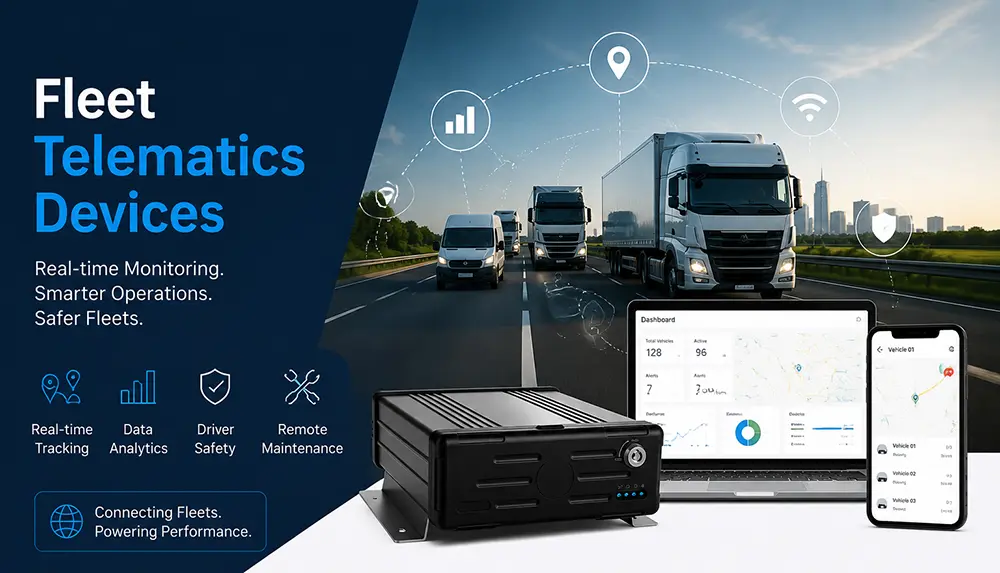
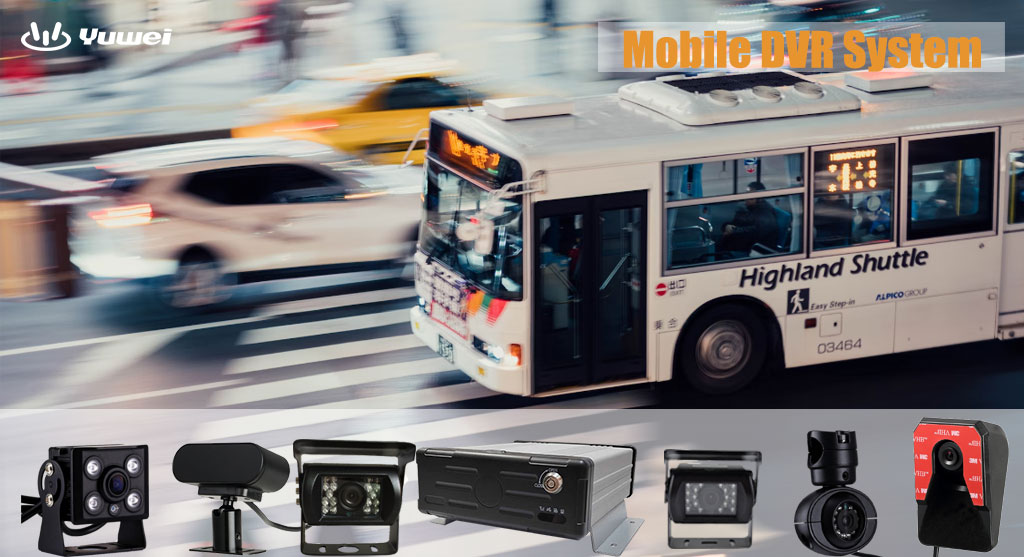
High-Definition In-Vehicle & Exterior Cameras + Onboard MDVR + 4G Communication + GPS/BDS Positioning + AI Active Safety Devices + Cloud Fleet Management Platform
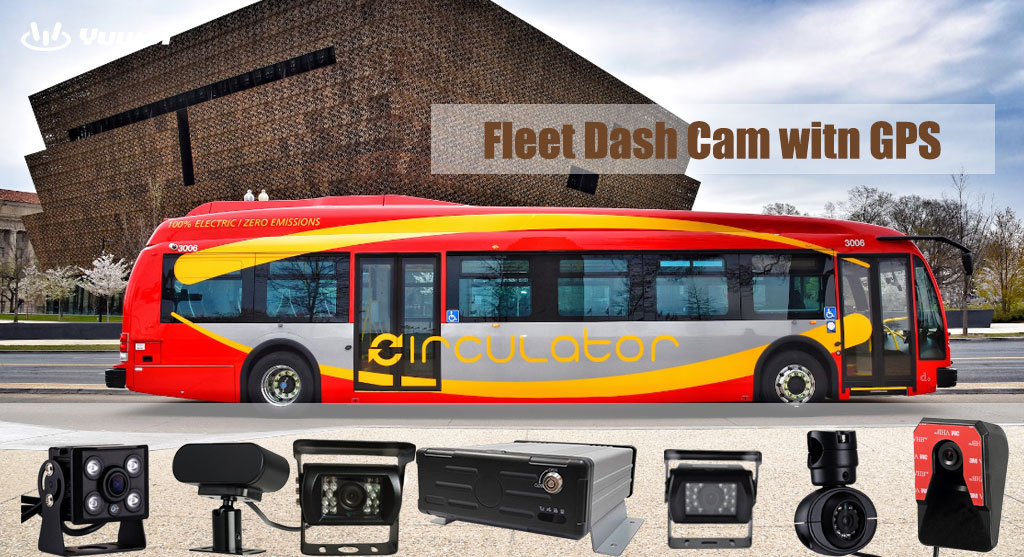
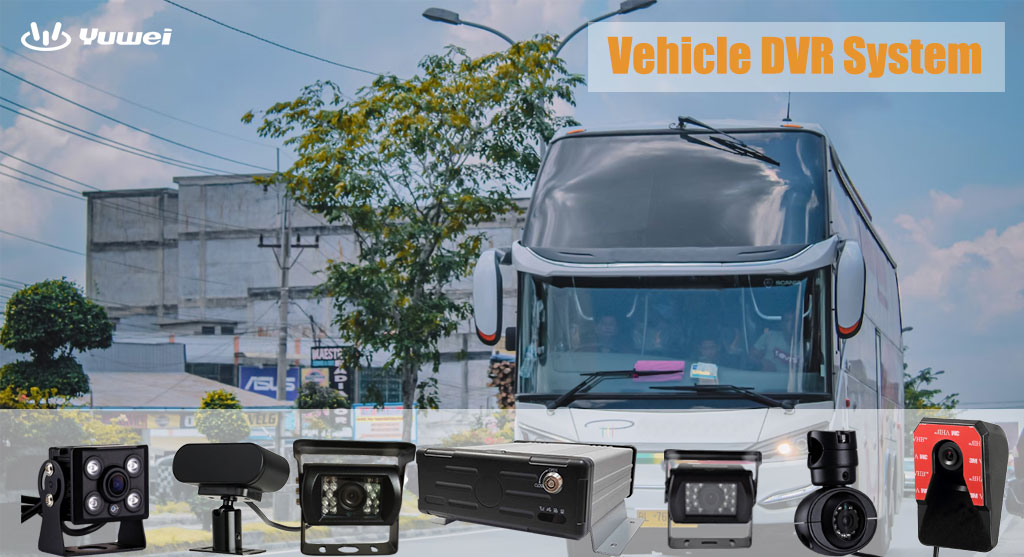
Once the vehicle ignition is activated, the onboard recording host automatically initiates continuous recording covering the passenger cabin, driver area, vehicle doors, forward road view, right blind spot and rear compartment. Footage can be stored locally on onboard hard drives or SD cards. Critical alarm footage and snapshots are uploaded to the management platform via 4G cellular networks.

Fleet administrators can access real-time vehicle locations, live video feeds, historical driving tracks and archived recordings via desktop computers or mobile terminals. When the system detects speeding, route deviation, fatigue driving, mobile phone use, lane departure, forward collision risks, pedestrians in blind spots or emergency button activation, it automatically generates alarm logs and saves associated footage captured before and after each incident.
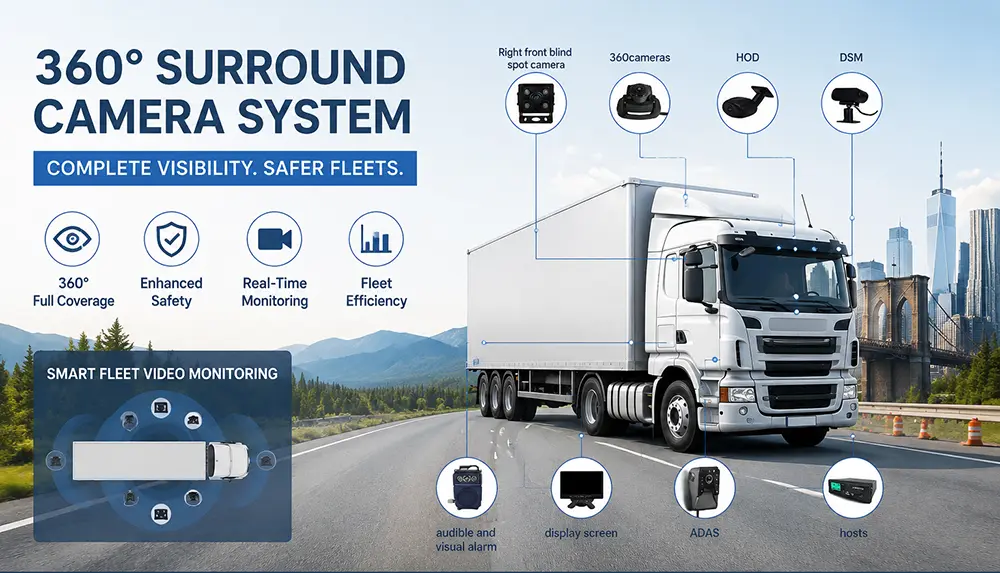
The YUWEI Coach Management System supports live HD video, historical playback, GPS track playback, geofencing, route administration, mileage & driving duration statistics, driver behavior analytics, anomaly alerts, remote voice broadcasting and passenger flow management. The platform also integrates active safety equipment including ADAS, DSM, HOD and BSD.
Regarding passenger privacy protection:
• Install prominent video surveillance notice signs inside vehicles to clearly state recording purposes;
• Implement tiered account access permissions, operation logging, encrypted data transmission and approval workflows for video export;
• Set data retention cycles in accordance with technical standards and storage durations to be issued by the Vietnamese government, prohibiting unauthorized duplication, data leakage or use of passenger recordings for purposes unrelated to safety management.
Hardware Configuration & Functional Capabilities of the Management Solution
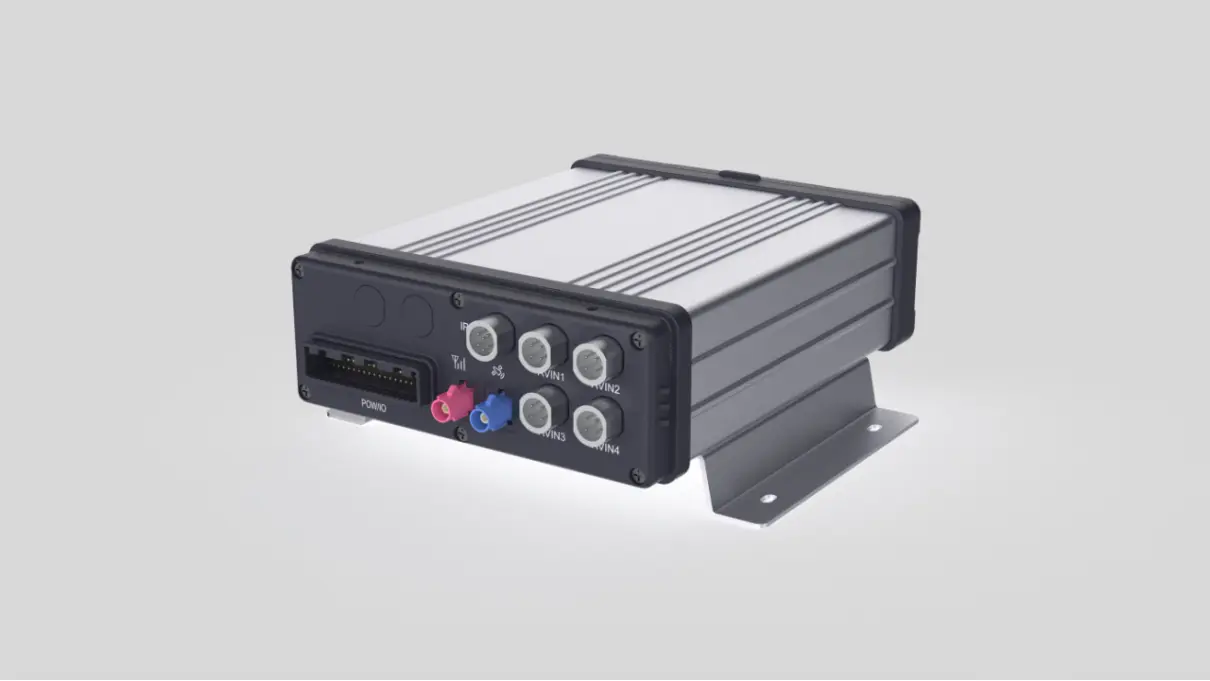
1. YUWEI MDVR F4 Onboard Recording Host
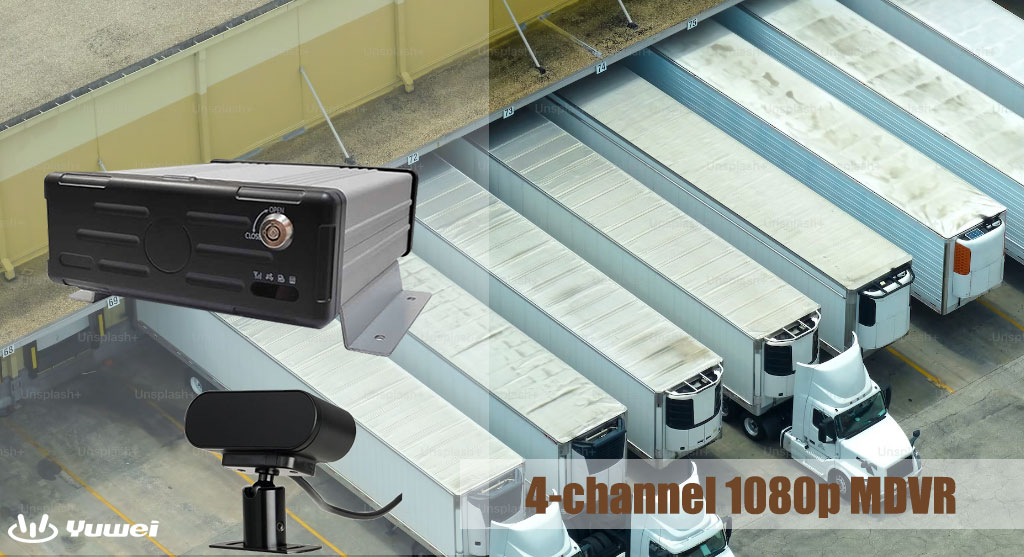
As the core unit of the entire system, the MDVR F4 receives video feeds from cameras, manages footage storage, GPS positioning, 4G data transmission and alarm event processing.
Core Functions
• Supports multiple AHD and IPC video channel inputs;
• Delivers 1080P high-definition recording on selected channels;
• Adopts H.265 / H.264 video encoding for efficient storage;
• Compatible with hard disk and SD card dual storage media;
• Enables remote video streaming over 4G networks;
• Equipped with dual-mode GPS/BDS positioning;
• Supports integration with ADAS, DSM and BSD intelligent algorithms;
• Triggers alerts for speeding, route deviation, power failure, low voltage and emergency incidents;
• Features pre-power-loss recording protection and onboard battery undervoltage protection;
• Allows remote firmware upgrades, onboard voice broadcasting and vehicle operational data management.
Public specifications for the F4 model confirm it supports up to 6 AHD/CVBS analog video inputs plus 1 IPC network camera input, with maximum storage capacity of 2TB via hard disk or SD card. For large coaches requiring multiple cabin cameras, ADAS, DMS, forward blind-spot, right blind-spot and rear-view cameras simultaneously, channel allocation planning is mandatory. For configurations exceeding the channel limit of a single host, dual-host setups or higher-channel expansion units are available. ([YUWEI Technology][4])
2. In-Cabin Passenger Recording Cameras
We recommend installing 2 to 4 wide-angle HD interior cameras based on vehicle length to cover the following zones:
• Front passenger seating area and front entry door;
• Middle aisle and central seating section;
• Rear passenger zone and rear exit door;
• Upper passenger cabin or key monitoring areas for double-decker buses.
Cameras must feature wide-angle lenses, infrared night vision, backlight compensation and tamper-resistant housings to guarantee clear identification of passenger activities under daylight, nighttime and low-light cabin conditions. During installation, minimize blind spots caused by seats, luggage racks and interior pillars, while avoiding direct capture of sensitive areas irrelevant to safety supervision.
3. Passenger Flow Statistics System
Passenger counting cameras deployed at front and rear doors record boarding volumes, alighting volumes, real-time onboard passenger counts and passenger flow fluctuations at each station.
System Capabilities
• Generates passenger flow statistics filtered by vehicle, route, station and time period;
• Calculates vehicle load factor and identifies peak travel hours;
• Cross-references ticket sales data with actual passenger numbers;
• Optimizes vehicle scheduling and departure frequencies;
• Supplies data evidence for route adjustments and operational subsidy audits.
The native YUWEI coach management platform supports door-mounted video surveillance and passenger flow analytics, and generates comprehensive operational reports incorporating route data, mileage records and real-time vehicle status.
4. HOD Driver Hand Operation Monitoring Camera
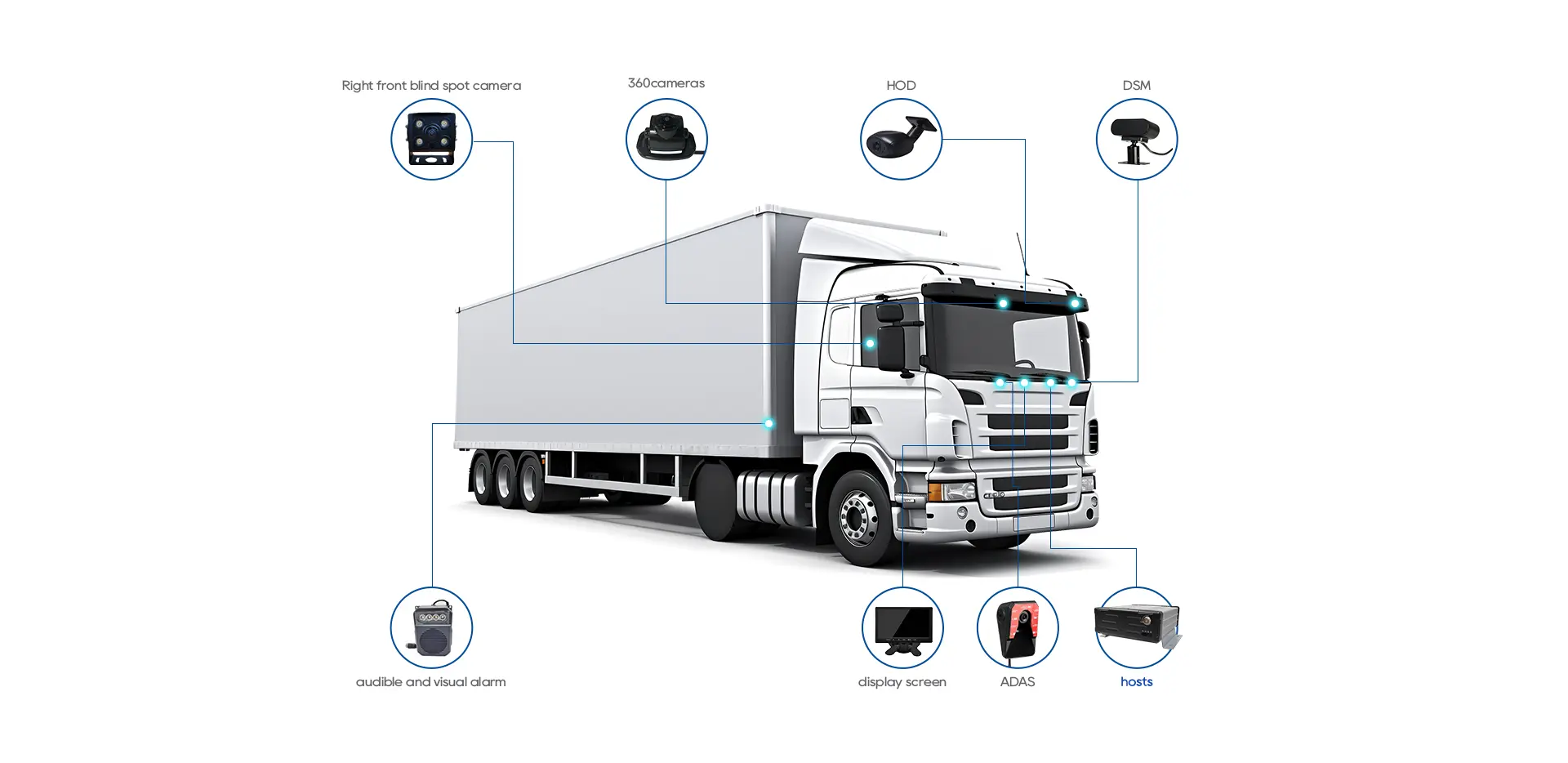
The HOD camera focuses on the driver’s hands and steering operations. Paired with host-side algorithms, it detects unsafe behaviors including hands off the steering wheel, mobile phone usage and unfastened seat belts.
This camera supports 720P AHD video, infrared fill light, built-in audio pickup and wide-angle framing, and can be mounted on the dashboard, A-pillar or overhead driver compartment.
5. DMS Driver Status Monitoring Camera
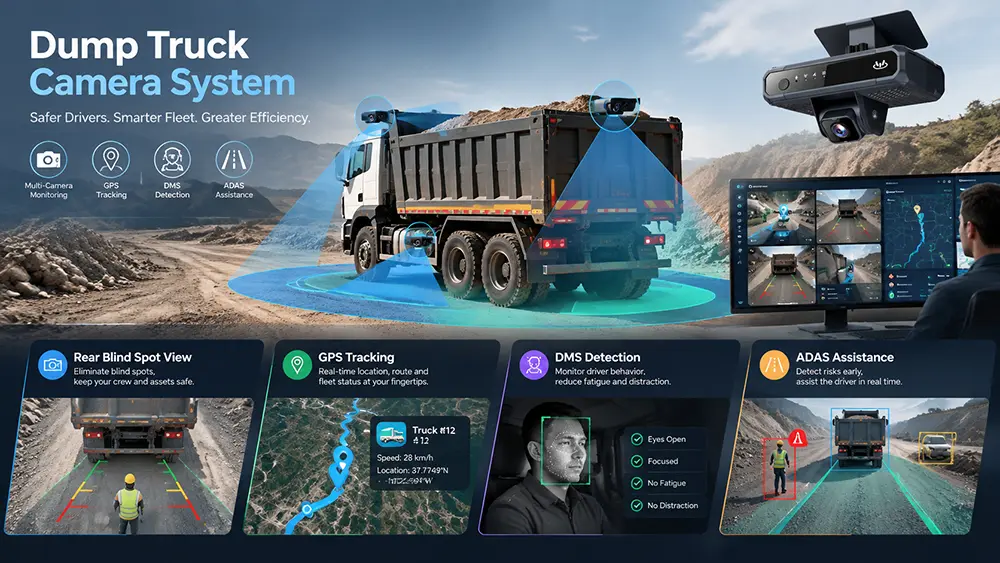
The DMS camera identifies hazardous driver states such as fatigue, eye closure, yawning, distracted attention, smoking, mobile phone operation and driver absence. Upon detecting anomalies, the system activates in-cabin audible reminders and uploads alarm snapshots, footage, timestamps and vehicle coordinates to the cloud management platform.
6. ADAS Forward Active Safety Camera
Mounted on the front windshield, the ADAS camera delivers forward collision warnings, lane departure alerts, following distance reminders and pedestrian collision risk notifications.
Beyond recording road conditions ahead, the system alerts drivers to brake or evade hazards prior to collisions, shifting coach safety management from post-incident evidence collection to proactive accident prevention. The YUWEI coach platform fully supports ADAS alerts for forward collisions, lane departure, insufficient following distance and pedestrian hazards.
7. Forward Blind-Spot Camera
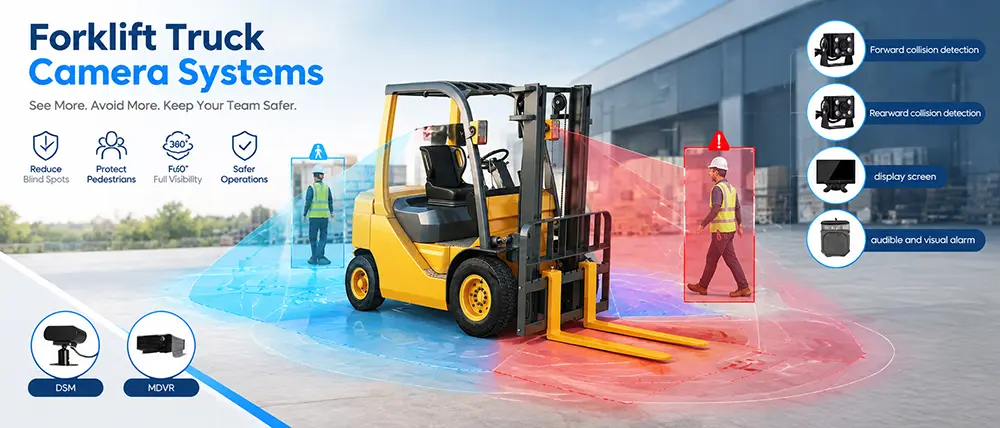
Large coaches feature severe forward blind spots near the front bumper that are invisible to drivers. The forward blind-spot camera monitors pedestrians, bicycles, motorcycles and obstacles beneath the vehicle front, making it ideal for bus stops, schools, transit terminals and crowded public zones.
8. Right-Side Blind-Spot BSD Camera
The right blind-spot BSD camera monitors motorcycles, bicycles and pedestrians alongside the vehicle’s right flank during turning maneuvers. When collision risks are identified, the system synchronously activates the in-dash display and audible-visual alarm to warn the driver.
9. Rear View Reversing Camera
Waterproof reversing cameras installed at the vehicle rear automatically activate rear-view footage during reverse gear, reducing collision risks inside parking lots, passenger terminals and maintenance yards.
10. Multimedia Onboard Display Screen
Onboard multimedia screens display route information, station announcements, arrival alerts, service reminders and safety promotional content. They also link with reversing, blind-spot and alarm systems to stream live feeds from monitoring cameras for the driver.
11. Audible & Visual Alarm Device
The audible-visual alarm unit interconnects with ADAS, DMS, BSD, door status sensors and emergency panic buttons. It instantly alerts drivers and attendants via sound and flashing lights upon detection of fatigue driving, forward collision risks, blind-spot pedestrians, abnormal door status or onboard emergencies.
Recommended YUWEI Intelligent Coach Management System
Vietnam’s mandatory passenger compartment recording regulations taking effect in 2029 are not limited to adding a single interior camera; they require passenger transport enterprises to build a digital safety ecosystem covering vehicles, drivers, passengers and centralized management platforms.
For public transit buses, intercity coaches, tour buses, airport shuttles, corporate staff shuttles and all other commercial passenger vehicles with 8 or more seats, enterprises are advised to conduct advance assessments covering available camera channels, cabin coverage scope, video storage capacity, 4G network coverage and backend management access permissions to avoid rushed retrofitting work close to the regulatory enforcement date.
Centered on the MDVR F4 onboard data host, the scalable YUWEI Intelligent Coach Management System can be configured with customized combinations of cabin cameras, passenger flow analytics, HOD, DMS, ADAS, forward blind-spot cameras, right-side BSD cameras, reversing cameras, multimedia displays and audible-visual alarms to deliver the following full-spectrum capabilities:
• Continuous real-time passenger cabin recording with remote cloud access;
• Synchronized logging of video footage, timestamps, GPS coordinates and vehicle operational status;
• Passenger flow and route performance data analytics;
• Real-time monitoring of driver fatigue and dangerous driving behaviors;
• Proactive warnings for forward collisions, lane drift and blind-spot hazards;
• Emergency incident alerting and automatic upload of critical recorded footage;
• Centralized management of vehicle travel tracks, mileage, speed limits and geofencing zones;
• Unified fleet oversight for multiple vehicles, transport routes and assigned drivers.
With a scalable integrated hardware and software platform, the YUWEI system fully equips Vietnamese passenger transport operators to comply with the 2029 in-cabin recording legal requirements. Additionally, it delivers secondary operational benefits including reduced accident rates, improved transport efficiency, standardized driver conduct and enhanced passenger riding experience.
Email:hello@yuweitek.com