










Italian Taxi DVR Dash Cam System
Italian Taxi Tracking Management
Current Situation of Taxis and Ride-Hailing Services in Italy
Italy’s taxi industry has long adopted a strict licensing management model. Compared with other European countries, the growth of its traditional taxi fleets remains limited. According to public data released by Italy’s traffic regulatory authorities, there are approximately 23,000 to 25,000 valid Taxi operating licenses nationwide in 2024, alongside over 20,000 NCC (Noleggio Con Conducente, chauffeured rental vehicles for private pre-booked passenger transport service) operational vehicles. The overall professional passenger transport market scales up to 40,000–50,000 vehicles.
The Italian Ministry of Infrastructure and Transport has launched the national electronic registration system RENT for Taxis and NCC vehicles. This system centrally administers taxi permits and NCC operation authorizations, advancing digital supervision across the industry.
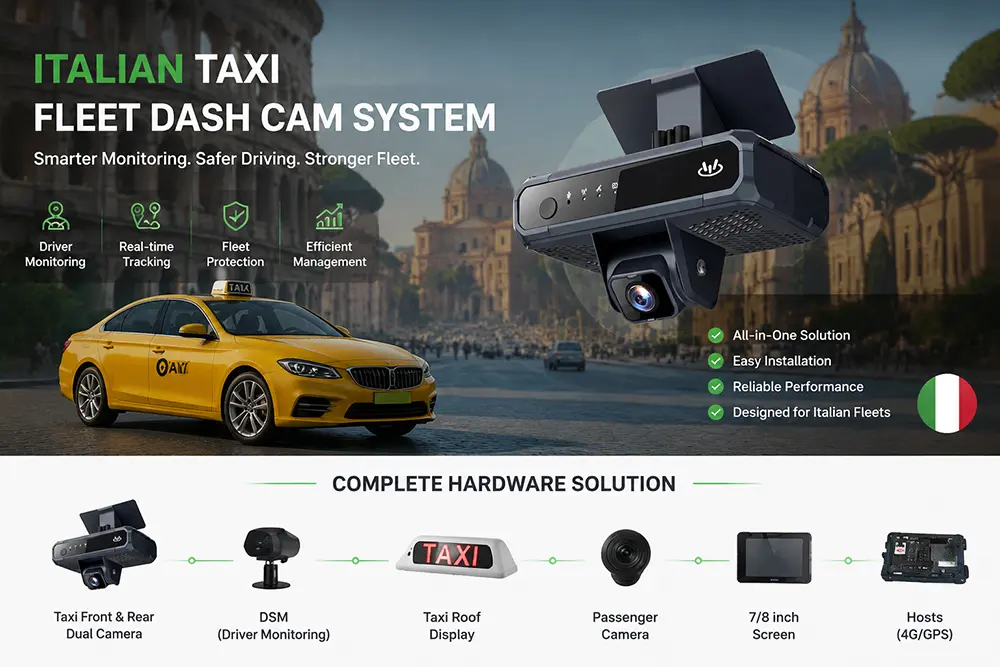
Unlike markets such as the UK and Canada, which feature rapid expansion of ride-hailing platforms, Italy’s mobility sector is distinctly regulation-oriented. Traditional Taxis are restricted by municipal licensing quotas, while platforms including Uber deliver services primarily through partnerships with NCC fleets. In recent years, surging travel demand in tourist hubs like Milan and Rome, paired with the market entry of new platforms such as Bolt, has driven the industry toward greater transparency, digitalization and intelligence.
Against this backdrop, Italian taxi and NCC operators are upgrading from conventional GPS location tracking management to next-generation fleet management solutions integrating DVR dashcam video surveillance, AI driving analytics, telematics remote information processing, and intelligent speed limiting assist systems.
Digital Upgrade Demands for Italy’s Taxi Industry
The core characteristics of Italy’s taxi market are as follows:
Limited vehicle volume, coupled with stringent regulatory requirements, high service standards and complex operating environments.
Accordingly, fleet digital transformation centers on the following priorities:
Service Supervision Pressures Driven by Tourist Cities
Italy hosts world-famous tourist destinations including Rome, Milan, Venice and Florence.
Taxis and NCC vehicles deliver the following services:
• Airport transfers
• Hotel & corporate transportation
• Urban sightseeing trips
• High-end business passenger services
Operators must guarantee:
• Full traceability of all service procedures
• Complete transparency of driving routes
• Restorable footage for customer complaint investigations
• Standardized driver conduct
Conventional GPS systems only display vehicle coordinates and cannot identify the following risks:
• Dangerous driving behaviors
• Speeding violations
• Fatigued driving
• In-vehicle disputes between drivers and passengers
EU Road Safety Legislation Accelerates Intelligent Driving Assist Adoption
Italy’s road infrastructure bears typical European features:
• Narrow roadways in historic city centers
• Mixed traffic of motorcycles and bicycles
• High proportion of long-distance highway journeys
• Complicated mountainous road sections
Therefore, taxi fleets require not only accident recording functions but also proactive risk mitigation tools.
Specifically, the AI ADAS + Mandatory Speed Limiting Assist System has become a pivotal upgrade direction for commercial vehicle safety across Europe.
Demands for Driver Administration & Operational Efficiency
For taxi companies and NCC fleets, core management pain points cover:
• Driver compliance with speed limits
• Occurrences of hazardous driving
• Rationality of route planning
• Maximization of vehicle utilization rate
Thus, fleets need to establish a closed-loop management framework based on on-board data:
Vehicle Status → Driving Behavior → Risk Scoring → Operational Optimization
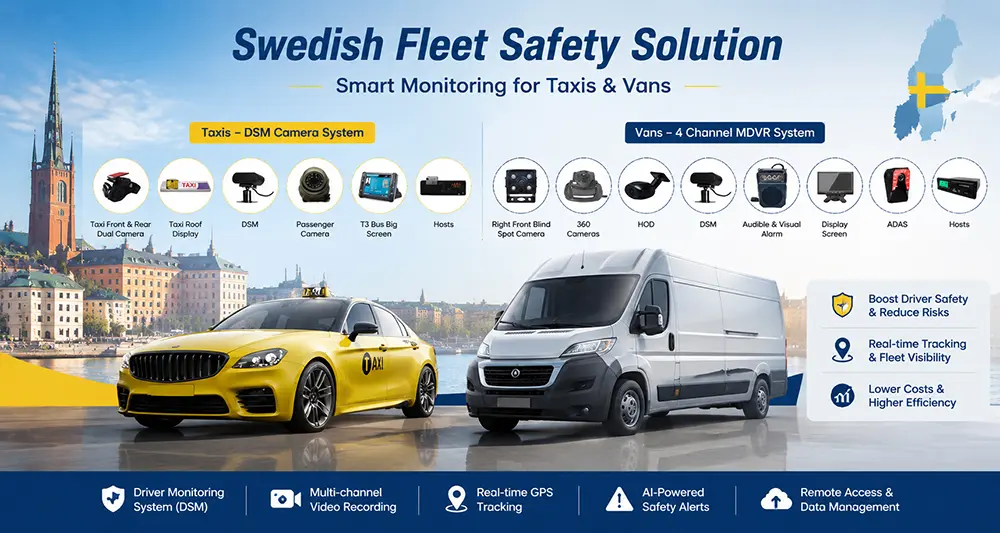
Overall Architecture of Intelligent Taxi DVR System for Italy
Tailored to Italy’s market characteristics, the intelligent taxi solution adopts a four-tier framework:
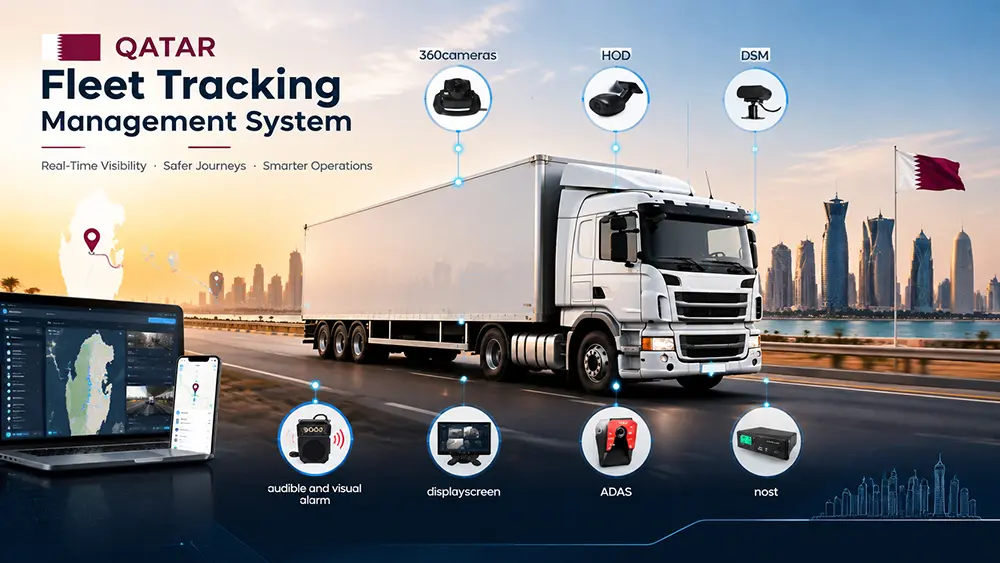
Vehicle Sensing Layer + Mobile DVR Video Processing Layer + AI Safety Control Layer + Cloud Telematics Platform
① Vehicle Sensing Layer
This layer serves as the data entry point, collecting all vehicle operational metrics.
Core Hardware
1. Dash Cam Intelligent On-Board Camera
Core use cases:
• High-definition road video recording
• Synchronization with GPS trajectory data
• Secure storage of accident evidence
• Remote real-time video access
Applicable vehicle types:
• Taxi vehicles
• NCC chauffeured commercial vehicles
• Ride-hailing operational fleets
2. DSM Driver Status Monitoring Camera
Performs real-time analysis of driver conditions to detect:
• Fatigued driving
• Eyes closed while operating the vehicle
• Distracted attention
• Mobile phone usage during driving
It shifts fleet management from post-accident remediation to preemptive risk prevention.
3. ADAS Advanced Driver Assistance Camera
Delivers the following active safety alerts:
• Forward collision warning
• Lane departure reminder
• Pedestrian recognition
• Safe following distance detection
It significantly enhances driving safety on complex urban road networks.
② Mobile DVR Layer
Core Equipment: MDVR (Mobile Digital Video Recorder)
Acting as the central intelligent management hub of each vehicle, the MDVR connects all peripheral devices:
• Dash Cam
• DSM Camera
• GPS Module
• On-board Display Terminal
Primary Functions
• Simultaneous multi-channel video recording
• Fusion of video footage and vehicle operational data
• Local mass storage
• 4G/5G remote data uploading
• Auto-locked event-triggered video files
For Italian taxi enterprises, the MDVR enables synchronized monitoring of:
Front road conditions, driver status, passenger compartment footage, and full vehicle driving trajectories.
③ AI Safety Control Layer
This module differentiates Italy’s customized solution from generic DVR systems.
Mandatory Speed Limit Control System
Integrates multiple data sources:
• GPS geolocation
• National road speed limit database
• Visual recognition via ADAS cameras
• ECU vehicle communication interface
Real-Time Speed Monitoring Functions
The system continuously evaluates three key metrics:
• Statutory speed limit of the current road segment
• Real-time travelling speed of the vehicle
• Potential speeding hazards
Speeding Warning Mechanism
When the vehicle exceeds the legal speed cap, the system triggers multi-channel alerts:
• Voice prompt for the driver
• On-screen visual warning
• Automatic record upload to cloud backend
Enforceable Speed Governance
Fleet administrators can set differentiated speed thresholds in the backend:
• Maximum speed limits for urban zones
• Separate speed caps for highway sections
• Customized velocity ceilings for designated vehicle groups
This hardware suite effectively cuts down three major operational costs for fleets:
Speeding fines, traffic accident risks, and commercial insurance premiums.
④ Cloud Telematics Remote Management Platform
The cloud platform centralizes all vehicle data streams, including:
• Real-time GPS positioning
• Archived video recordings
• Full driving behavior logs
• Speeding violation records
• Real-time vehicle operational status
Administrators are empowered with the following operational capabilities:
• Live tracking of all vehicle locations
• Retrieval of historical video footage
• Data analysis of driver safety scores
• Full audit trail of speeding incidents
• Data-driven route optimization
The complete intelligent transport closed-loop workflow is structured as:
Video Capture → AI Intelligent Recognition → Active Speed Limit Control → Cloud Centralized Management
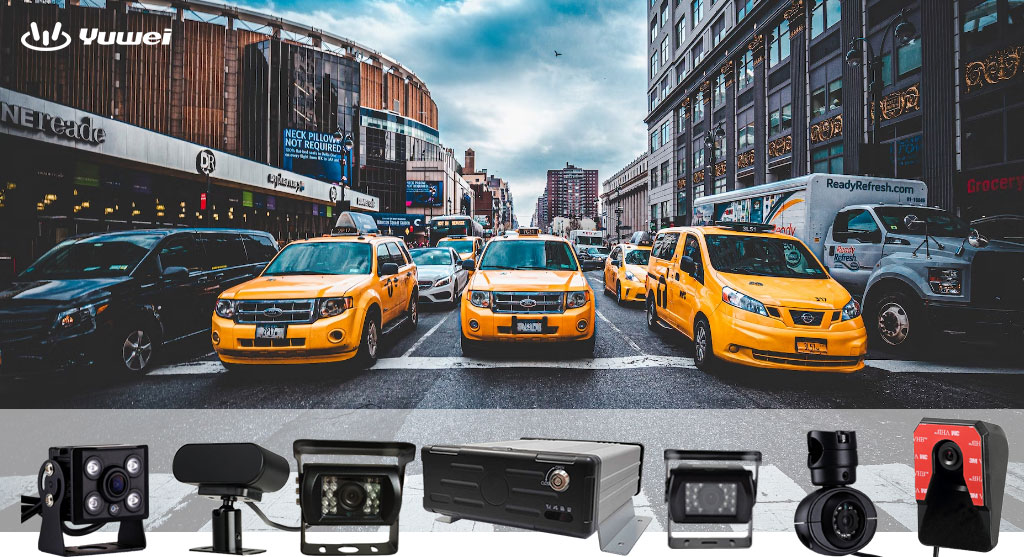
Core Hardware Solutions for Italian Taxi DVR System
1. Fleet Dash Cam – Intelligent Video Recording Terminal
Product Reference Model: Fleet Dash Cam
Core Functions:
• High-definition forward road recording
• GPS trajectory synchronization
• 4G remote live view & playback
• Auto-protected collision event videos
• Cloud-based evidence archiving & management
Application Scenarios:
• Standard Taxi fleets
• NCC chauffeured vehicles
• Small-scale passenger transport fleets
2. MDVR – Central Core of Fleet Video Management
Product Reference Model: Full HD Mobile DVR
Core Functions:
• Multi-channel camera access support
• Centralized unified video management
• Fusion of video, location and vehicle data
• Stable remote wireless transmission
Applicable Clients:
• Taxi operating companies
• Corporate chauffeured transport fleets
• Airport passenger transfer fleets
3. ADAS – Active Driving Safety System
Product Reference Model: ADAS Camera
Core Functions:
• Forward collision early warning
• Lane departure alarm notification
• Real-time pedestrian detection
• Safe following distance reminder
Paired with the speed limiting assist system, it realizes full proactive safety control.
4. DSM – Driver Behavior Monitoring Unit
Product Reference Model: DSM Camera Y9
Detection Metrics:
• Driver fatigue
• Visual distraction
• Mobile phone operation while driving
• High-risk driving maneuvers
Supports the construction of standardized driver safety rating systems.
5. Display Screen – On-Board Intelligent Interactive Terminal
Product Reference Model: Infotainment Screen
Core Functions:
• Real-time multi-channel video display
• Pop-up ADAS hazard alert notifications
• In-cab speeding limit reminders
• Real-time dispatching order information display
Strengthens drivers’ instant risk judgment and response capacity.
How Telematics & Speed Limiting Assist Systems Optimize Italian Fleet Management
1. Mitigate Speeding-Related Risks
The system automatically archives complete speeding records including:
Exact time of violation, geographic location, and total speeding duration
This data delivers tangible business benefits for operators:
Reduced traffic penalty fees, lower traffic accident rates, and decreased commercial insurance liabilities.
2. Improve Passenger Safety & Service Experience
Passengers benefit from standardized upgrades including:
Regulated driving manners, consistent high-quality service, and fully auditable trip records, which collectively boost taxi brand reputation and customer loyalty.
3. Streamline Driver Supervision Workflows
The cloud platform auto-generates comprehensive driver evaluation reports:
Safety driving performance scores, internal risk ranking lists, and targeted safety training recommendations, simplifying management for large driver teams.
4. Lift Overall Operational Efficiency
Data analytics unlock multiple operational optimizations:
Route planning refinement, reduced empty mileage driving, lower fuel consumption, and maximized daily vehicle utilization rate.
Typical Application Scenarios in Italy
1. Urban Taxi Fleets in Rome & Milan
Key Characteristics: High tourist passenger volume, complex mixed urban road conditions
Recommended Hardware Combination: Dash Cam + DSM Camera + ADAS Camera + Mandatory Speed Limiting Assist System
2. NCC High-End Chauffeured Transfer Vehicles
Key Characteristics: Premium client groups, strict high-standard service requirements
Recommended Hardware Combination: MDVR + DSM Camera + On-Board Infotainment Display Screen
3. Airport Long-Distance Transport Fleets
Key Characteristics: Long continuous driving hours, strict safety compliance standards
Recommended Hardware Combination: MDVR + ADAS Camera + Full Telematics Cloud Platform
Intelligent Development Trends for Italy’s Taxi Industry
The Italian taxi sector will advance along three core technological trajectories in the future:
1. AI-Powered Safety Driving Supervision
Traditional Mode: Manual post-hoc driver monitoring
Future Upgrade: Real-time AI risk identification and instant active intervention
2. Video-Supported Insurance Ecosystem
Insurance providers will increasingly integrate multi-dimensional data:
Driving behavior metrics, in-car video evidence, and driver risk scoring models, enabling customized actuarial premium pricing.
3. Intelligent Automatic Speed Governance
New commercial vehicles will widely integrate interconnected safety modules:
Road speed limit visual recognition, instant in-cab speed reminders, and active vehicle speed restriction control to lift national overall road safety standards.
While Italy’s Taxi and NCC passenger transport market remains regulated under a strict licensing framework, surging tourist mobility demand and the rollout of digital industry supervision are pushing fleets across the country to deploy intelligent management upgrades. The national RENT electronic registration system uniformly governs all Taxi and NCC operation permits, laying a foundational digital infrastructure for vehicle compliance oversight.
Going forward, Italian taxi operators will shift focus from simply expanding vehicle quantity to enhancing three core comprehensive capabilities:
Safety Control Capability × Data Management Capability × Intelligent Operation Capability
The integrated technical solution combining DVR Dash Cam, MDVR, ADAS, DSM, Mandatory Speed Limiting Assist System and Telematics Remote Information Platform will become a critical technical tool for Italian taxi fleets to boost road safety, satisfy regulatory compliance requirements, and maximize overall operational efficiency.