










What is a Fleet Tracker?
New Regulations for Commercial Fleet Tracking
Entering 2026, compliance requirements for commercial vehicles regarding "location + driving hours + active safety" have been simultaneously tightened in Europe and the United States. In the US, the FMCSA fully enforces the ELD (Electronic Logging Device) mandate in accordance with 49 CFR Part 395, continually eliminating non-compliant models since 2025. It requires CMV (Commercial Motor Vehicle) vehicles to transmit HOS (Hours of Service) driving records to roadside inspectors via dual channels such as 4G/USB/Bluetooth. Any inconsistency between the GPS trajectory and the logs will directly trigger accountability.
In the EU, the Smart Tachograph V2 will be extended from heavy-duty vehicles over 3.5 tons down to light commercial vans (N1 category) between 2.5 and 3.5 tons engaged in international freight/cabotage, starting from July 1, 2026. Combined with the EC 561/2006 driving and resting time rules, the IVDR bus safety directive, and the ACSF advanced driver assistance certification, it forms a trinity of supervision: "location + working hours + video evidence."
According to ACEA 2025 full-year data, newly registered vehicles in the EU included approximately 1.45 million vans (down 8.8% YoY), 307,000 trucks (down 6.2% YoY), and 38,200 buses & coaches (up 7.5% YoY). If existing vehicle fleets are added, mainline heavy trucks, city buses, logistics light passenger vehicles, cold chain, and special engineering vehicles collectively constitute millions of compliance tracking targets. In the US, the FMCSA estimates that about 3.5 million CMV drivers are subject to ELD regulations, corresponding to fleet carriers mainly consisting of heavy trucks over 26,001 lbs, passenger vehicles with 16 or more seats, and hazardous materials vehicles.
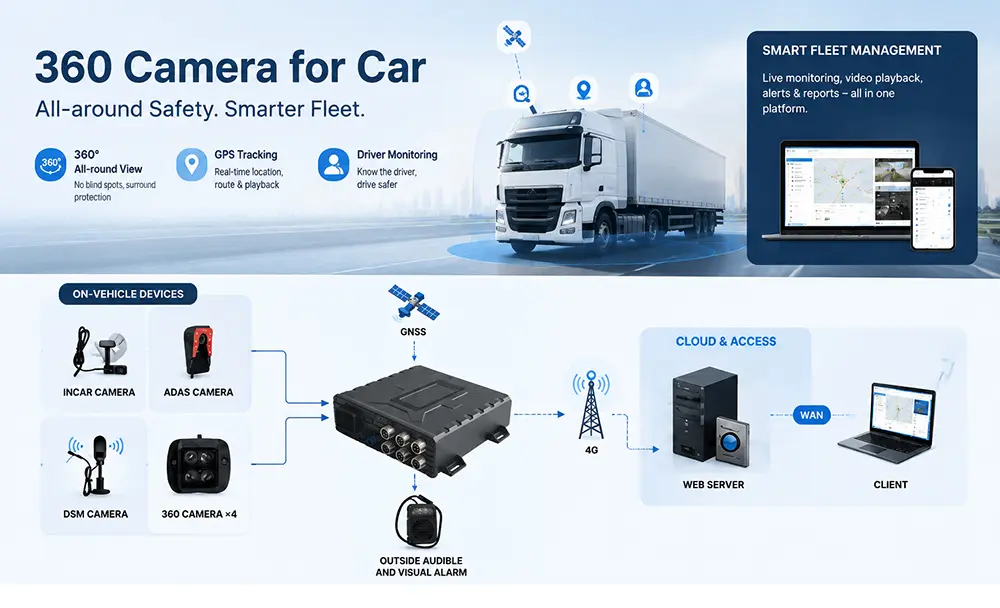
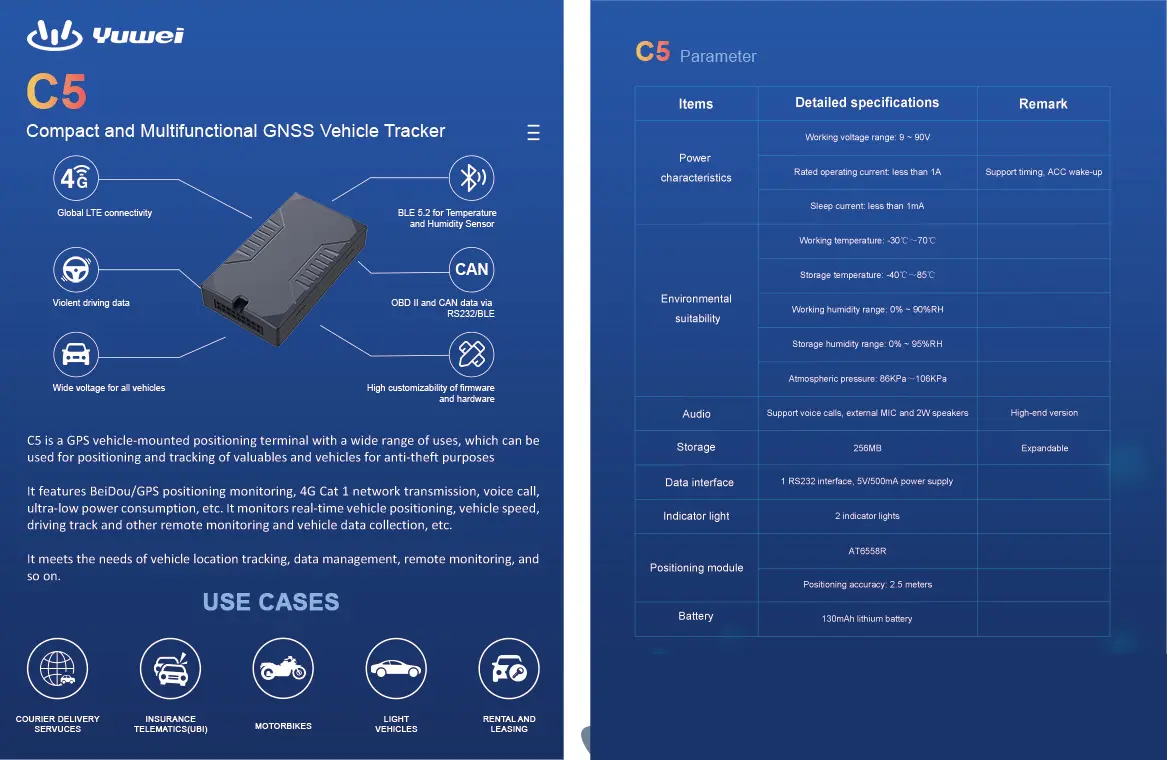
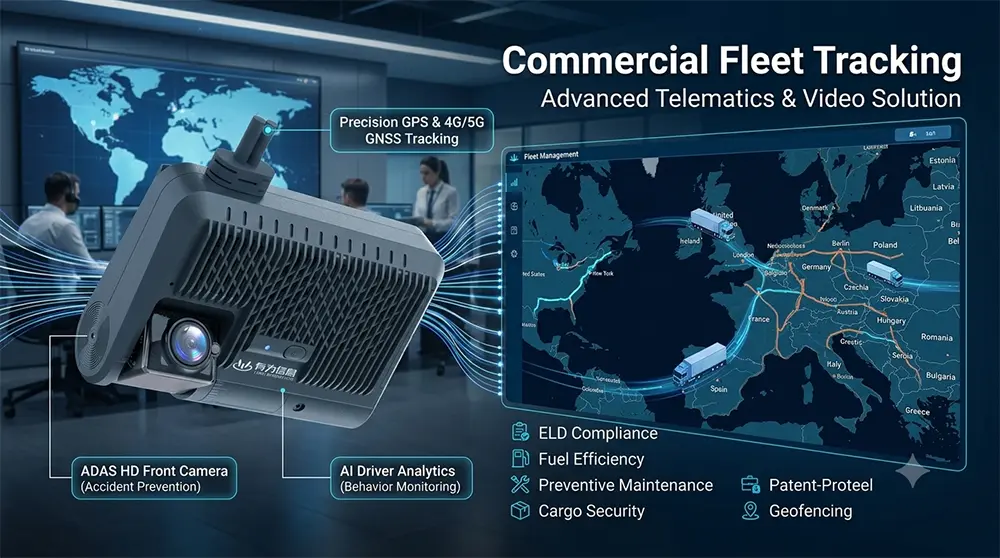
In short: Fleet Tracker = In-Vehicle GPS/BDS Positioning Terminal + Vehicle Bus (OBD/ECM) Data Acquisition + 4G Remote Transmission + Cloud Management Platform. Tracking fleet vehicles means enabling each vehicle to continuously report "where it is, how fast it is driving, who is driving, and whether there are collision risks," making it traceable in roadside inspection, accident, and dispatch scenarios.
Why Commercial Fleets Must Implement Vehicle Tracking
1.Compliance and Penalty Avoidance: Both the US ELD and the EU Smart Tachograph require trajectories and working hours to be auditable. Non-installation or mismatched data equals suspension of operations plus fines.
2.Accident Liability Recreation: Standard GPS can only prove "where the vehicle was," not "how the crash happened." Video footage combined with DSM (Driver Status Monitor) is the hard evidence required for insurance claims.
3.Preventing Fatigue and Distracted Driving: The biggest risks for long-haul heavy trucks, buses, and hazardous materials vehicles are drivers closing their eyes or using their phones. AI cameras can intervene with real-time voice alerts.
4.Reducing Fuel Consumption and Empty Runs: Geofencing, route deviation alerts, and idling alarms directly cut hidden costs.
5.Asset Theft Prevention and Dispatch Transparency: Vans, construction machinery, and cold chain vehicles are prone to theft when parked at night. Real-time positioning combined with fuel and power cut-off outputs is a baseline capability.
YUWEI Commercial Fleet GPS Tracking & Management Solution
1.Platform Layer: YUWEI Fleet Management Platform — Real-time GPS/BDS dual-mode positioning, historical trajectories, geofencing, segmented speed limits, fatigue driving alarms, night-time (2:00–5:00) restricted driving alarms, passenger flow statistics, voice intercom, and cloud storage for evidence retrieval.
2.Tracking Logic: In-vehicle MDVR records upon power-on → Cameras and GPS modules collect data in parallel → 4G uploads location/video/alarm events → The backend generates KPIs based on the vehicle/time period/driver → One-click export of RODS (Record of Duty Status) comparison packages during roadside inspections or insurance claims.
3.Proven Deployment: This solution has been deployed in over 30 countries globally, covering over 100,000 taxis, and validated by single domestic provincial bus projects with scales ranging from 6,000 to 15,000+ units.
Hardware Configuration List
Category | Device | Core Parameters / Functions |
Positioning & Main Control | Mobile DVR (MDVR) | 6-channel AHD video input, GPS/BDS, 4G, H.265, dual storage (2TB HDD + 2×512GB SD), 9–32V wide voltage, IP54, UPR (Uninterruptible Power Recording). |
Forward Active Safety | ADAS Camera A1080PS-Y | 1080P CMOS, LDW/FCW/HMW/PCW/TSR, 0.1Lux, 6mm F2.3, 52° Horizontal FOV. |
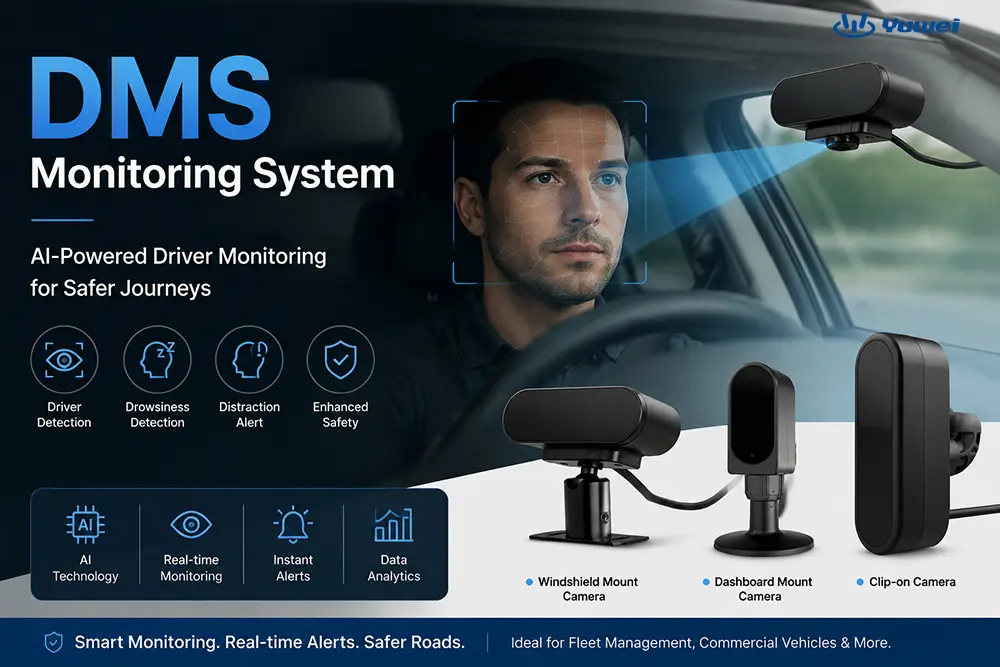
Driver Status Monitoring | DSM Camera Y9A | 720P AHD, fatigue/smoking/phone calling/distraction detection, IR 2m, 72° H-FOV, BMW connector to aviation connector. |
In-Cabin/Facial Backup | HOD HD Driver Camera | 720P, 115° wide-angle, 850nm IR, built-in microphone, 9–16V, mounted on A-pillar/roof. |
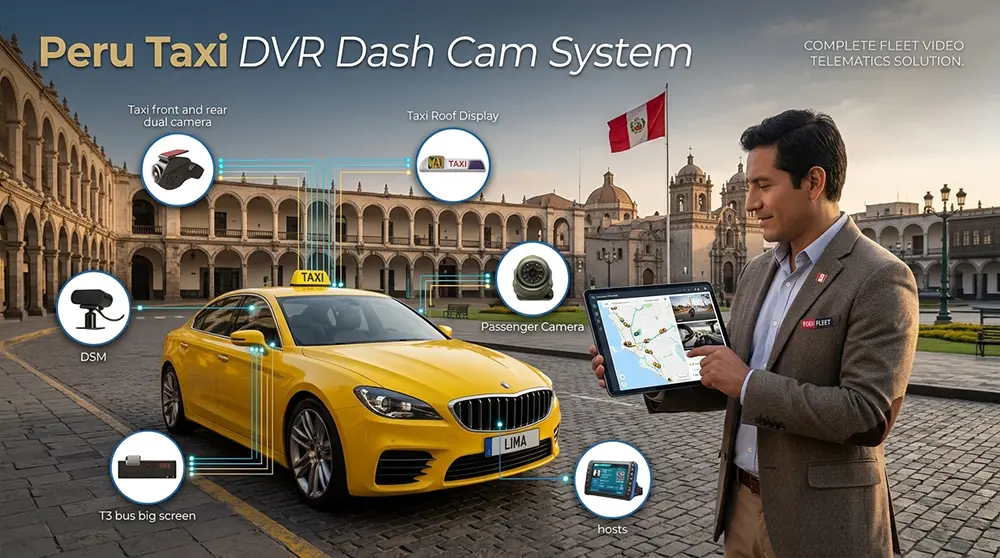
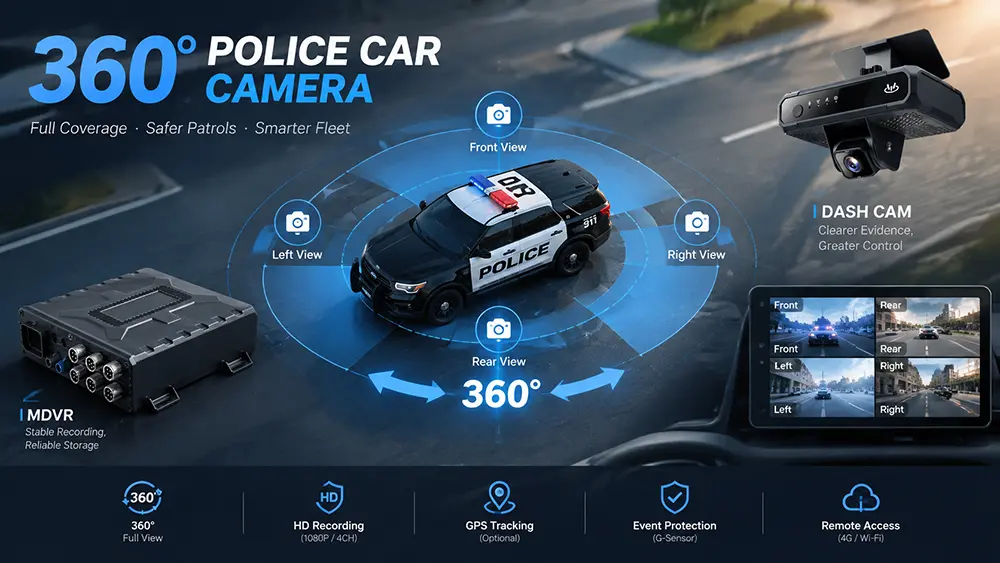
Dash Cam Recording | Fleet Dash Cam | Front and rear dual recording, event-triggered upload, shares cloud platform with MDVR. |
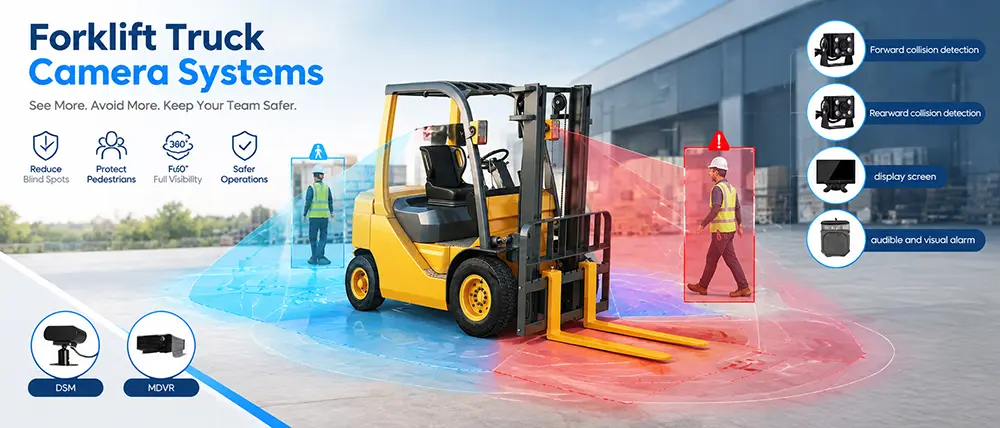
Blind Spot & Reversing | BSD Camera + Waterproof Backup Camera | Right blind spot pedestrian detection, IP-rated waterproof rearview, connects to MDVR to trigger steering/reversing alarms. |
Human-Machine Interface | 10.1" Infotainment Screen M3 | Android, CAN 500K, 4-channel SD video input, reversing switch <3s, Bluetooth/Wi-Fi screen mirroring, 18–32V. |
Wiring Key Points: The MDVR's M12-4 video port provides a unified 12V power supply to the cameras (single channel ≤0.5A). GPS uses Fakra-C Blue, and 4G uses Fakra-D. ACC, reversing, left/right turn, door edge, and brakes are connected to 8-channel I/O to achieve "auto-recording upon ignition, delayed power-off upon engine shutdown."
What Benefits Does GPS Tracking Bring to Fleets?
1.Compliance Alignment: Dual backup of GPS trajectory and HOS/Tachograph data, handling FMCSA roadside inspections and the EU 2026 new van regulations without pressure.
2.Lower Accident Rates: ADAS forward collision/lane departure warnings + DSM fatigue voice alerts. YUWEI case studies show that post-deployment accident rates can drop by about 40%, and insurance premiums decrease by approximately 25%.
3.Video as Evidence: 2–3 seconds of supercapacitor continued recording prior to a collision, highly efficient H.265 encoding, and cloud + local dual backup shorten the insurance claim cycle.
4.Transparent Operating Costs: Segmented speed limits, idling statistics, abnormal fuel consumption, and empty driving mileage are fully quantified, potentially cutting fraudulent reimbursements by 60%.
5.Strong Scalability: The MDVR reserves RS232/RS485/IPC interfaces, meaning no rewiring is needed for subsequent connections to passenger flow counters, temperature controls, fuel tank level sensors, or T-Boxes.
Email:hello@yuweitek.com