











Best Automatic Passenger Counters
Automatic Passenger Counters
In 2026, as urban public transportation moves towards intelligence, the Automatic Passenger Counting (APC) system is upgrading from "manual counting" to a real-time data hub powered by "AI Vision + Multi-Sensor Fusion."
What is an Automatic Passenger Counters?
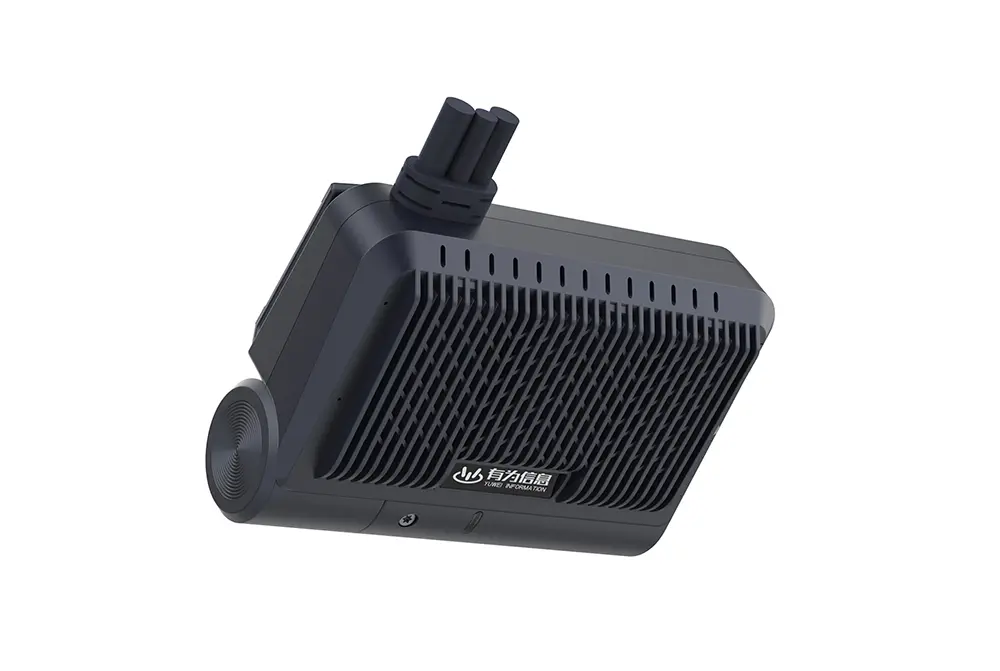
An Automatic Passenger Counter (APC) is a smart device installed at the doors of public transportation vehicles, such as buses, trains, and trams. It is used to automatically record passenger boarding and alighting behaviors, and to calculate the real-time passenger load inside the vehicle. Compared to traditional manual counting or ticket/card swiping statistics, APCs use sensors or cameras to automatically identify and analyze passenger entry and exit movements. The counting data is uploaded to a cloud platform in real time, providing a reliable basis for dispatching and route optimization.
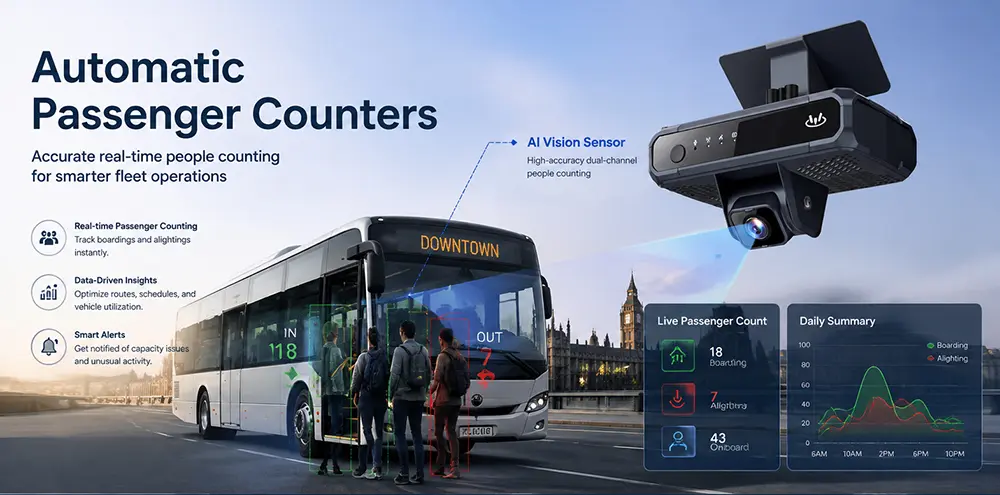
Data uploading relies on in-vehicle communication hardware: 4G/5G cellular networks, GPS/GNSS positioning modules, in-vehicle routers, and edge computing devices, alongside Wi-Fi local area networks, forming a "Collection-Transmission-Analysis" link (YUWEI). Edge computing nodes can store videos and data locally to prevent data loss caused by network interruptions.
The Value APC Brings to Operations
Improving Operational Efficiency
Real-time visibility of the passenger load inside the vehicle allows operators to optimize bus routes and service frequencies accordingly, thereby reducing traffic congestion and resource waste (YUWEI).
Supporting Smart Dispatching
Based on passenger flow data analysis, operators can achieve: dynamic adjustment of departure intervals, optimization of route planning, and enhanced capacity allocation during peak hours.
Enhancing the Passenger Experience
Alleviating overcrowding in carriages and providing passengers with real-time passenger flow information improves overall travel comfort and safety (YUWEI).
Data-Driven Decision Making
The system can generate outputs such as passenger flow heat maps, historical passenger flow trend analysis, and boarding/alighting station statistics, which serve urban transportation planning and policy-making.
2026 Selection Recommendations
1.Prioritize Accuracy: Clarify the accuracy metrics required in uncontrolled public transit environments.
2.Match Vehicles and Scenarios: Confirm whether the proposed solution covers your target vehicle types—buses, light rail/trains, ferries, cable cars, subways/platform screen doors, etc.
3.System Integration: Prioritize solutions that support HTTP API / cloud uploads / third-party dashboard integration, and are compatible with existing video surveillance cameras to lower retrofitting costs.
4.Privacy Compliance: In the EU or other privacy-sensitive scenarios, prioritize solutions featuring localized processing, anonymization, and non-visible light (depth/grayscale) technology.
5.Expansion and Ecosystem: Consider whether the system needs to be linked with dispatching systems, passenger information screens, in-vehicle MDVRs/edge computing, and real-time occupancy Apps.
Conclusion
In 2026, the APC has evolved from a single counting device into a smart integrated system featuring "AI Vision + IoT + Wireless Sensing + Edge Computing." For bus companies and smart transportation integrators, deploying high-precision binocular vision / AI video analysis APCs—combined with a cloud platform for data-driven operations—is one of the most cost-effective paths to realizing the digital management of public transportation.
Email:hello@yuweitek.com