










Hazardous Goods Transport Vehicles 4-Channel MDVR
Hazardous Goods Transport Vehicles DVR
Indonesia’s hazardous goods transportation covers various cargo types including refined oil products, liquefied petroleum gas, chemical raw materials and hazardous waste. According to the latest verifiable national aggregated data released by Indonesia’s Central Statistics Agency, approximately 6,277,403 registered trucks were operating nationwide in 2024. The current regulatory framework mainly governs road freight transportation administration, qualification requirements for hazardous goods transport practitioners, intelligent traffic management, as well as electronic waybills for hazardous waste and transport trajectory tracking. Regulatory priorities are gradually shifting to full-process management covering personnel, vehicles, routes, cargo and records. It should be noted that Indonesian regulations do not yet impose a uniform mandatory requirement for all hazardous goods transport vehicles to install 4-Channel MDVR systems. Nevertheless, such systems can significantly boost enterprises’ safety management capabilities and facilitate accident traceability.
Reasons for Installing 4-Channel On-Board Video Recorders on Hazardous Goods Transport Vehicles
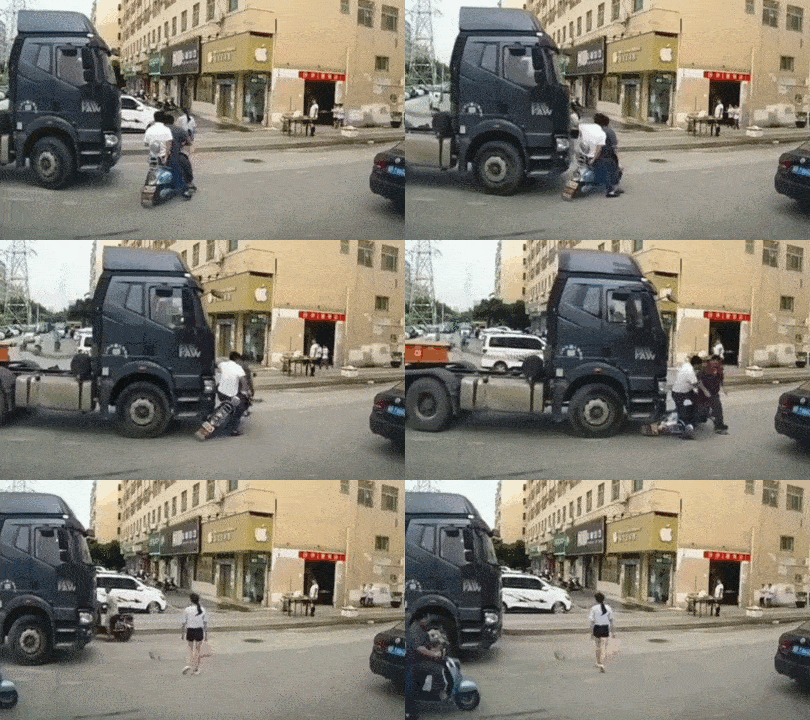
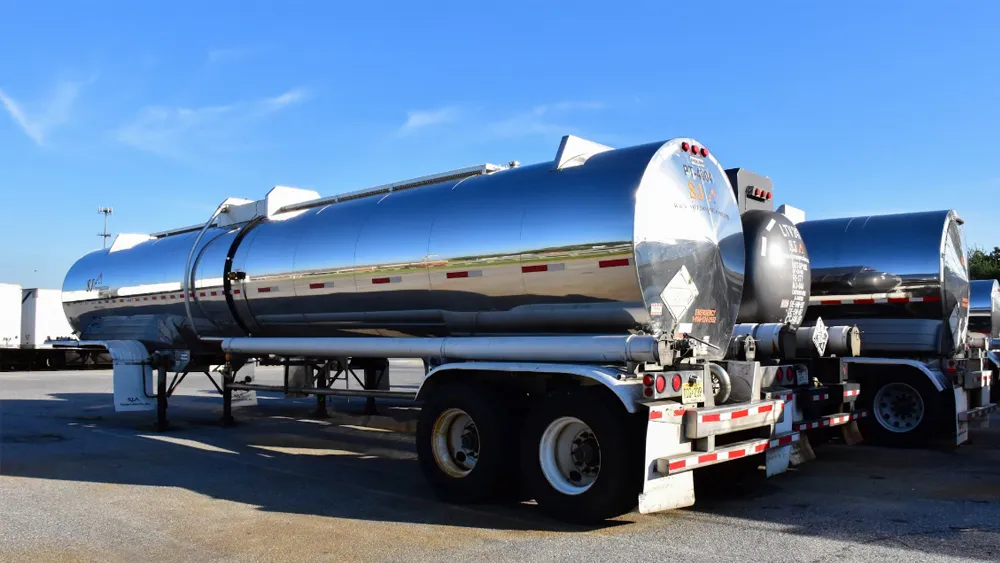
Hazardous goods transport vehicles feature long bodies and large turning radii, making it impossible for drivers to fully observe the close front area, vehicle sides and rear via rearview mirrors. When entering industrial parks, oil depots, ports, gas stations or densely populated areas, pedestrians, motorcycles and small vehicles can easily enter blind zones. Even minor collisions may trigger secondary incidents such as cargo leakage, combustion or explosions.
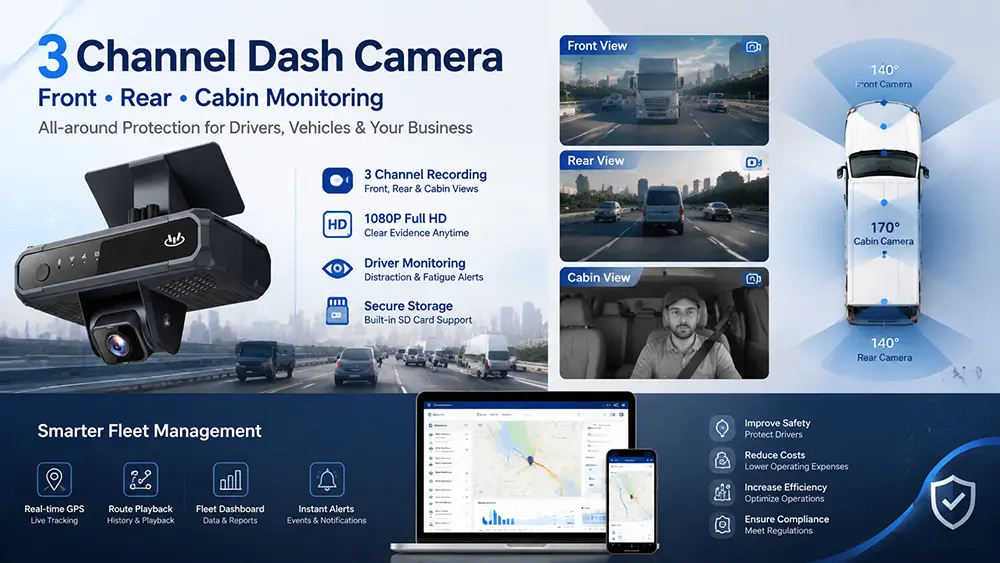
In addition, hazardous goods transport is typically characterized by long travel routes, extended continuous driving hours and a high proportion of night-time operations. Manual spot checks struggle to promptly detect risky driving behaviours including fatigue driving, smoking, phone use, distracted driving, insufficient following distance and lane departure. A 4-Channel MDVR system simultaneously captures footage of the road ahead, the driver, vehicle side areas and the rear compartment, and uploads alarm events to the management platform. This transforms fleet management from post-incident investigation to pre-emptive early warning and in-transit intervention. YUWEI’s tank truck solution identifies blind zone control, driving behaviour supervision, real-time positioning and remote dispatching as core management demands for hazardous goods fleets.
4-Channel MDVR Solution for Indonesian Hazardous Goods Transport Vehicles
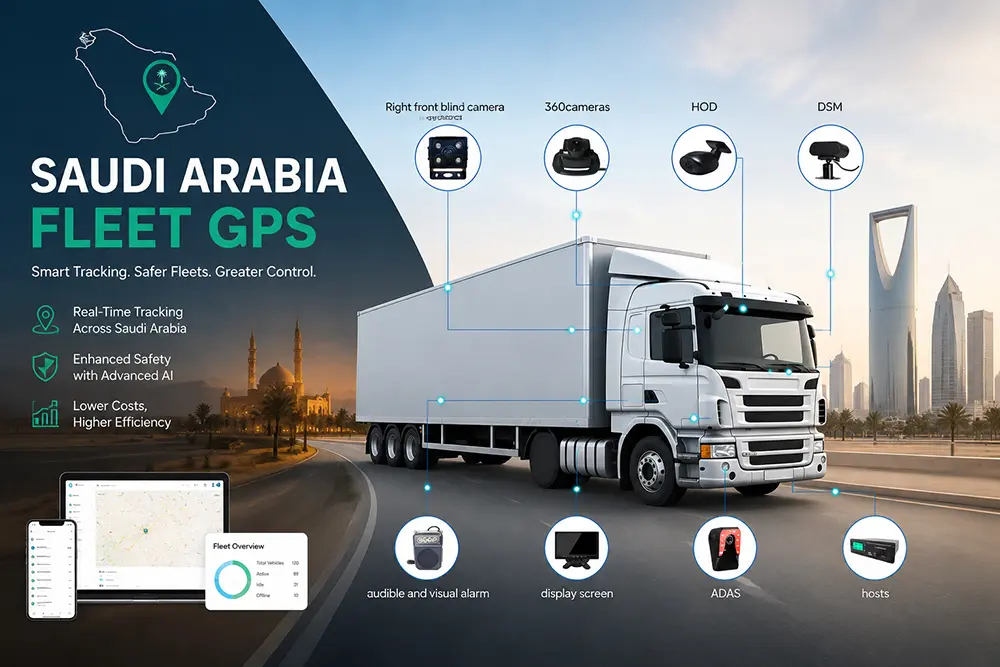
The complete solution centres on the YUWEI Mobile DVR F4, interconnecting 4 cameras, GPS positioning, 4G communication, an in-cab display, audible and visual alarms, and a fleet management platform.
Channel 1: Front Road ADAS Camera
Mounted on the inner side of the windshield, this camera continuously records road conditions ahead of the vehicle. It supports lane departure warning, forward collision warning, safe following distance alert, pedestrian collision warning and traffic sign recognition. When potential hazards are detected, the system instantly sends voice reminders to the driver while saving corresponding video footage.
Channel 2: Driver Monitoring DMS Camera
Facing the driver, the DMS camera identifies abnormal states such as eye closure, yawning, smoking, phone calls and distracted driving. The system triggers in-cab reminders and uploads event records, timestamps, vehicle coordinates and video clips to the platform, enabling managers to conduct driver safety scoring and targeted safety training.
Channel 3: Side Blind Zone BSD Camera
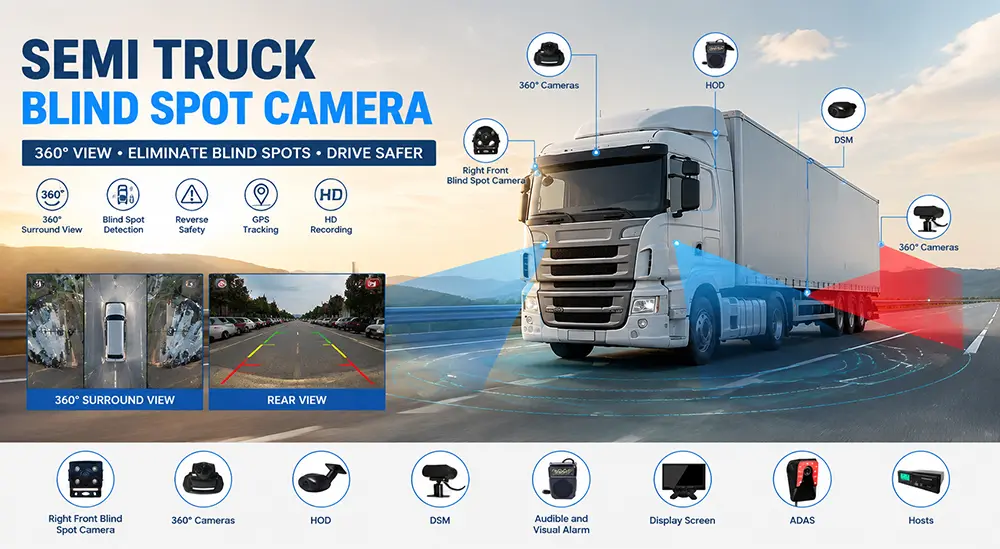
The side BSD camera monitors areas out of the driver’s rearview mirror coverage. When pedestrians, motorcycles or other vehicles enter dangerous blind zones, the system activates both in-cab voice prompts and external audible-visual alarms to alert the driver and surrounding road users. The camera’s mounting position (left or right side of the vehicle) is determined based on cab structure, turning blind zones and local actual road conditions.
Channel 4: Rear Waterproof Reversing Camera
Installed at the tail of the tank or cargo compartment, the rear camera monitors reversing zones, loading/unloading sites and rear vehicle conditions. When reversing is engaged, the display automatically switches to the rear camera feed, helping drivers avoid collisions with staff, equipment, loading pipelines and fixed obstacles.
The F4 device supports a maximum of 6 AHD or CVBS analogue video inputs. Beyond the standard 4-channel configuration, customers can add extra cameras for front lower blind zones, left-side blind zones or loading/unloading areas to build a 5-channel or 6-channel extended solution.
GPS Positioning & Remote Fleet Management Solution
Integrated with 4G cellular communication, Wi-Fi, dual-mode GPS and Beidou positioning, the F4 synchronously records vehicle location, speed, heading and video footage. Management teams can view real-time vehicle positions, historical travel trajectories and live video feeds via desktop computers or mobile terminals, enabling unified oversight of all fleets on a single digital map.
The platform supports custom configuration of designated transport routes, electronic geofences, speed-limited zones, no-entry restricted areas and maximum dwell time thresholds. The system automatically generates alerts for rule violations including route deviation, entry into high-risk zones, prolonged stationary periods, speeding and positioning equipment malfunctions. For hazardous waste transportation, trajectory data serves as critical supplementary documentation to support corporate electronic waybill records and full transport process archiving.
After hard braking, collisions, fatigue driving or blind zone alarms are triggered, the platform retrieves video footage captured before and after each incident, paired with vehicle location, speed and heading data for comprehensive incident analysis. Compared with standalone GPS trackers or basic dashcams, synchronized video and positioning data reconstruct accident sequences more thoroughly, mitigating liability disputes between drivers, carriers, cargo owners and third parties.
Hardware Configurations, Application Scenarios & Core Functionalities
1. YUWEI Mobile DVR F4
Hardware Configuration: On-board video recording main unit, 4G communication module, GPS/BDS dual positioning module, hard disk or SD card storage
Core Functions: Multi-channel video recording, real-time positioning, remote live video streaming, historical footage playback, trajectory query, electronic geofence alerts, speeding alarms, route deviation alarms, overstay alarms, equipment fault alerts, and power-off video recording protection. The F4 supports H.265/H.264 video encoding, dual storage via hard disk and SD card, and features vehicle battery undervoltage protection.
2. ADAS Front View Camera
Application Scenarios: Highways, intercity roads, mountainous routes and night-time transportation
Core Functions: Lane departure alert, forward collision warning, insufficient following distance alert, pedestrian collision warning and traffic sign recognition alert
3. DMS Driver Monitoring Camera
Application Scenarios: Long-distance haulage, night shift transport and continuous driving supervision
Core Functions: Detection of fatigue, smoking, phone calls and distracted driving; automatic voice prompt activation and alarm log uploads upon abnormal behaviour detection
4. Side BSD & Front Lower Blind Zone Cameras
Application Scenarios: Industrial parks, oil depots, ports, urban roadways, narrow intersections and vehicle turning manoeuvres
Core Functions: Surveillance of side and front lower blind zones, pedestrian and vehicle identification, synchronized in-cab voice reminders and external audible-visual alarm linkage
5. Waterproof Reversing Camera
Application Scenarios: Oil depot reversing, loading/unloading platforms, warehouses, parking lots and night shift operations
Core Functions: Real-time rear-view display to prevent reversing collisions; permanent recording of loading/unloading areas and vehicle tail conditions
6. On-Board Multimedia Display Screen
Application Scenarios: Real-time multi-camera feed viewing inside the driver’s cab
Core Functions: 4-channel video input support, touchscreen operation, built-in navigation, Wi-Fi and Bluetooth connectivity; automatic feed switching triggered by turn signals, reverse gear signals or system alarm events
7. Audible & Visual Alarm
Application Scenarios: Vehicle turning, reversing, pedestrian blind zone intrusion and detected collision risks
Core Functions: Simultaneous audio and light alerts for drivers and surrounding personnel, compensating for the limited coverage of in-cab voice prompts alone
Recommended YUWEI Hazardous Goods Transport Vehicle Management System
For Indonesian hazardous goods transport enterprises, standalone GPS trackers only track vehicle locations, while ordinary dashcams merely provide limited post-incident video evidence. Powered by the F4 on-board video terminal, the integrated YUWEI solution unifies ADAS, DMS, side BSD, reversing cameras, in-cab displays, audible-visual alarms and the GPS positioning platform. It delivers all-round coverage of driving risk prevention, blind zone monitoring, transport route supervision and credible accident evidence collection.
Email:hello@yuweitek.com