











How much 360 Camera for Car
Introduction
In commercial vehicle fleet scenarios such as logistics transportation, public transit, and mining engineering, reversing, turning, and passing on narrow roads are the top three situations with a high incidence of accidents. With long vehicle bodies and large blind spots, even a slight moment of inattention from the driver can lead to scrapes, collisions, or even casualties. In recent years, in-vehicle 360-degree surround view camera systems have become standard equipment for an increasing number of commercial fleets to enhance safety and operational efficiency, thanks to their intuitive "panoramic, zero-blind-spot" effect. So, how much does a set of in-vehicle 360-degree surround view cameras actually cost? This article will explain everything at once, covering what the product is, its functions, the problems it solves, the fleets it suits, and finally, the cost structure and recommended solutions.
What is an In-Vehicle 360-Degree Surround View Camera System?
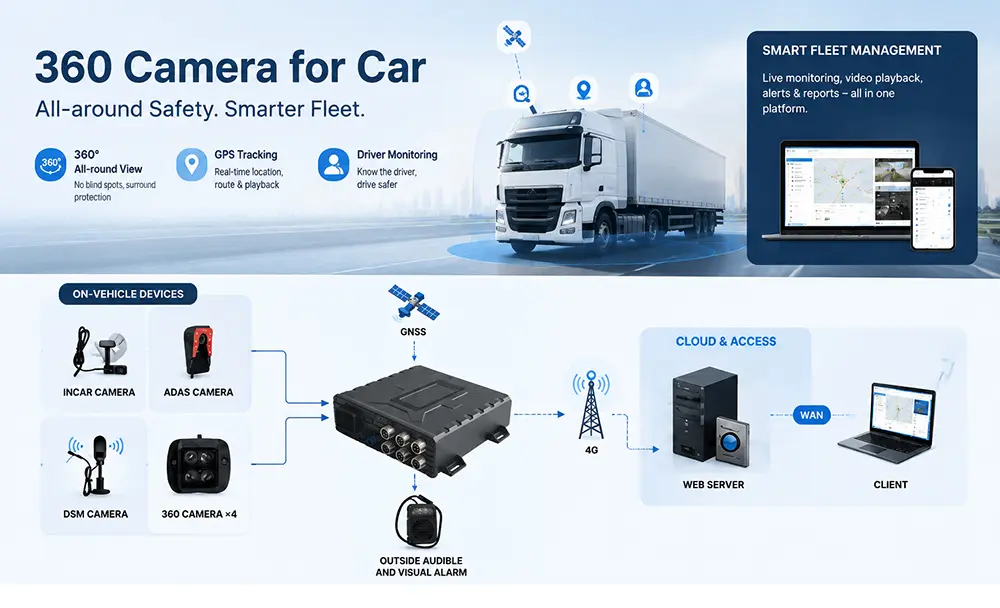
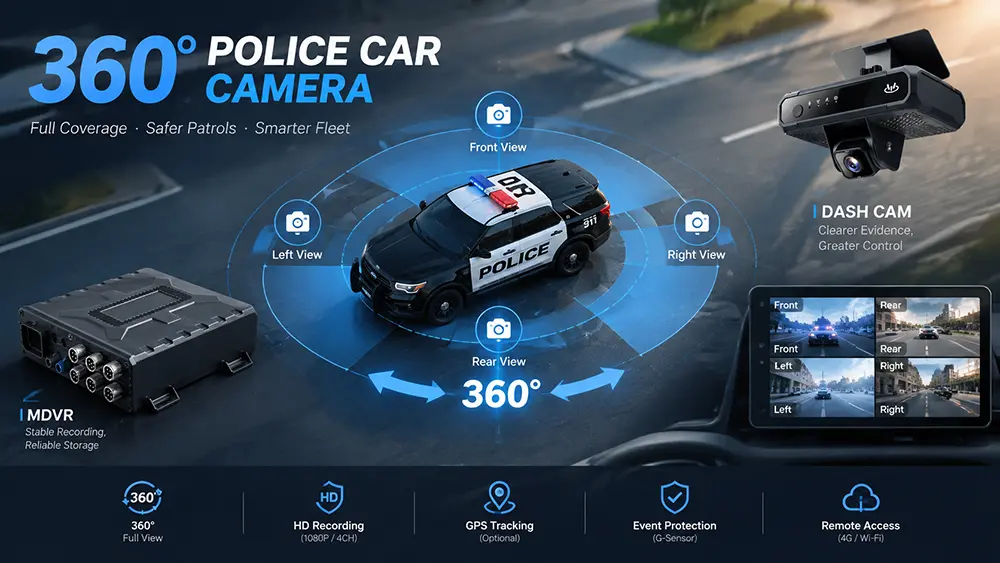
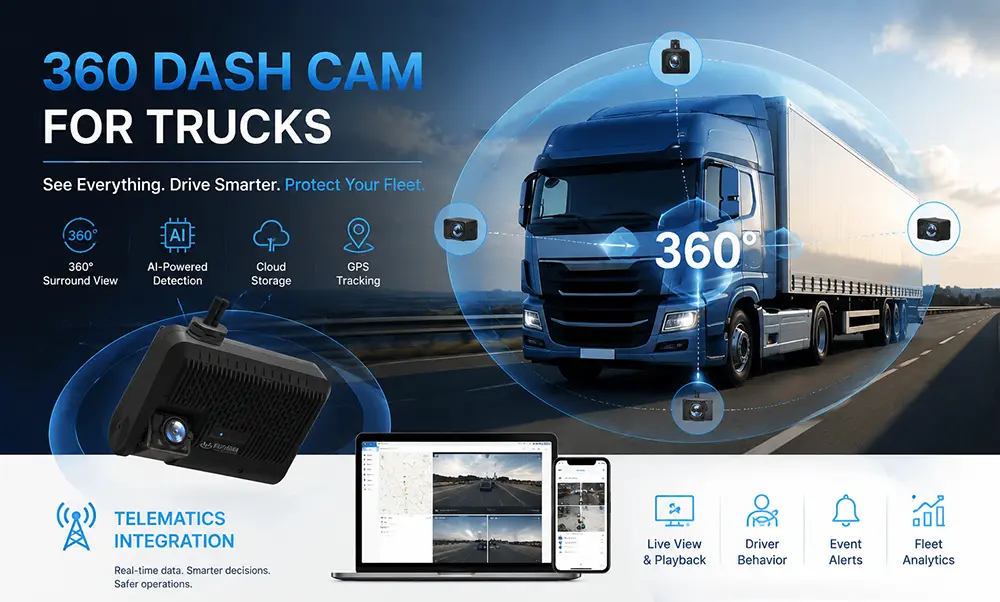
An in-vehicle 360-degree surround view camera (360° Surround View System, also known as AVM) is a wide-angle camera system installed at multiple positions—front, rear, left, and right—around the vehicle. By arranging several wide-angle/fisheye cameras around the vehicle body, it captures multi-channel footage in real time and transmits it to the core processing host inside the vehicle. Through software stitching algorithms, it synthesizes a complete 360° image of the vehicle's surroundings, which is ultimately displayed on the cabin monitor as a 2D bird's-eye view or a 3D stereoscopic panoramic image.
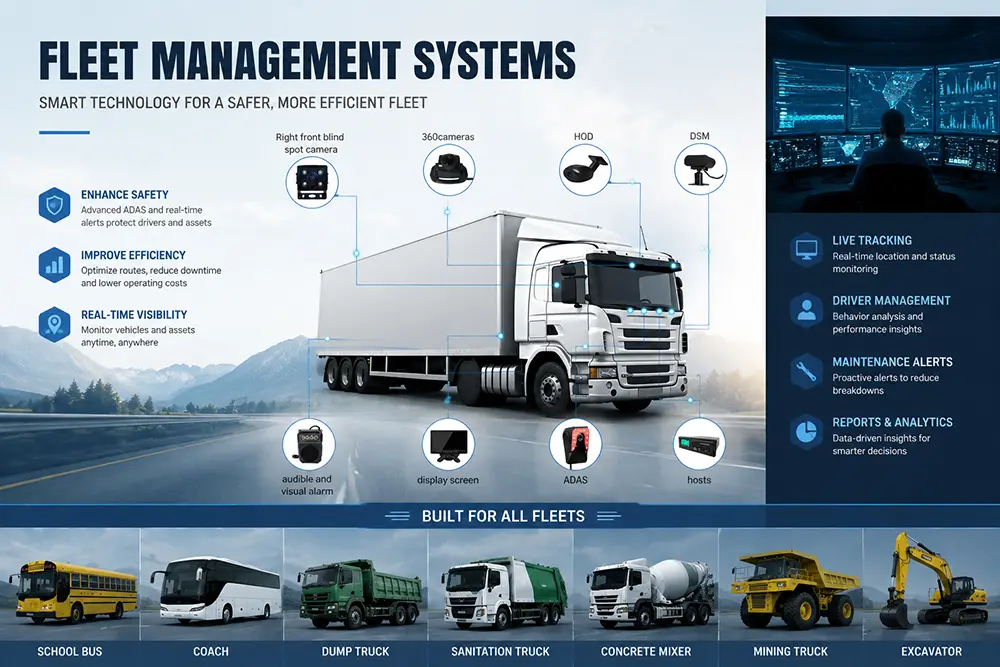
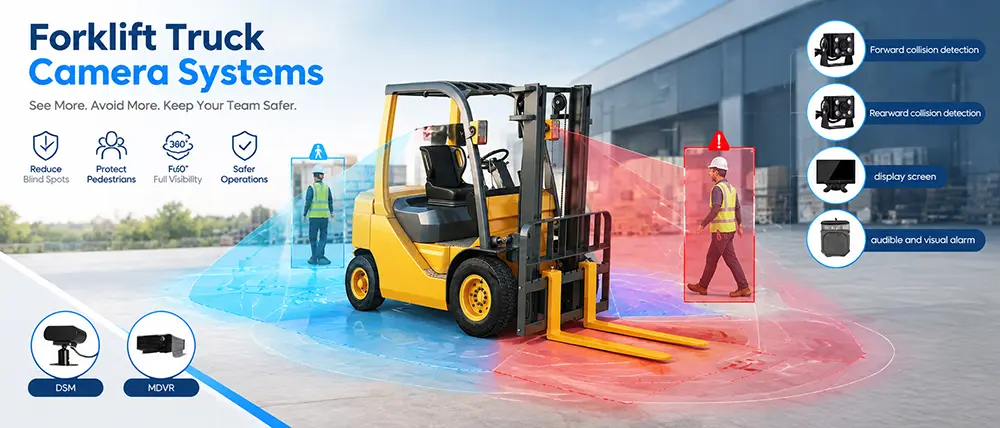
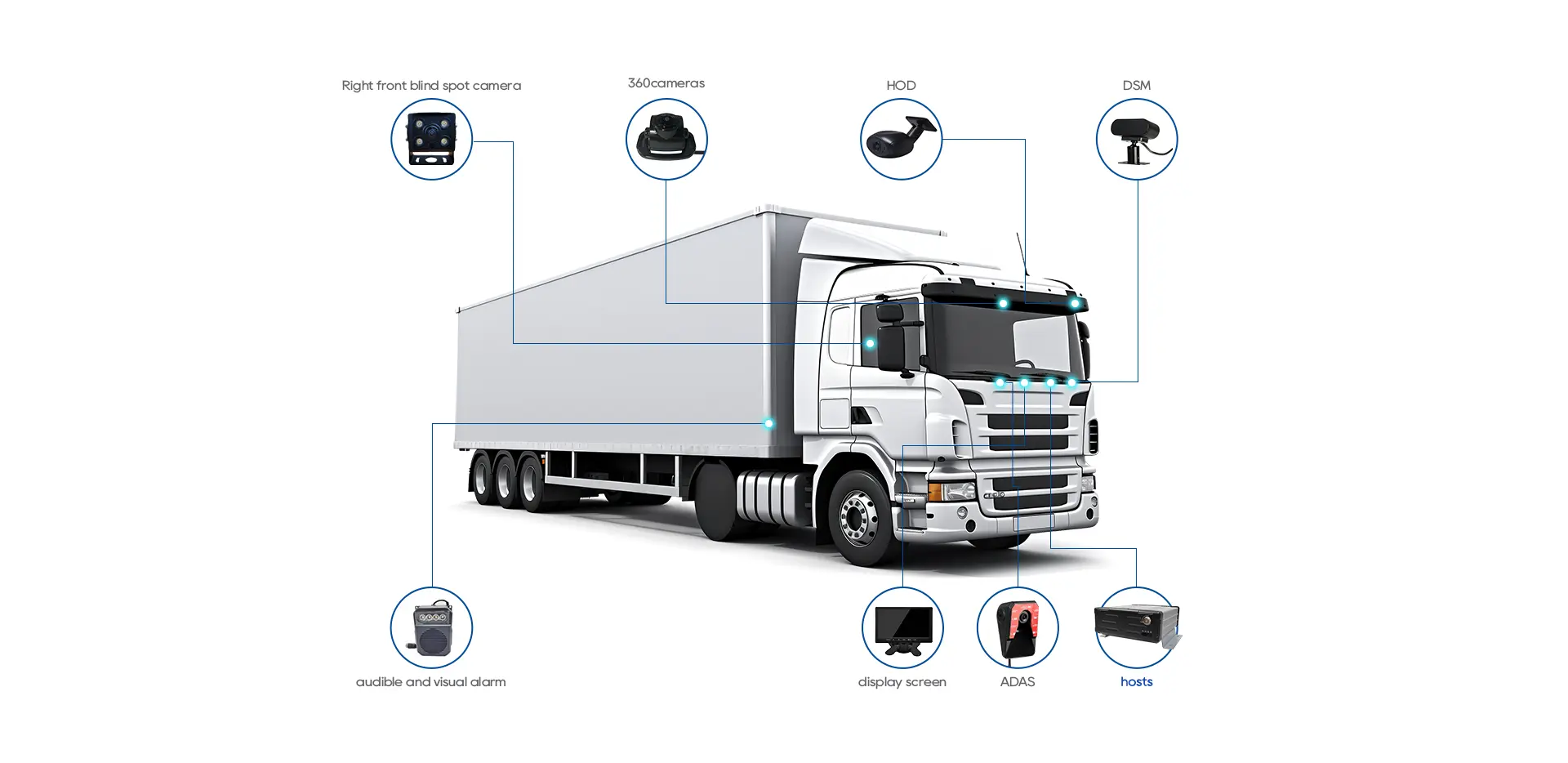
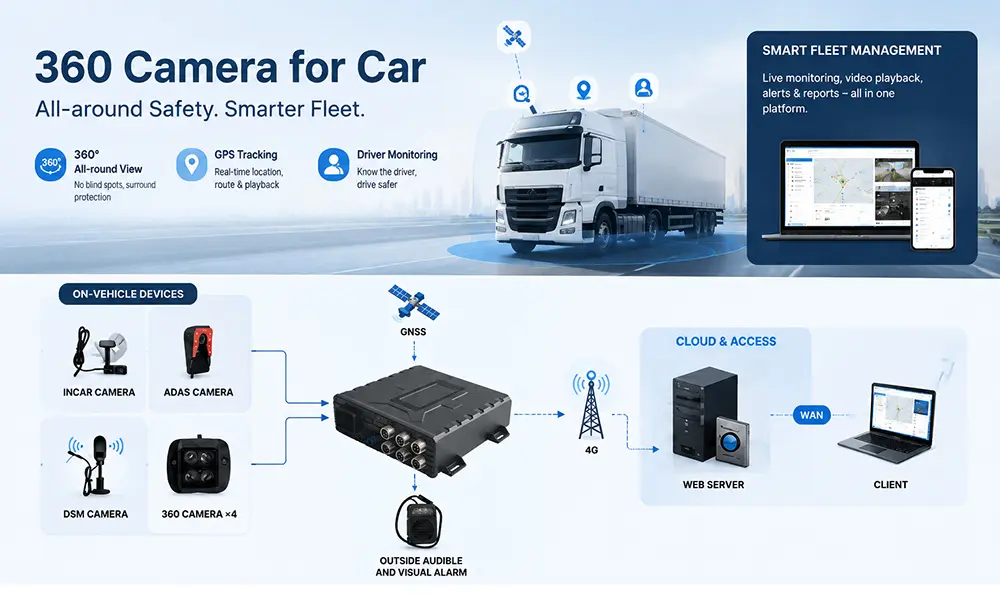
A complete system typically consists of three parts: First, the multiple surround-view cameras around the vehicle body (front, rear, left, right, commonly 4 cameras); Second, the core processing host, which in commercial vehicle solutions is usually integrated with a Mobile Digital Video Recorder (MDVR), responsible for image stitching, algorithmic processing, and video storage; Third, the display screen in the cabin for real-time presentation of the panoramic view. Some solutions are also paired with audible and visual alarms, ADAS/DSM cameras, etc., forming a more comprehensive intelligent advanced driver assistance system.
What are the Functions of a 360-Degree Surround View Camera System?
1.2D/3D Surround View: Outputs a clear 2D bird's-eye view or high-quality 3D panoramic image, effectively eliminating the vehicle's visual blind spots.
2.Blind Spot Detection (BSD): Identifies vulnerable road users such as pedestrians and non-motorized vehicles, providing collision warnings with an accuracy rate of over 90%.
3.Advanced Driver Assistance Systems (ADAS): Provides functions like forward collision warning, headway monitoring, and lane departure warning to help drivers maintain safe driving.
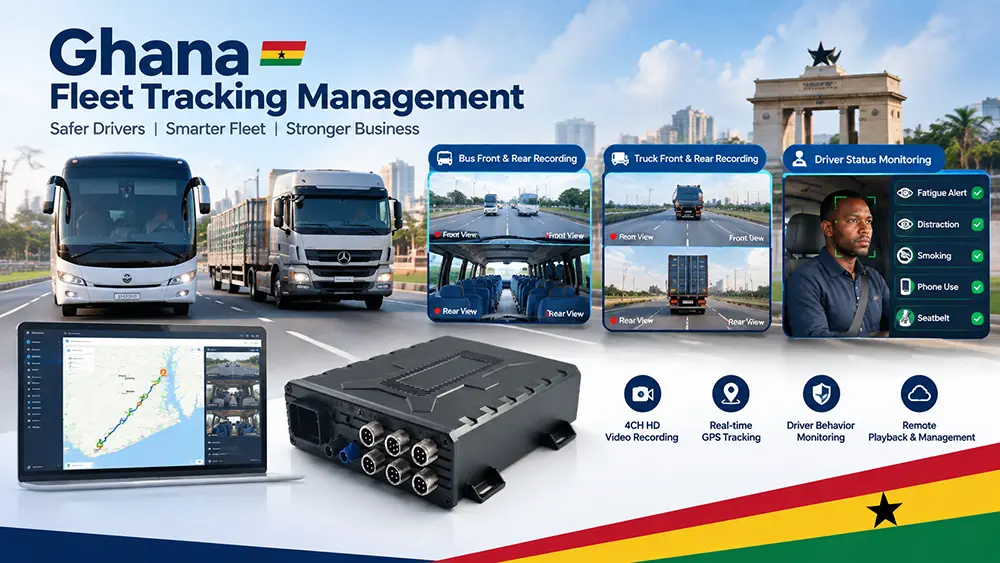
4.Driver Status Monitoring (DSM): Monitors dangerous behaviors such as fatigue driving, distraction, phone usage, and smoking, with an accuracy rate exceeding 95%.
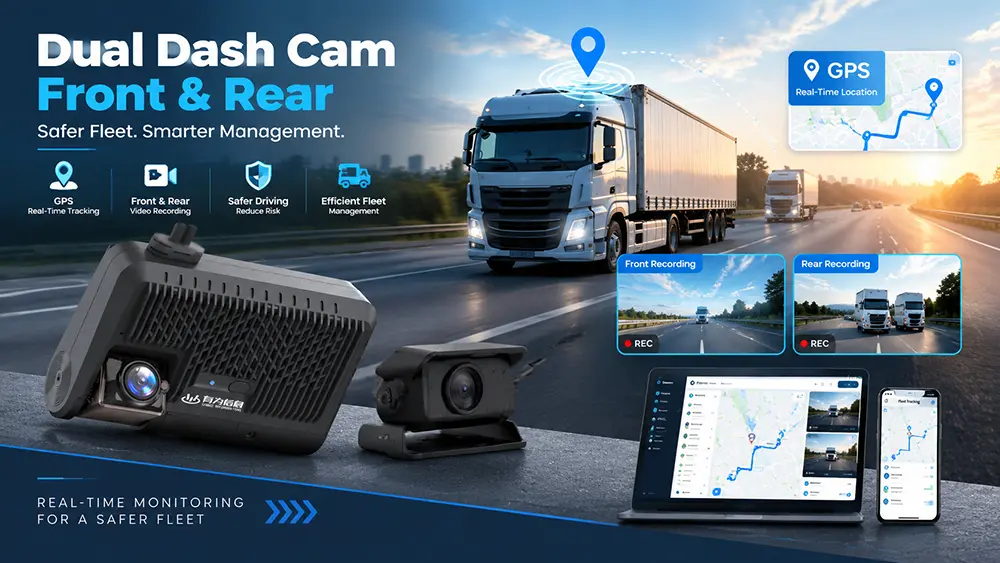
5.Real-Time Monitoring and Video Recording: Allows real-time viewing of vehicle location, speed, and status on an electronic map. Live camera feeds and historical recordings can be retrieved for accident evidence and driving behavior review.
6.AI Intelligent Alarm: Provides real-time warnings for high-risk behaviors such as speeding, harsh braking, and route deviation, helping fleet managers intervene promptly.
7.Trajectory Playback and Route Planning: Queries historical driving trajectories for investigation and evidence collection, and can also convert verified trajectories directly into standard routes.
8.Driving Behavior Analysis: Generates driver scorecards, behavior rankings, and customized reports on speeding, harsh braking, and idling.
9.Remote Maintenance and FOTA: Supports remote batch software upgrades and remote troubleshooting, eliminating the need to return vehicles to the factory.
10.Fuel Consumption Monitoring: Monitors fuel levels in real time, assisting with fuel consumption analysis and anti-theft measures.
What are the Benefits and What Problems Does it Solve?
For commercial fleets, the value of installing a 360-degree surround view camera system is mainly reflected in three aspects:
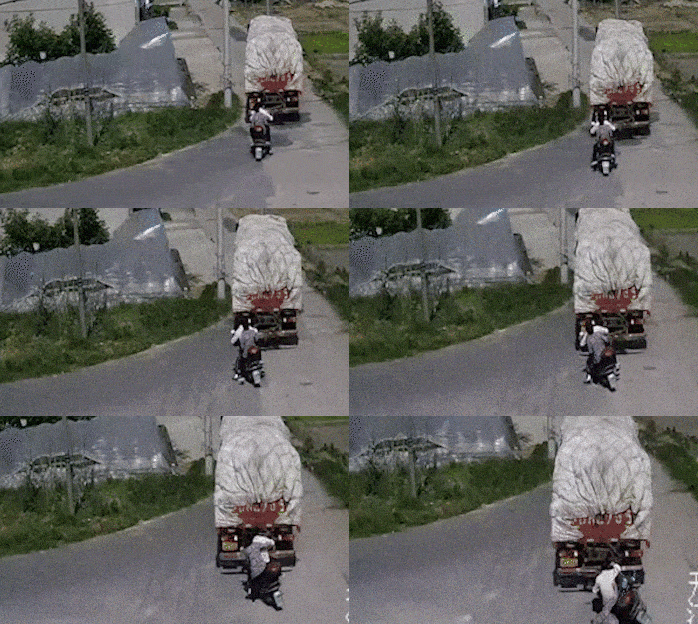
1.Directly targets visual blind spots, the "culprit" of accidents. Long vehicles like semi-tractor trailers and mining trucks have severe visual blind spots on their left, right, and rear. When reversing or turning, they are extremely prone to fatal accidents such as crushing or scraping. The 360 surround view system pieces together a blind-spot-free image using cameras around the vehicle, allowing drivers to see the surrounding conditions at a glance, thereby reducing the accident rate from the source.
2.Solves the difficulty of judging safe distances in complex road conditions. In complex environments such as winding mountain roads, mining areas, and construction sites, it is difficult for drivers to accurately judge the safe distance between the vehicle body and obstacles or slopes with the naked eye. Panoramic images, combined with radar and warning algorithms, can provide timely prompts when danger approaches, avoiding potential risks.
3.Upgrades from "passive recording" to "active prevention + data management." The system not only records video for evidence but also monitors and intervenes in high-risk behaviors like fatigue and distracted driving in real time. Meanwhile, through driving behavior analysis, trajectory playback, and fuel consumption monitoring, it helps fleets achieve refined management, reducing accident, fuel, and insurance costs, and improving overall operational efficiency.
Which Commercial Fleets is it Suitable For?
Any commercial fleet that frequently needs to reverse, turn, or pass through narrow roads, or has high requirements for driving safety and fleet management, is suitable for deploying a 360-degree surround view camera system. This primarily includes:
1.Logistics and Transportation Fleets: Long vehicles such as semi-trailers, tractor-trailers, and box trucks, solving turning and reversing blind spots.
2.Passenger Transport and Bus Companies: Ensuring the safety of passengers boarding/alighting and driving, paired with DSM to monitor driver status.
3.School Buses and Commuter Fleets: Paired with audible and visual alarms to provide safety prompts, such as warnings for passengers left behind.
4.Mining and Construction Machinery Fleets: Mining trucks, dump trucks, excavators, and loaders operating in complex environments with restricted visibility.
5.Forklifts, Port Vehicles, and Special Vehicles: Narrow aisle operations and mixed pedestrian-vehicle scenarios requiring precise environmental perception.
6.Hazardous Materials Transportation Fleets: Operations with extremely high safety requirements that need full visibility and traceability throughout the journey.
Recommended Solution: YUWEI 360-Degree Surround View Camera System
Addressing the blind spot and safety management pain points of commercial vehicles, YUWEI has launched a 360-degree surround view camera system solution. It uses an AI-MDVR as the core, supporting up to 8 camera channels and multiple interactive devices. The network transmission layer relies on a 4G wireless network for real-time data return. The cloud platform layer, based on mainstream cloud service providers, offers device management, video monitoring, and data analysis capabilities to achieve three major goals: real-time monitoring, fleet safety, and data-driven decision-making.
The YUWEI 360 system deeply integrates 2D/3D surround view with AI algorithms: a seamless 2D/3D panoramic image eliminates blind spots while overlaying AI algorithms such as ADAS, DMS, and BSD. Paired with an active safety cloud platform, it helps fleets proactively prevent accidents and optimize fleet performance. Core hardware includes:
1.360 Surround View Cameras: Installed around the vehicle body to eliminate visual blind spots and monitor the surrounding road environment.
2.AI-MDVR Core Host: Integrates 360 surround view functions with multi-channel video recording and storage, offering a more compact structure and better cost efficiency.
3.ADAS Camera: Installed on the front windshield for forward collision and lane departure warnings.
4.DSM Camera: Installed inside the cabin to monitor dangerous behaviors like fatigue, distraction, phone usage, and smoking.
5.Internal/External Cameras: Covering key areas such as the cockpit, passenger area, doors, and the rear to achieve blind-spot-free monitoring.
6.External Audible and Visual Alarm: Emits dual audio and lighting warnings outside the vehicle during emergencies to alert pedestrians to give way.
7.External Display Screen: Used for reversing imagery and in-cabin monitoring.
8.Optional Extensions: Obstacle detection radar, RFID card readers (for driver identification and attendance), fuel level sensors, etc.
For scenarios like mining trucks, YUWEI also provides comprehensive solutions including the 360 surround view camera system, audible and visual alarm systems, waterproof MDVRs, Driver Status Monitoring (DSM), and obstacle detection radar. These feature waterproof and shockproof designs for stable operation in harsh environments like mines, and combine video monitoring with positioning for better dispatching and safety supervision.
Regarding after-sales and services, YUWEI offers full-lifecycle technical services (preventive maintenance, daily support, network tuning, and troubleshooting), on-site installation guidance (via real-time voice or smart APP for standardized installation), and remote maintenance with batch FOTA upgrades to quickly resolve issues without returning vehicles to the factory. The products are exported globally, having obtained CE, FCC, UKCA, NBTC, and other certifications, and the factory is ISO 9001 Quality Management System certified. The system supports expansion to multiple channels and can be flexibly customized for different vehicle types (trucks, buses, school buses, etc.).
Cost Breakdown: How Much Does a 360 Surround View System Cost?
Price is the most critical concern for fleet decision-makers. The cost of a 360-degree surround view system is primarily determined by its hardware configuration. Prices vary based on different vehicle models, the number of cameras, and feature combinations. Here, we use the typical hardware configuration of the YUWEI 360 system as an example to give you a clear concept of the costs.
The hardware configuration of a complete 360 camera system mainly includes:
1.Core Host (MDVR): The mobile digital video recorder serves as the processing core of the system, responsible for 360 surround view stitching, AI algorithm calculations, and video storage.
2.360 Surround View Cameras: Installed at the front, rear, left, and right of the vehicle (typically a set of 4) to achieve 360-degree imaging without blind spots.
3.External Audible and Visual Alarm: Issues sound and light warnings in dangerous or alert-required scenarios to ensure pedestrian safety.
4.(Optional) Accessories: Display screen, wiring harnesses, mounting brackets, and other auxiliary accessories.
Cost reference is as follows:
1.Single YUWEI (2D Display) 360 Surround View Camera: Approximately $35 per unit
2.Complete YUWEI 360 Camera System Hardware: Approximately $340 per set (includes MDVR, surround view cameras, audible/visual alarm, and matching hardware)
In other words, a hardware investment of around $340 for a complete 2D 360 surround view system equips a vehicle with a comprehensive safety solution featuring MDVR recording, 360 surround view, and audible/visual alarms. It should be noted: this is only a reference price for a typical configuration. The actual cost will vary depending on the vehicle type (truck, bus, school bus, mining truck, etc.), the required number of camera channels, whether ADAS/DSM/BSD is added, and whether radars and sensors are selected.
Email:hello@yuweitek.com