










Israel Taxi DVR Fleet Telematics Tracking Management
Taxi DVR Fleet Telematics Tracking Management
New Taxi Regulations and Fleet Scale in Israel
The Israeli Ministry of Transport is advancing the "Good Ride" reform and the "Uber Law" shared mobility bill. The former mandates that all taxis nationwide use smart meters to record trips and fares; a November 2025 undercover inspection by the Tax Authority revealed that approximately 80% of drivers failed to use the meter as required. The latter requires app-based dispatch platforms to provide real-time GPS tracking, driver photos and ratings, and cybersecurity compliance.
As of 2023, there were approximately 22,447 registered taxis in Israel (12,839 diesel, 8,922 hybrid, 347 gasoline, 326 fully electric, and 13 gas-powered), coupled with around 25,000 licensed operators by the end of 2023. With Uber and Lyft planning to enter the market in 2026, traditional license holders must not only protect their monopoly on street-hailing but also transform their fleets into compliant assets that are "auditable, trackable, and replayable." Simply installing a basic dash cam is no longer sufficient; what is needed is an integrated, closed-loop system combining a Dash Cam + Mobile DVR (MDVR) + Telematics Cloud Platform.
Taxi Management Challenges in Israel
1.Pricing Trust Crisis: During night shifts in Jerusalem and Tel Aviv, as well as on long-distance trips to the airport (Ben Gurion), disputes between passengers and drivers frequently occur over "unactivated meters, detours, or shekel rounding." A national census by the Tax Authority in 2025 explicitly highlighted pricing violations, putting license owners at risk of having their licenses revoked.
2.Safety and Religious Community Blind Spots: Ultra-Orthodox (Haredi) communities see a significant amount of unlicensed "gray carpooling." Licensed taxis operating in dense areas like Bnei Brak and the Old City of Jerusalem must be able to prove their innocence. Without infrared night-vision recording inside the vehicle, it is difficult to distinguish between a drunken passenger causing a disturbance and a driver being falsely accused.
3.High Temperatures and Vibrations in Hybrid/Diesel Vehicles: Summer temperatures inside vehicles in Israel can exceed 60°C. With diesel vehicles making up over half the fleet, traditional consumer-grade DVR hard drives are prone to freezing. Continuous bumping on long-distance intercity routes (e.g., Tel Aviv–Jerusalem) can easily loosen connectors.
4.Disruptive Competition from Shared Platforms: The "Uber Law" requires private vehicles connected to apps to transmit real-time GPS data. If traditional taxi companies cannot turn data like "where is my car right now, is the driver awake, and what is the distance to the car ahead" into readable back-end data, their dispatch efficiency will be completely crushed by Gett and the incoming Uber.
5.Bilingual Driver Behavior (Arabic/Hebrew): Fatigue, smoking, and handheld phone use are highly common during intercity night shifts. However, fleet managers typically only see the results in monthly complaint reports, without ever witnessing the process.
Telematics Solutions for Israeli Taxi Fleets
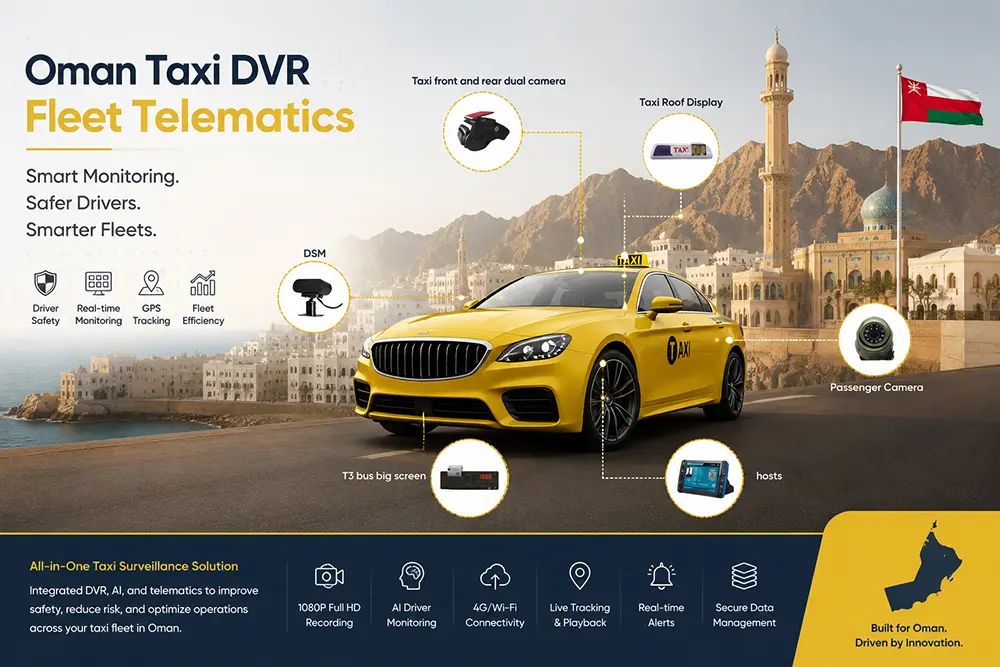
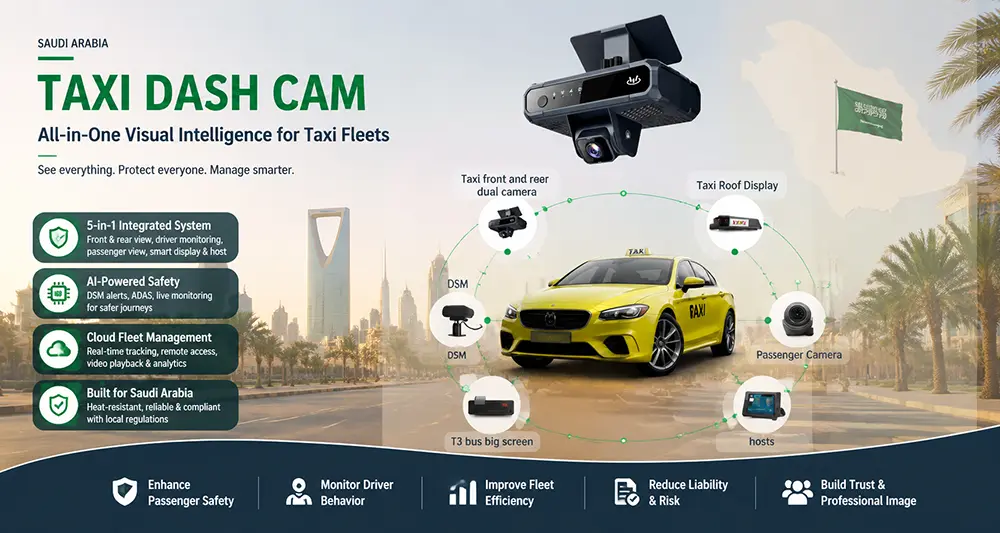
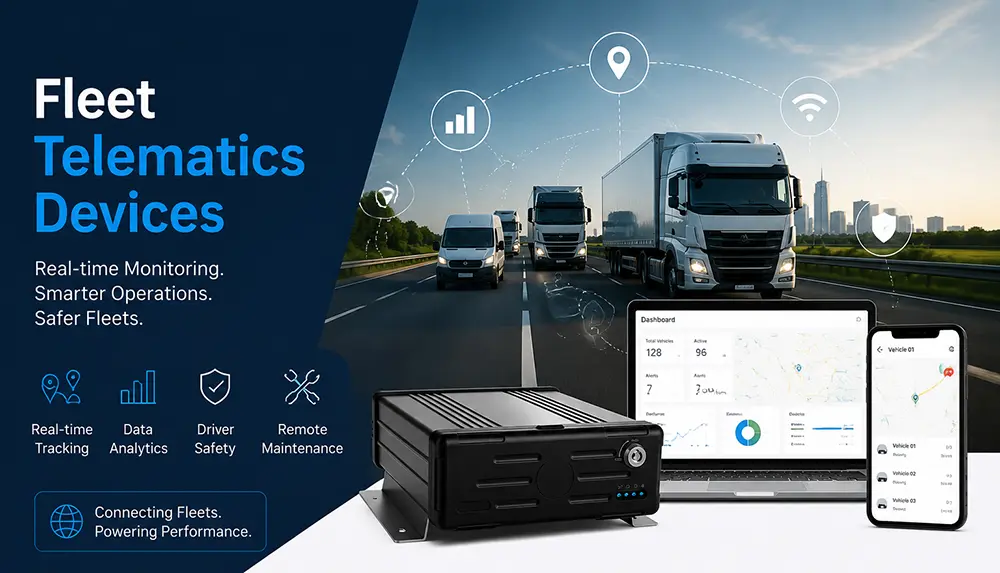
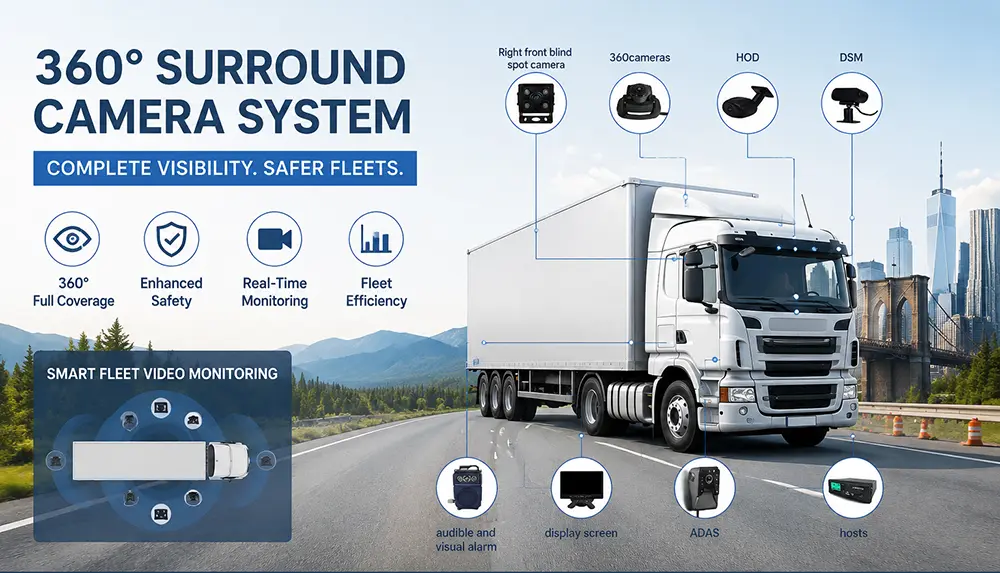
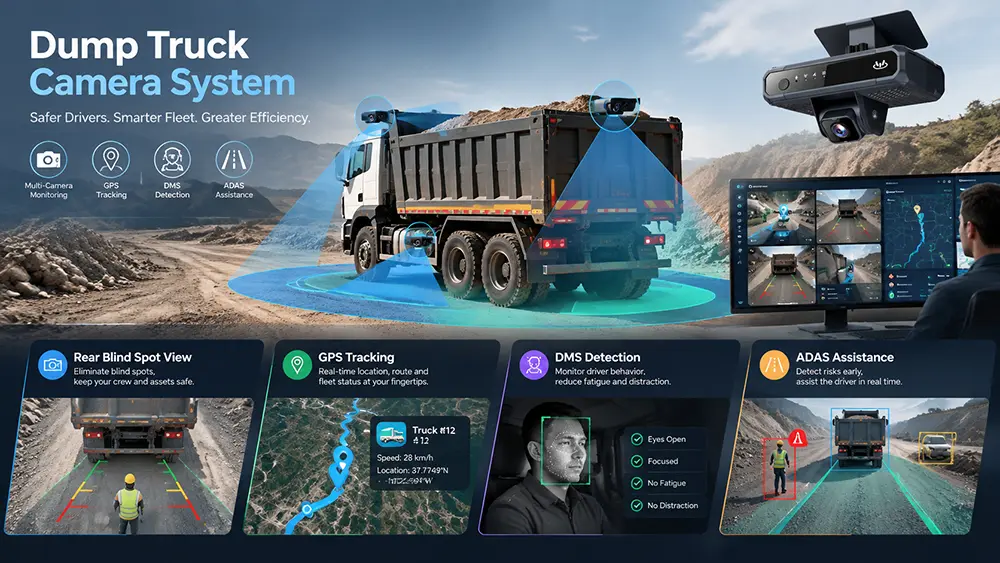
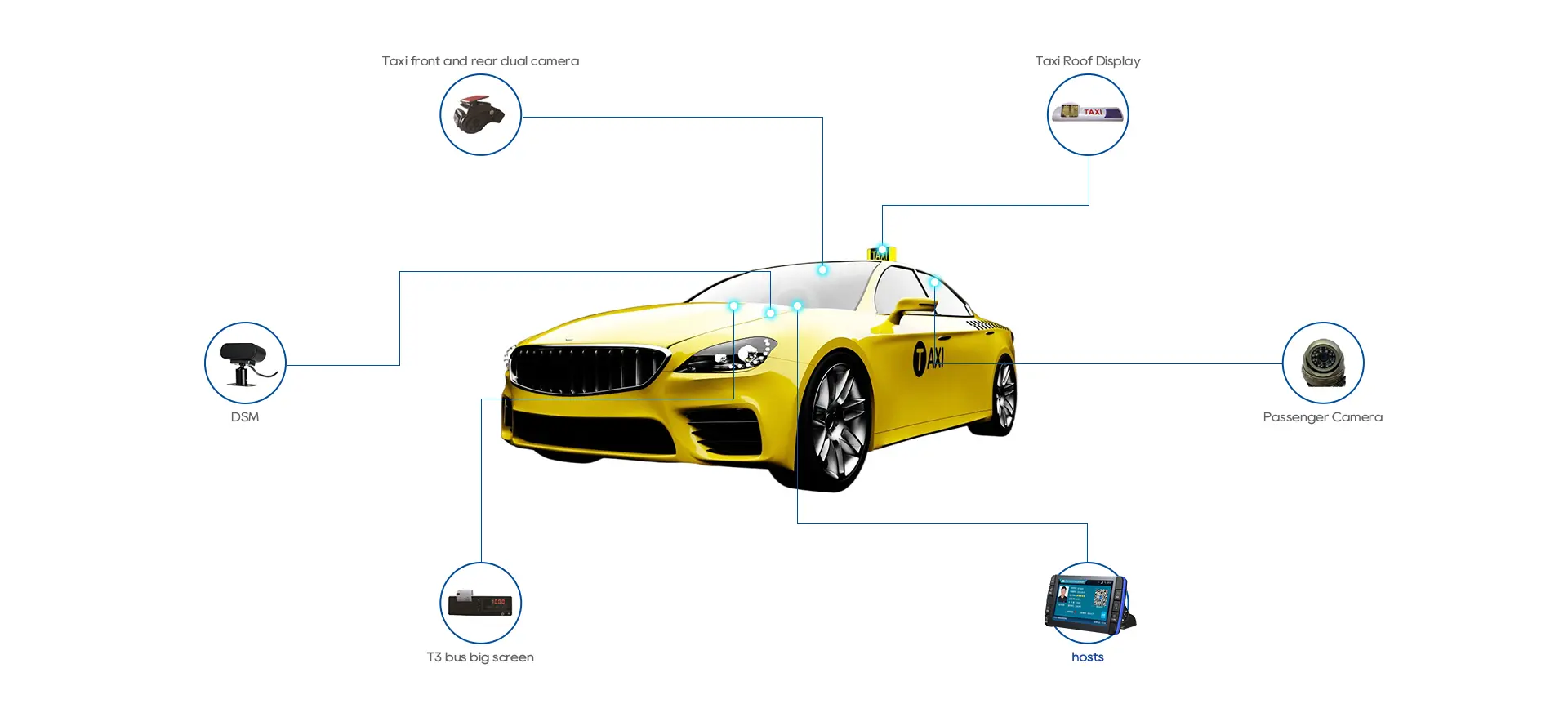
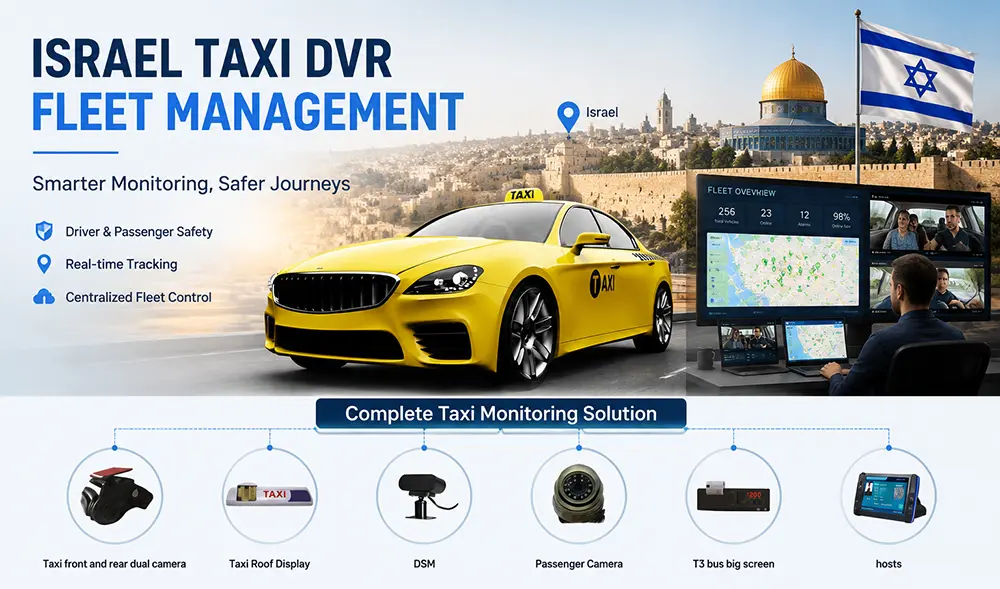
Based on the YUWEI taxi fleet GPS tracking management system, this solution connects the front ADAS, interior DSM/HOD, 360° surround view, Fleet Dash Cam, MDVR host, and Android central control screen to the same cloud backend via 4G/5G, GPS/BDS, and AI vision algorithms. This allows fleet managers in a Ramat Gan office to monitor every single vehicle from Eilat to Haifa:
1.Trip Data Alignment: Trip data automatically aligns with the smart meter. Activated/unactivated meters, empty mileage, and night surcharge periods are fully backed by video evidence.
2.ADAS + DSM Triggered Alarms: Alarms for lane departure, forward collision, dozing off, or phone calls are instantly pushed to the dispatch console and provide voice reminders on the in-vehicle screen.
3.One-Click SOS & Video Backup: One-click SOS for accidents or robberies. The MDVR features voltage-loss capacitor continued recording, and dual video backup (HDD + SD) that is tamper-proof and anti-dismantling.
4.Comprehensive Backend Reporting: The backend generates reports on mileage, fuel consumption trends, violation frequencies, and driver service scores, seamlessly interfacing with the inspection formats of the Israeli Tax Authority's "Good Ride" audits.
Solution Hardware Configuration List
Hardware Note: The entire system features DC 12V/24V adaptive power. Cameras utilize BMW locks and aviation connectors. The MDVR is equipped with hard drive shock absorption, perfectly suited for Israel's hot summers and the vibrating cabin environments of diesel vehicles. YUWEI hardware holds CE/ROHS and ISO 9001 manufacturing system certifications, facilitating vehicle inspections for license owners.
Benefits of Taxi Fleet Telematics Tracking Management
Unified Real-Time Location and Pricing Auditing: GPS/BDS transmits data every 5–10 seconds. Combined with Dash Cam timestamps and smart meter activation signals, the system allows direct export of "video + trajectory + mileage" triple evidence when the Tax Authority audits "unactivated meters," avoiding 80% of violation-related fines.
1.Intervenable Driver Status: The DSM triggers an alarm if the driver closes their eyes for 2 seconds, sending a pop-up to the backend and a voice prompt "התעורר" (Wake up) to the in-vehicle screen, stopping fatigue driving before accidents occur. Monthly reports tally phone call and smoking frequencies per driver, serving as a solid basis for contract renewal or training.
2.Second-Level Liability Determination for Accidents and Disputes: Three synchronized recording channels (front, rear, and interior) ensure swift resolution. Whether it's a scrape in the airport queue, a passenger leaving a phone behind, or a nighttime fare evasion—the dispatch desk can simply click the license plate number to pull up a 1-minute clip. Insurance claims go from "two weeks of arguing" to "settled the same day."
3.Efficiency Warfare Against the Uber Law: The MDVR's 4G channel transforms empty mileage rates, hotspot dwell times, and order response rates into live dynamic maps. Fleet managers can perform dynamic dispatching comparable to app platforms. Traditional licenses no longer rely solely on street hailing but use Telematics data to counter-snatch orders from Gett/Uber drivers.
4.Asset Security and Low-Power Protection: The MDVR has a static current of <2mA and low-voltage protection that cuts off at 8.5V/17V, preventing battery depletion after the taxi finishes its night shift. Supercapacitors ensure continuous recording after a power loss, capturing the final frames even during a "forced disconnect and theft."
5.Multilingual, Multi-Tenant Backend: The YUWEI cloud platform supports Chinese/English and operator customization. A central hub in Tel Aviv can simultaneously manage sub-fleets in Tel Aviv, Ashdod, and Be'er Sheva. Data can be cross-exported as CSV files by license plate, driver ID, or time period, feeding directly into accounting and insurance systems.
During this critical window of "mandatory smart meters + the countdown to Uber's entry" in Israel, YUWEI upgrades every taxi from a "black-box license" to a "readable data point" through Dash Cam evidence collection + MDVR storage + ADAS/DSM early warnings + Android screen interaction + Cloud Telematics. What fleet managers need is not just more cameras, but fewer unreasonable complaints and more compliant, long-distance orders.
Email:hello@yuweitek.com