










Best Semi Truck Blind Spot Camera
Semi Truck Blind Spot Camera
With the continuous expansion of global logistics and transportation scale, semi-truck blind spot accidents have become a critical issue in road safety. Documents from multiple industrial solution and technology manufacturers show that blind spot monitoring and BSD (Blind Spot Detection) camera systems are evolving into core configurations for safety upgrades of modern fleets.
Why Must Semi-Trucks Be Equipped with Blind Spot Cameras?
Blind spot hazards have long plagued heavy-duty trucks and cannot be fully resolved by rearview mirrors alone.
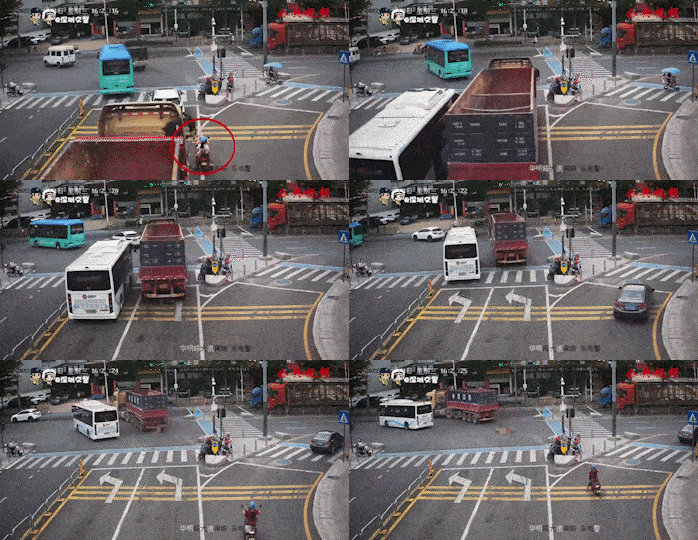
• The blind zone on the right side of a semi-truck can extend more than 10 meters
• Approximately 37% of traffic accidents are related to truck blind spots
• 65% of such accidents involve pedestrians or non-motor vehicles
Risks brought by blind spot issues include:
• Difficulty spotting other vehicles or pedestrians during turns and lane changes
• Frequent accidents while parking and reversing
• Disputes arising from complicated liability identification after collisions
Therefore, blind spot cameras and BSD systems have become an essential industry requirement.
Mainstream Semi-Truck Blind Spot Camera System Architecture in 2026
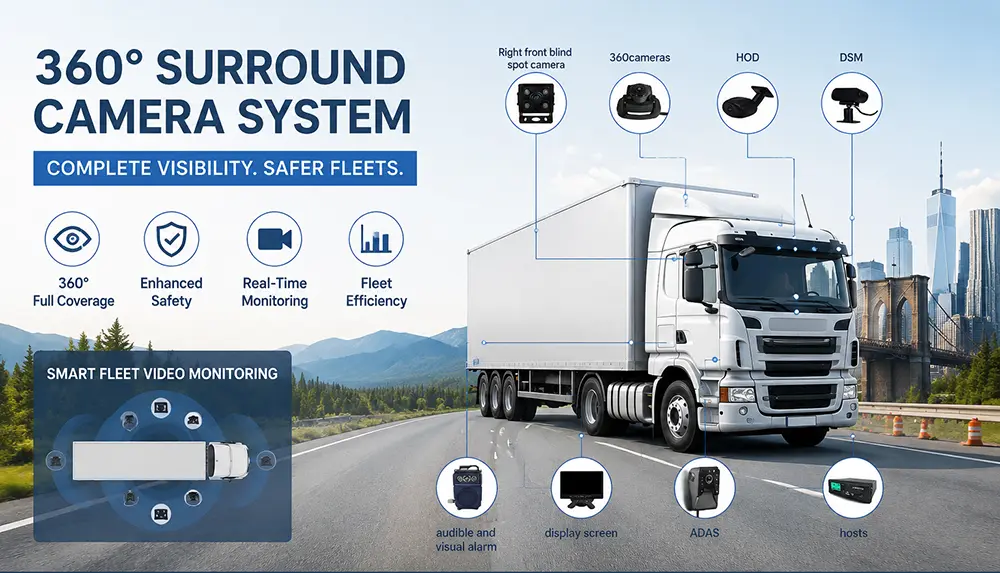
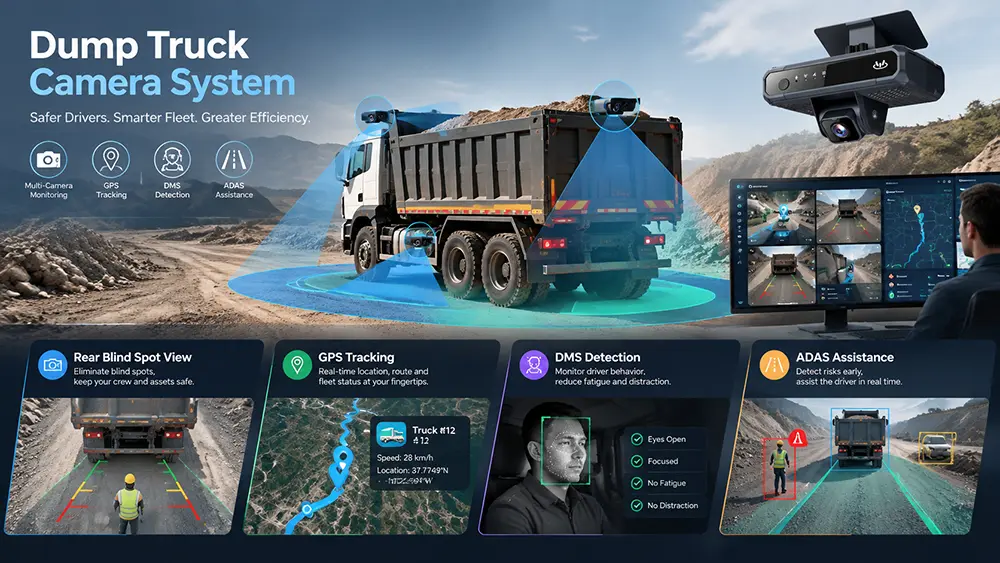
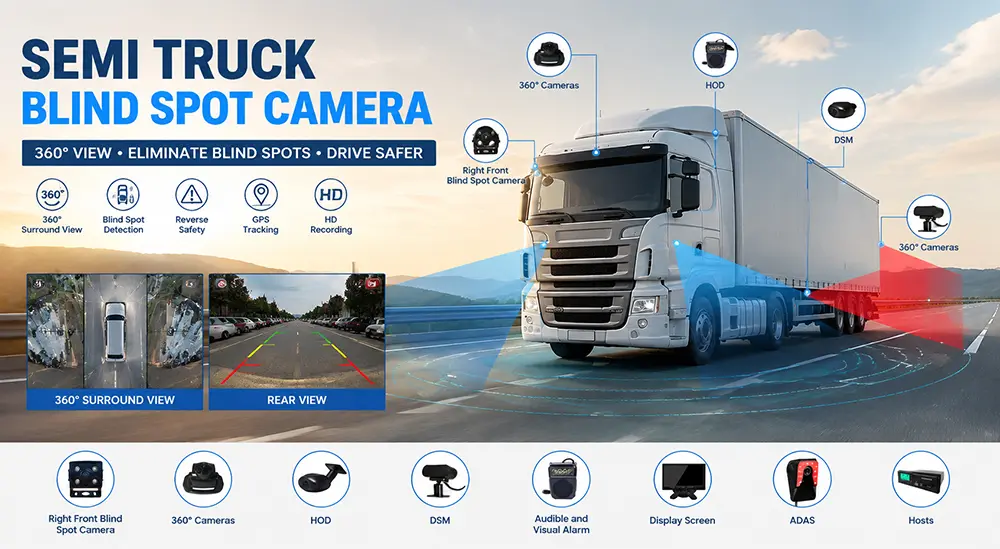
Based on solutions from multiple manufacturers, modern systems generally consist of the following modules:
1. Multi-Camera System
Typical configurations include:
• Front-facing camera
• Side blind spot cameras
• Rear-view camera
• In-cabin monitoring camera (optional)
Combined, these cameras deliver:
• 360° panoramic view
• Full real-time blind spot coverage
• View switching linked to steering operations
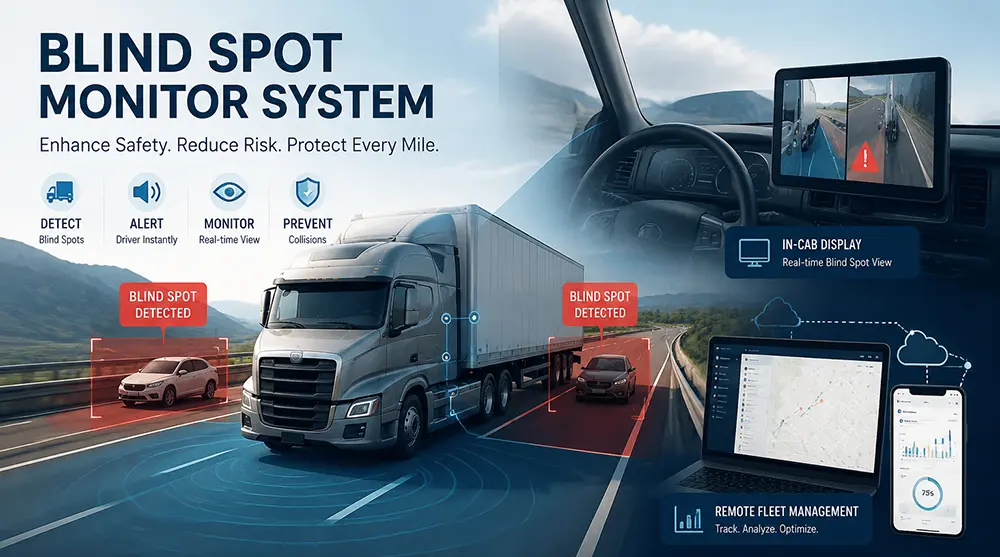
2. BSD Blind Spot Detection System
Core BSD (Blind Spot Detection) functions cover:
• Dynamic target recognition
• Moving object detection
• Dual visual and audible alerts
• Risk level indication
3. AI Intelligent Analysis System
Advanced new-generation systems integrate AI capabilities:
• Automatic identification of high-risk targets in blind zones
• Behavior prediction (trajectory tracking of vehicles and pedestrians)
• Real-time safety reminders
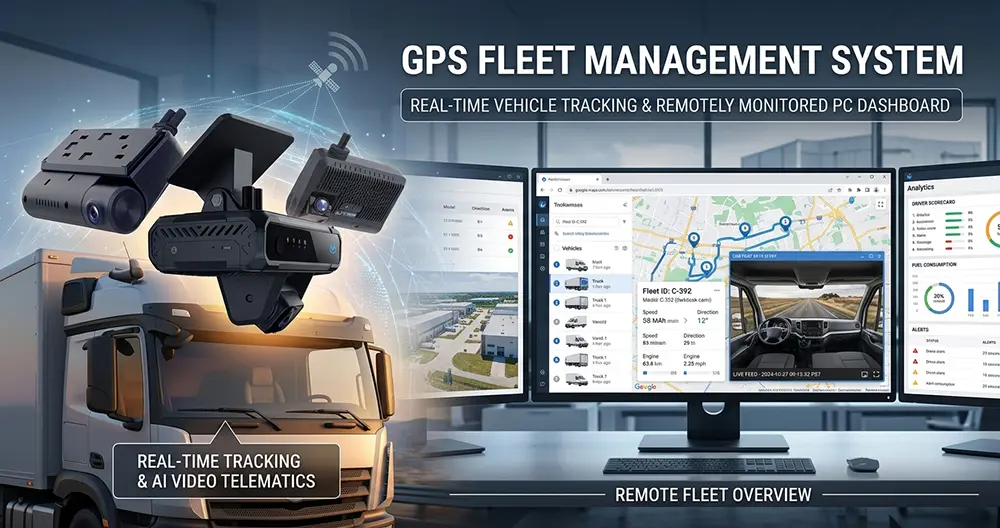
• Linked data analysis with fleet management systems
Core Functions of Semi-Truck Blind Spot Cameras
Per specifications from CITOPS and multiple integrated system solutions, mainstream features are listed below:
1. Full Real-Time 360° Surround Coverage
Multiple cameras work in tandem to deliver seamless zero-blind monitoring around the entire vehicle.
2. Automatic View Switching
• Auto-switch to side camera views during turns
• Auto-switch to rear camera view while reversing
• Continuous front and side dynamic monitoring during regular driving
3. Night Vision & Low-Light Enhancement
Optimized for night driving, highway travel and complex low-light operating environments.
4. Waterproof & Shockproof Industrial-Grade Design
Built to withstand long-term harsh operating conditions for truck transportation.
5. Event Recording & Evidence Storage
Footage is retained for:
• Post-accident analysis
• Insurance claim processing
• Defense against staged collision fraud
Recommended YUWEI Semi-Trailer Blind Spot Cameras
YUWEI offers two blind spot camera variants: rear-view and side-view models. Compatible with 10–24V vehicle power supplies, they feature wide temperature resistance and 6G anti-vibration performance, paired with easy-to-install magnetic mounting bases. The cameras can identify all types of vehicles and pedestrians, with tiered buzzer warnings paired with red and yellow alert frames; external audible and visual alarms are supported. A dedicated mobile APP enables wireless calibration and video playback. Designed solely as a driving aid, the devices effectively eliminate blind spot hazards for semi-trailers.
Core Functions of YUWEI Semi-Trailer Blind Spot Cameras
(1) Intelligent Vehicle & Pedestrian Recognition Warning
Identifies a full range of targets including cyclists, motor vehicles and pedestrians. Active alerts trigger once targets enter the monitored zone, with differentiated warnings based on near and far danger levels.
(2) High-Definition Image Layered Marker Alerts
Tracking frames are overlaid on live footage to distinguish risk distance via two colored markers:
• Red Frame: Target inside calibrated scale lines (high immediate hazard at close range)
• Yellow Frame: Target outside calibrated scale lines (long-distance precaution reminder)
The system outputs crisp real-time monitoring footage compatible with all vehicle-mounted displays.
(3) Tiered Audible Buzzer Alerts
• Long-distance yellow frame warning: Two short "beep beep" tones at a slow alert frequency
• Close-range high-risk red frame warning: Continuous rapid "beep beep beep" sustained alarm
Alarm audio can be played directly through vehicle-mounted displays with built-in speakers.
(4) 10-Channel Linked Audible & Visual Alarm Output
When vehicles or pedestrians enter the warning zone, buzzer alerts activate simultaneously. The device’s 10 output ports transmit high-level electrical signals to trigger external audible and visual alarm devices synchronously.
(5) APP Visual Calibration & Debugging
• Connect mobile phones to the camera’s dedicated WiFi network
• Support photo capture, video recording, playback and horizontal image flip
• Calibration controls: Toggle warning functions, customize scale line styles, drag to adjust monitoring ranges, toggle obstacle distance measurement, modify alarm modes (all settings save automatically after adjustment)
• Auxiliary features: Image quality adjustment, system configuration import, automatic WiFi activation, high-definition mode switching
(6) 24/7 Automatic Detection Activation
Real-time vehicle and pedestrian detection launches automatically upon device power-up to continuously scan blind zones. All alarms stop automatically once targets exit the monitored warning area.
(7) Long-Distance Detection Optimized by Camera Model
• Rear-view reversing camera: Maximum detection distance of 12 meters
• Side blind spot camera: Maximum detection distance of 15 meters
Detailed Technical Specifications of YUWEI Semi-Trailer Blind Spot Cameras
Parameter Category | Detailed Specifications |
Imaging Performance | Digital wide dynamic range support, 74dB dynamic range, automatic infrared fill light, optimized for low-light environments |
Detection Range | Rear-view camera: 0.5–12 meters; Side-view camera: maximum 15 meters |
Power Supply Parameters | Operating voltage: 10–24V; Auto power-off below 9V |
Environmental Resistance | Operating temperature: -30℃ ~ +70℃; maximum humidity 95%; anti-vibration rating 6G |
Alarm Accessories | 10-channel electrical level output for external audible & visual alarms; tiered buzzer alert tones |
Product Dimensions | Rear-view camera: 79×75×77mm; Side-view camera: 90×63×61mm |
Mounting Structure | Strong magnetic base installation; recommended mounting height: 1.0–1.6 meters |
Wiring Interfaces | 8-pin male/female aviation connectors, 4-pin aviation port, alarm trigger cable, temporary dedicated USB cable for calibration |
Installation Position Guidance | Rear-view model mounted at vehicle tail; side-view models mounted on both sides of the trailer to cover all visual blind zones |
Supporting Software | Dedicated calibration APP (Version 10.6); supports direct WiFi connection, video playback, image calibration and fully customizable parameters |