







Forklift Blind Spot Camera System Installation and Cost
Forklift Blind Spot Camera System
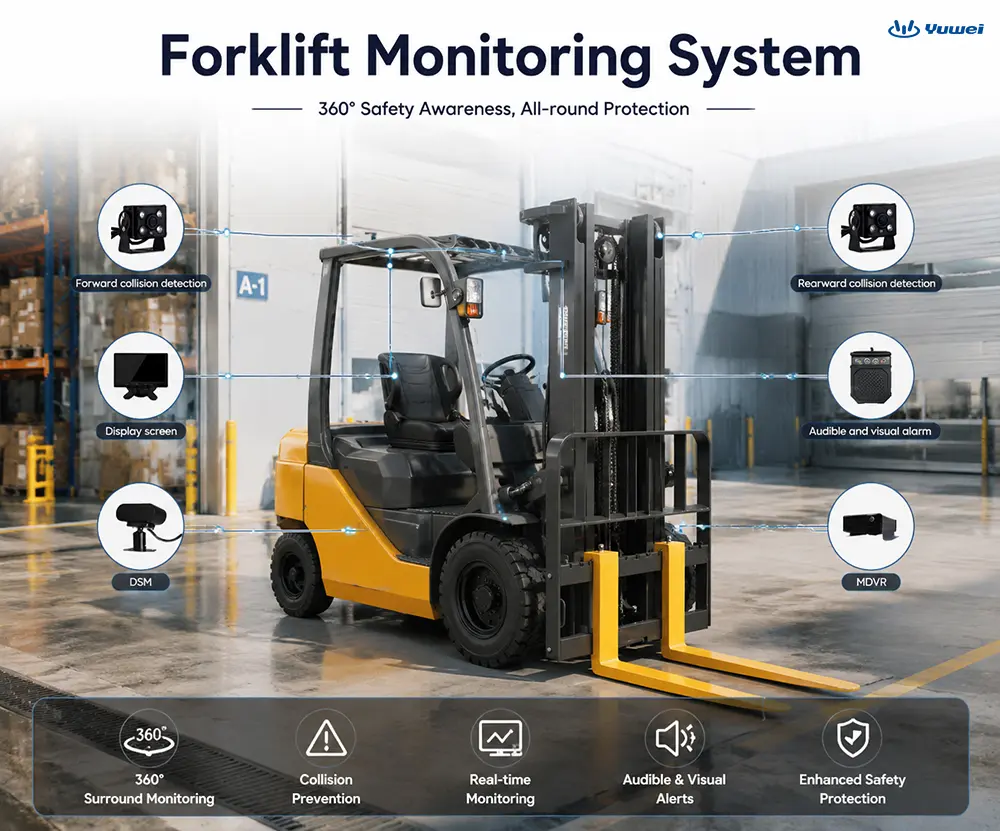
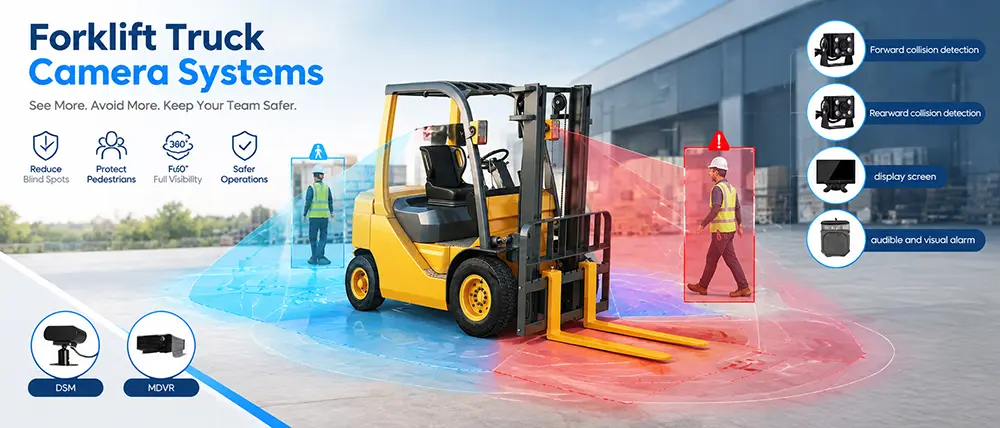
Forklift and reach truck operators frequently work under conditions with obstructed visibility: moving masts, towering racks, narrow aisles, walking pedestrians, fragile cargo, as well as rear and side blind spots. A suitable forklift camera system can help operators clearly see the fork tips, pallet slots, rack positions, and surrounding environments, thereby reducing collisions, near misses, and downtime. Having more cameras is not always better. An effective approach is to first identify the risks, then determine the camera type, installation location, display method, and whether AI pedestrian detection or video recording is required.
What are the forklift blind spots:
1.High Racking Blind Spots
When the mast is raised, operators may not be able to see the fork tips, pallet slots, and rack beams, leading to repetitive positioning, collisions with racks, or dropped cargo.
2.Reversing and Rear Blind Spots
Cargo, counterweights, masts, or attachments obstruct the rear view. When reversing, it is easy to overlook pedestrians, pallets, pillars, and other vehicles.
3.Side and Turning Blind Spots
When turning in narrow aisles, side clearance is difficult to judge, making it easy to scrape racks, door frames, or equipment.
4.Pedestrian and Vehicle Mixed-Traffic Blind Spots
In loading docks, aisle intersections, pedestrian crossings, and busy areas, pedestrians may suddenly enter the forklift's travel path.
Forklift Camera System Selection
Based on operational complexity, YUWEI configurations are divided into three tiers:
1.Basic single or dual cameras: Solves one core blind spot, such as fork view or reversing rear view.
2.AI detection and multi-camera: Covers rear, side, and pedestrian areas, adding active alerts.
3.360° bird's-eye view and recording: Suitable for narrow aisles, docks, busy loading/unloading areas, and high-demand fleets.
Types of Forklift Camera Systems
Fork View and Mast View: Reach Truck High Racking Solutions
The main challenge for reach trucks is that the moving mast and raised load obstruct the operator's line of sight. When forks, fork carriages, or pallets approach high racks, operators often have to rely on experience to judge alignment. YUWEI fork view and mast view cameras provide real-time images of the fork tips, pallet slots, and rack positions on the monitor, helping to:
1.Enter and retrieve pallets in high racks
2.Align forks and engage loads
3.Place cargo with reach trucks
4.Reduce repetitive positioning around moving masts
5.Lower the uncertainty and collision risks of blind loading
Moving masts and telehandlers are particularly suited for wireless configurations, which avoid routing long signal cables through the moving mast and facilitate retrofitting. Cameras can be bracket-mounted, fork-mounted, or magnetically mounted, depending on the vehicle model, task, and site conditions.
Reversing, Rear View, and Side View: Covering Rear and Side Blind Spots
Reversing is a high-risk scenario for forklifts. Cargo, racks, attachments, or the forklift's structure may obstruct the rear view. When operators reverse, turn, exit aisles, or navigate around cargo, it is difficult to fully understand what is behind and to the side.
The YUWEI reversing camera system can be equipped with rear-view and side-view cameras. Installation locations include the rear counterweight, side frames, overhead guard, around attachments, fork carriage, or mast area. The system supports single-screen displays and can also combine multiple camera feeds onto the same monitor. It helps operators:
1.Reverse and turn more safely
2.Observe approaching vehicles and pedestrians from the sides at aisle intersections
3.Cover areas obstructed by cargo, masts, or racks
4.Reduce scrapes and collisions caused by poor visibility
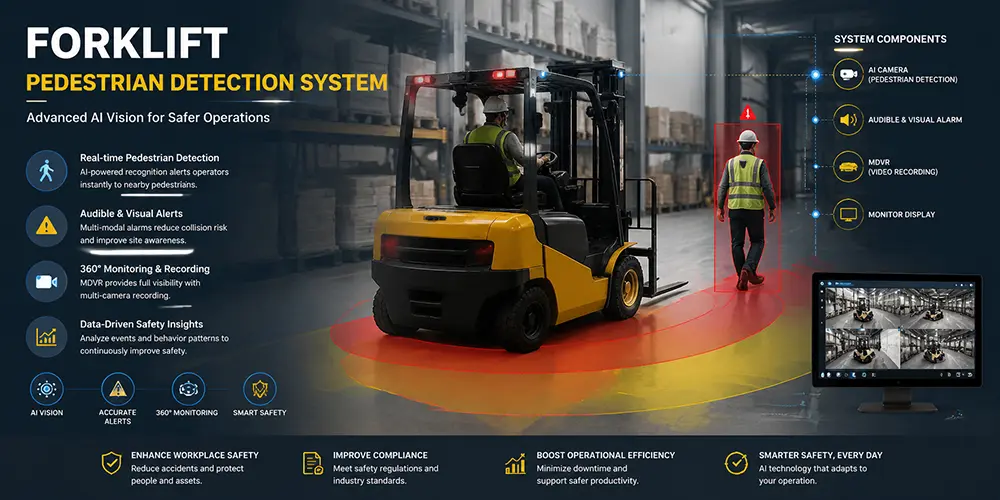
AI Pedestrian Detection: Adding an Active Safety Layer
In areas where pedestrians, forklifts, and other vehicles share aisles, loading docks, crosswalks, or busy traffic zones, passive video feeds may not be enough. YUWEI combines forklift cameras with AI pedestrian detection to alert operators with visual and audible alarms when personnel are detected in preset zones. Advantages:
1.Pedestrians do not need to wear tags or specialized equipment
2.Alarm zones can be configured at the front, rear, or sides of the forklift
3.Can be combined with real-time video feeds and monitor layouts
4.Suitable for mixed-traffic areas, intersections, and loading docks
AI pedestrian detection cannot replace warehouse safety procedures. It should be combined with traffic rules, walkways, operator training, speed control, equipment inspections, and on-site supervision as part of a layered safety approach.
360° Bird's-Eye View Camera System: Panoramic Vision in Narrow Spaces
The forklift 360-degree camera combines multiple external camera views into a bird's-eye view, helping operators understand their surroundings in narrow aisles, loading docks, busy loading/unloading areas, and other restricted zones. The YUWEI 360° system can combine front, side, rear, and corner views to form a top-down image. Applicable for:
1.Forklifts approaching racks, loading dock doors, and pallet yards
2.Travel paths with pedestrians, other vehicles, and limited clearance
3.Low-speed turning, dock operations, and narrow aisle positioning
4.Situations requiring broader environmental awareness when space is limited
360° systems typically require more cameras, processing units, and installation time, making them more suitable for high-risk, high-value, or high-frequency operations.
Technical Specifications and Compatibility
Different warehouse environments have vastly different requirements. The following specifications can serve as a reference for YUWEI selection.
YUWEI systems are compatible with reach trucks, counterbalance forklifts, side loaders, telehandlers, and various warehouse vehicle models. Specific compatibility must be confirmed based on the forklift brand, model, mast height, power supply, and working environment.
Factors Affecting the Price of YUWEI Forklift Camera Systems
Prices vary significantly, primarily depending on:
Next Steps: Tell YUWEI Your Forklift Model and Working Environment
If you need to find a camera system for a warehouse, fleet, or specific forklift, YUWEI can help plan the correct vision solution. Please provide:
1.Forklift or reach truck type
2.Brand and model
3.Mast height
4.Rack height
5.Working environment (cold storage, indoor, outdoor, loading dock, etc.)
6.Primary blind spots
7.Desired camera installation locations
8.Power preference (wired/wireless)
9.Whether AI pedestrian detection is needed
10.Whether recording is needed
11.Fleet size
YUWEI will help develop a viable forklift camera system solution based on actual tasks, warehouse layout, and operational risks.
Email:hello@yuweitek.com