




In Ride Camera Solutions for Student Transportation
School bus surveillance camera systems
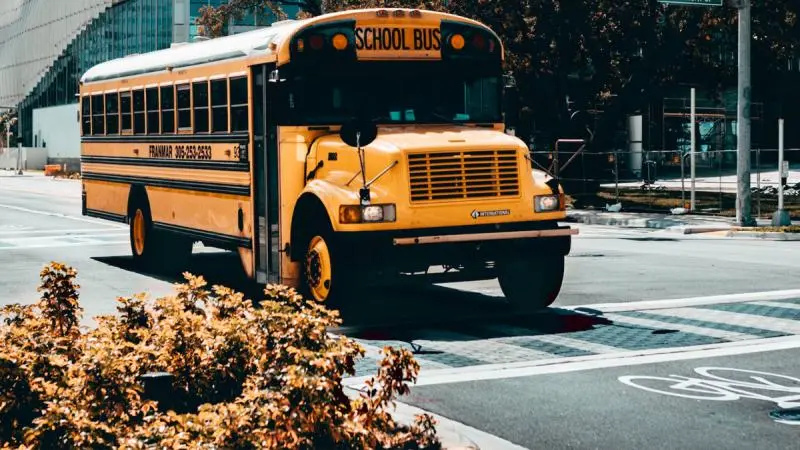
Student transportation is not an ordinary transportation business; it is the most critical link among schools, daycare institutions, kindergartens, school bus operators, and parents. With parents' increasing demands for transparency, the rise in traffic disputes, school bus blind spot accidents, and the increasing difficulty of managing in-vehicle behavior, in-ride camera solutions for student transportation have become the core infrastructure of modern student transportation management.
A mature solution should not just be "installing a few cameras," but rather integrating in-vehicle monitoring, exterior evidence collection, driver management, boarding and alighting safety, video storage, and backend viewing, transforming the school bus into a safe space.
Why Do Student Transportation Vehicles Need Specialized Camera Solutions?
Ordinary household dash cams or store surveillance cannot meet the needs of school bus scenarios:
1.Students are short and highly active; the front and rear doors, aisles, seating areas, and rear blind spots all need coverage.
2.Drivers run fixed routes for long periods, requiring fatigue prevention, distraction prevention, and harsh braking/harsh acceleration management.
3.Parents care about "whether the child got on the bus, whether they were bullied, and whether they missed their stop."
4.Schools and management need objective evidence to handle complaints, insurance, traffic violations, and regulatory inspections.
5.The equipment must be vibration-resistant, high/low temperature-resistant, withstand voltage fluctuations, and support long-term loop recording.
Therefore, student transportation vehicles are more suitable for vehicle-grade multi-channel video systems rather than consumer-grade single-lens dash cams.
From Single Vehicle Cameras to Fleet Security Platforms
School Bus Camera Systems: Whole-Vehicle Multi-Angle Coverage
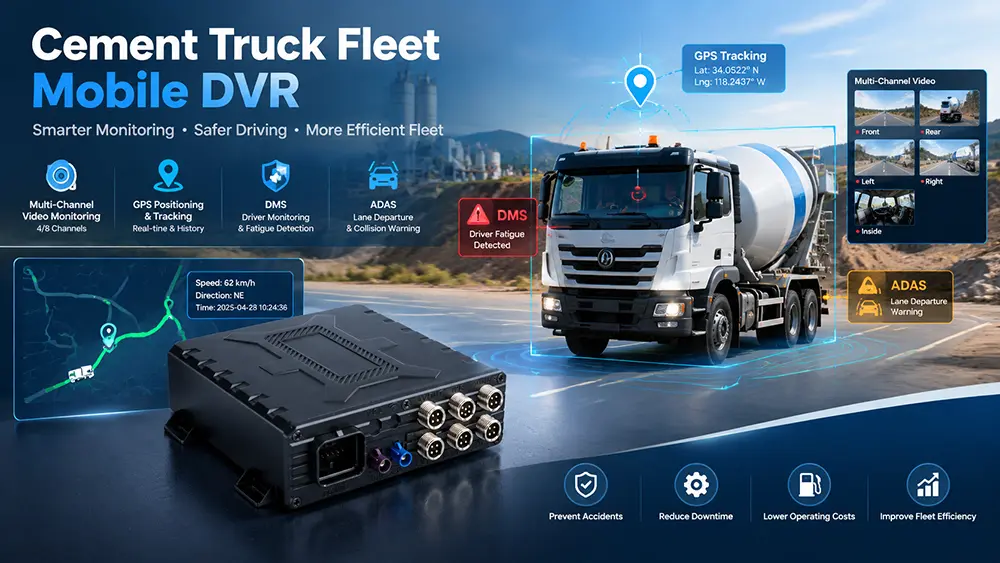
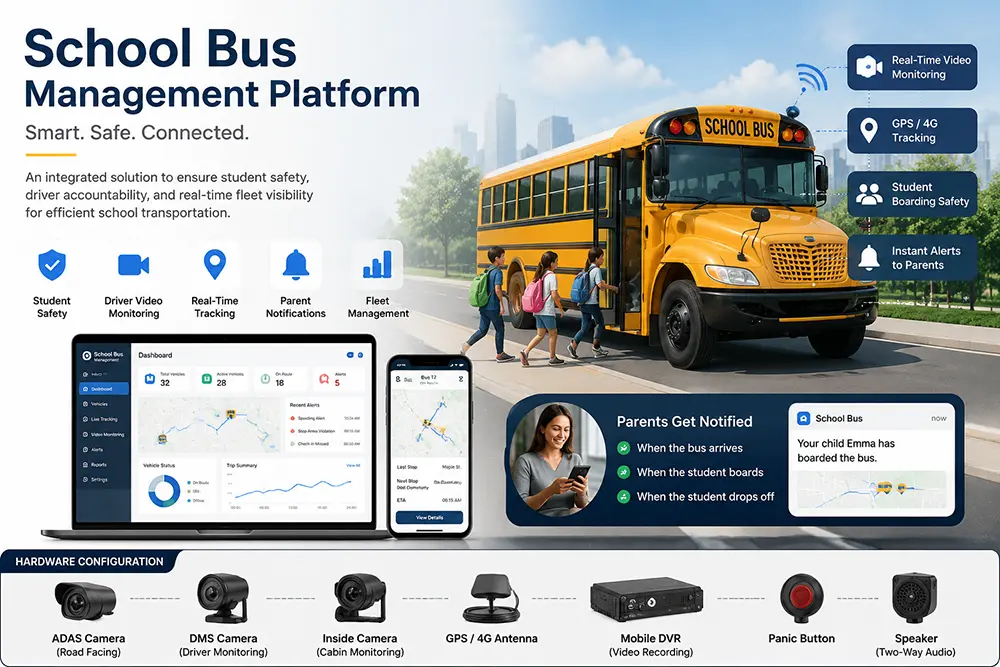
A complete school bus camera system typically consists of an MDVR/NVR host (such as the YUWEI V8N model), a storage card or hard drive, a power management module, a GPS/4G module, and a management platform.
Camera hardware includes:
1.Forward-facing camera: Captures the road surface, traffic lights, forward collisions, and following distance.
2.Driver camera: Monitors fatigue, phone calls, smoking, and distraction.
3.In-vehicle panoramic camera: Covers aisles, seats, and student behavior.
4.Door camera: Records boarding and alighting, roll call, and RFID/card swiping linkage.
5.Side blind spot camera: Observes children, bicycles, and roadside vehicles during boarding and alighting.
6.Rear/Reversing camera: Eliminates the fatal blind spot behind large vehicles.
7.Stop-arm camera: Captures illegally overtaking vehicles that run the red lights.
Recommendation: Kindergarten and primary school vehicles should have at least a four-channel setup: "front + interior + rear + door"; standard school buses should gradually upgrade to 6–8 channels.
YUWEI School Bus Fleet GPS Tracking Management System
If you are purchasing an integrated "camera + GPS + AI management backend" system, you can refer to the YUWEI School Bus Fleet GPS Tracking Management System.
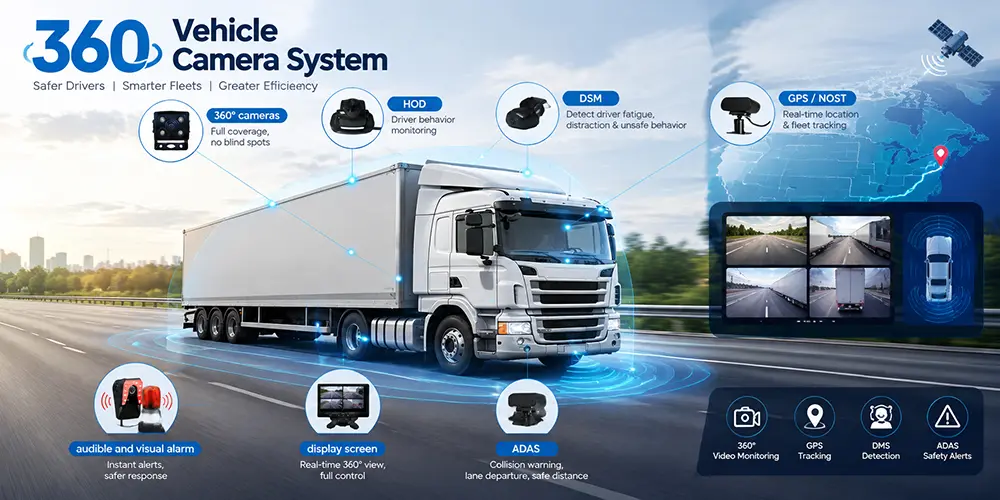
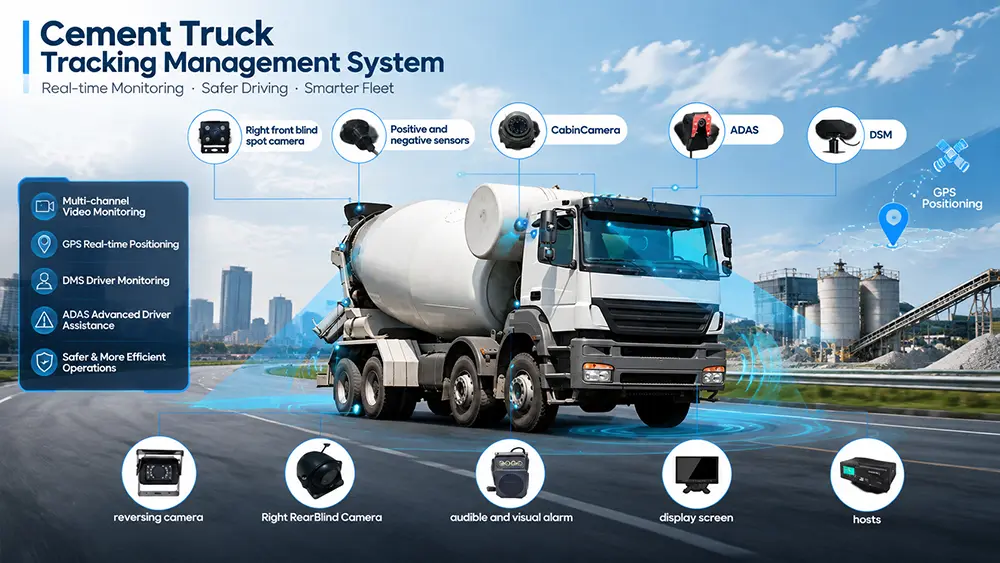
It integrates GPS/BDS positioning, Mobile DVR (featuring models like the YUWEI V8N), ADAS forward assistance, DSM driver status monitoring, HOD hands-off detection, right-side blind spot BSD, front and rear cameras, facial recognition attendance, overload/overspeed reminders, and life detection/anti-abandonment all into the same platform.
The value of this type of solution is: cameras are no longer isolated recording devices, but instead enter the cloud platform together with vehicle location, driver behavior, student boarding/alighting data, and alarm events, making it suitable for centralized management by schools or school bus operators with more than 5 vehicles.
School Bus Mirror Camera:
Large school buses often have a blind spot of over 10 meters at the rear, making run-over accidents highly likely when reversing. The school bus mirror camera installs a wide-angle, waterproof, night-vision camera at the rear of the vehicle and displays the image on the dashboard or interior rearview mirror screen, allowing drivers to clearly see children behind them when reversing and pulling into stops.
The YUWEI solution can also be expanded:
1.Automatically wake up the display when engaging reverse gear
2.Radar/ultrasonic triggered pop-up screens
3.Link with MDVR to save "reversing event clips"
4.360° stitching assistance to reduce scratches on the left and right rear wheels
Manufacturers like YUWEI also add BSD (Blind Spot Detection) to the right-side blind spot: when the vehicle approaches pedestrians/bicycles, the in-vehicle speaker reminds the driver with a "beep beep", and the external sound and light alarm broadcasts "Danger, please keep away", upgrading "seeing the blind spot" to "actively preventing blind spot accidents".
For student transportation vehicles, rearview is not about "convenient parking," but preventing the most irreversible accidents.
School Bus CCTV:
School bus CCTV is primarily used for continuous monitoring and video retention inside the cabin:
1.Bullying, fighting, throwing objects, and standing/walking can be reviewed
2.The behavior of drivers and onboard teachers can be audited
3.Parent complaints can change from "one-sided stories" to "timestamp + video footage"
YUWEI's school bus CCTV/MDVR solutions support recording upon engine startup, 1080p high definition, 4G/5G real-time transmission, and cloud storage + local SD/SSD/HDD dual backup; the DSM camera can also recognize phone calls, smoking, closed eyes, lowered heads, and both hands leaving the steering wheel, pushing alerts to the management backend.
CCTV systems are typically paired with:
1.Infrared night vision
2.Wide Dynamic Range WDR (to handle strong light from windows)
3.Microphones (must comply with local audio recording laws)
4.Event tagging: harsh braking, door opening, line crossing, alarm buttons
5.Cloud or local dual storage
School Bus Surveillance Camera Equipment:
When choosing school bus surveillance camera equipment, do not just look at pixels; look at "practicality and safety":
1.Anti-Vibration: Consumer-grade cameras have average anti-vibration; School bus-grade surveillance cameras feature vehicle-grade anti-vibration with screw-locked fixation.
2.Power Supply: Consumer-grade cameras use USB/cigarette lighters; School bus-grade surveillance cameras use 9–36V wide voltage and anti-reverse connection.
3.Temperature: Consumer-grade cameras operate between 0–40℃; School bus-grade surveillance cameras commonly operate between -30~70℃.
4.Lens: Consumer-grade cameras use single angles; School bus-grade surveillance cameras use wide-angle/fisheye/telephoto combinations.
5.Storage: Consumer-grade cameras use single cards; School bus-grade surveillance cameras use SD/SSD/HDD + Cloud backup.
6.Management: Consumer-grade cameras offer local viewing; School bus-grade surveillance cameras offer fleet platform remote viewing.
YUWEI, as a vehicle surveillance equipment manufacturer, provides hardware including AI Dash Cams, MDVRs (like the V8N series), ADAS cameras, DSM cameras, in-vehicle/exterior door/forward/rear/blind spot cameras, vehicle displays, facial recognition machines, life detectors, etc. The equipment has passed CE, FCC, UKCA, NBTC, and RoHS certifications, and the factory possesses ISO 9001 / ISO 14001 qualifications, making it highly suitable for export-oriented school bus projects or overseas international school procurement.
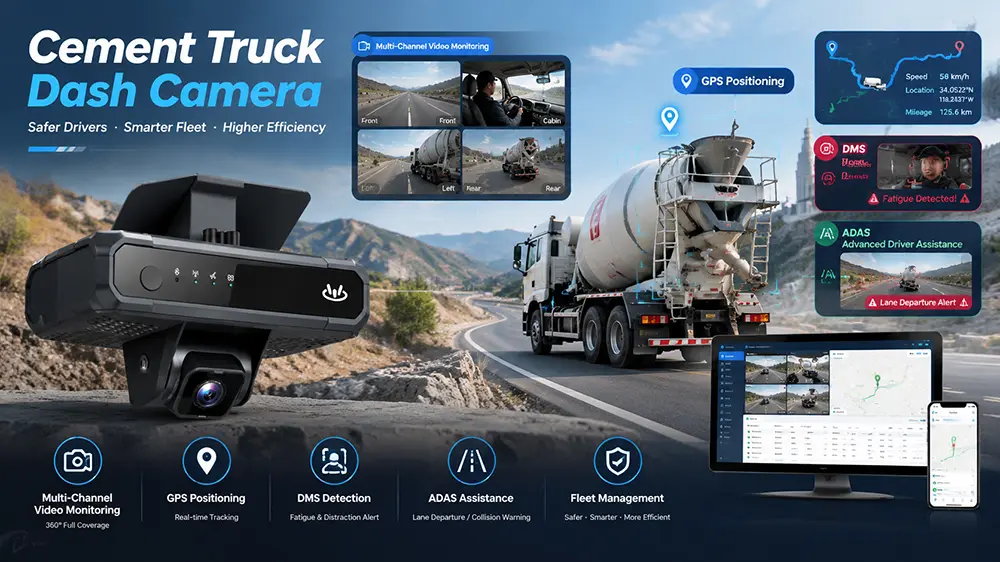
School Bus Dash Cams:
School bus dash cams are primarily oriented towards "what happened on the road":
1.Who is fully responsible in a rear-end collision?
2.Who ran the red light at the intersection?
3.Was there a warning when a pedestrian suddenly rushed out?
4.Did the driver speed or jerk the steering wheel?
Modern school bus dash cams are no longer just forward-recording, but rather feature:
1.Front + rear + driver three-channel synchronization
2.G-sensor triggered accident locking
3.Bound with GPS speed/trajectory
4.Support for H.265 to save storage
5.Support for automatic platform upload of accident clips
For insurance companies, traffic police, and school legal affairs, this video footage is often more useful than verbal statements. In the YUWEI solution, the Mobile DVR will upload high-definition video and alarm data to the cloud during dangerous driving or collisions, and administrators can remotely download accident clips for insurance claims, fraudulent claim rebuttals, and third-party evidence collection.
Management Challenges in Student Transportation Scenarios: How Do Cameras Solve Them?
Bullying and In-Vehicle Disputes
Internal CCTV + aisle cameras can restore the timeline, protecting victimized students, as well as drivers and teachers who are falsely accused.
Illegally Overtaking the School Bus Stop-Arm
Dedicated stop-arm cameras capture the license plate, time, and location, handing them over to law enforcement. A large number of US states already permit automated enforcement.
Children Left Behind on the Bus
The YUWEI solution includes a life detection / anti-abandonment device: after turning off the engine, the driver or onboard teacher must walk to the rear of the vehicle to press the confirmation button; if no inspection is made and vital signs are detected in the cabin, the platform automatically alarms. Paired with door cameras and back-row cameras, this can drastically reduce the risk of "abandoned children."
Driver Fatigue and Dangerous Driving
The ADAS + DSM + HOD combination is critical:
1.ADAS: Forward collision warning, lane departure, following too closely.
2.DSM: Eyes closed, yawning, looking at the phone, smoking, distraction.
3.HOD: Hands off the steering wheel alarm.
YUWEI's backend turns the driver's safety score, number of violations, mileage, fuel consumption, and harsh braking/acceleration into reports, allowing schools to transition from "investigating after an accident" to "front-loaded risk management."
Trust Crisis Between Parents and Schools
Having video recording does not equal full public disclosure. The professional solution is:
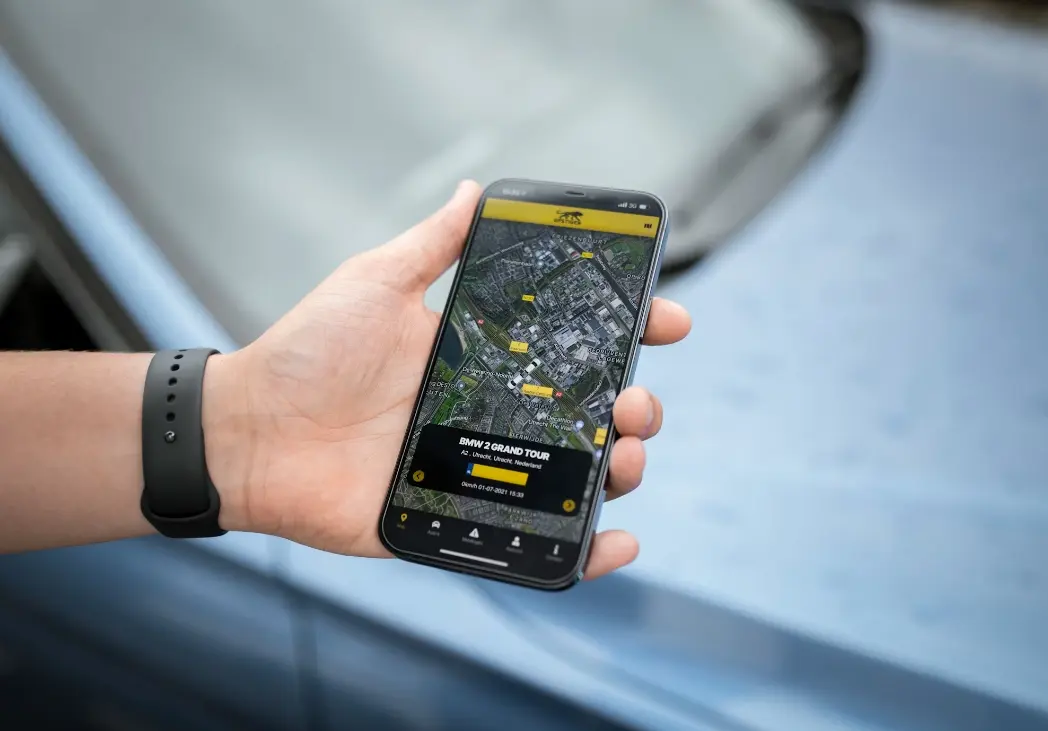
1.Parent App to check real-time school bus location and estimated time of arrival.
2.Push notifications of "Boarded / Alighted" after swiping cards/faces for getting on and off the bus.
3.School backend to view in-vehicle video, GPS trajectories, and alarm logs.
4.Accidents/complaints enter the archives; surveillance is not abused in daily use.
YUWEI's school bus system provides an architecture of "School Management Backend + Parent-Side Notifications + Driver Behavior AI Alarms + Cloud Video", which is perfectly suited for kindergartens, international schools, and daycare institutions wanting to operate with home-school transparency.
If You Do Not Choose YUWEI and Consider Other Suppliers, We Recommend Asking the Following Questions:
1.How many camera channels are supported? Can the front/interior/rear/door/driver/stop-arm record simultaneously?
2.Is the host an MDVR or a regular dash cam?
3.Can it lock and save the last 30 seconds after a power outage?
4.Does it support 4G/5G real-time viewing? Who pays for the data?
5.Is the storage SD, SSD, or HDD? Will it drop disks at high temperatures?
6.Does it have ADAS / DSM / HOD / BSD? How are alarms pushed to the administrator?
7.Can it integrate with GPS, RFID attendance, and geofences?
8.How are parent-side notifications handled: App / WeChat Mini Program / SMS / Email?
9.Anti-child abandonment: Is there life detection / a rear confirmation button?
10.Does the manufacturer have its own factory? Does the equipment have CE/FCC/UKCA/ISO certifications?
For an integrated "hardware manufacturer + school bus management platform" supplier like YUWEI, the advantage is that the cameras, MDVR (such as the V8N), GPS terminals, AI algorithms, and backend are all developed in-house, making future capacity expansion, firmware upgrades, multi-lingual backends, and overseas certification communication smoother. The drawback is that you need to confirm whether local installers, SIM cards, cloud server regions, and after-sales time zones cover your operating area.
Deployment Architecture Recommendations (Small Fleet → Large Fleet)
1.Kindergartens/Daycare Institutions (1–5 vehicles): Dual-channel or four-channel MDVR + forward recording + interior + rearview + door, with a basic cloud backend.
2.School-Owned School Buses (5–30 vehicles): MDVR + AI driver monitoring + BSD right-side blind spot + facial recognition attendance + overload/overspeed reminders + parent notifications.
3.Regional School Bus Operators (30–300 vehicles): YUWEI-style central dispatch console + real-time video + ADAS/DSM alarms + life detection + fuel/mileage/maintenance reports + driver safety scores + data docking with education/transportation bureau platforms.
Why You Should Consider YUWEI as the Solution Foundation
If you are looking for a "camera manufacturer + school bus GPS management software" to be delivered together, YUWEI's selling points are very straightforward:
1.Self-Researched and Self-Produced: GPS/BDS terminals, AI Dash Cams, Mobile DVRs (including the V8N model), ADAS/DSM/BSD cameras, interior and exterior door cameras, vehicle displays, facial recognition machines, and life detection.
2.Comprehensive School Bus Scenario Features: Real-time positioning, 1080p multi-channel recording, fatigue/distraction/phone call/smoking alarms, right-side blind spot sound and light warnings, overload and overspeed alerts, boarding and alighting attendance, anti-abandonment, one-touch SOS, and cloud playback.
3.Complete Certifications: CE, FCC, UKCA, NBTC, RoHS, ISO 9001, ISO 14001.
4.Implemented Globally: School fleet projects in China, Southeast Asia, Latin America, Australia, Africa, etc.
5.Direct Supply from Manufacturer: Under similar configurations, quotes usually have more room for profit than pure trading company brands.
Email:hello@yuweitek.com